All you ever wanted to know about Blue Cheese but were afraid to ask?

Or perhaps more than you realised there was to know about Blue Cheese and had no idea of how much to ask.
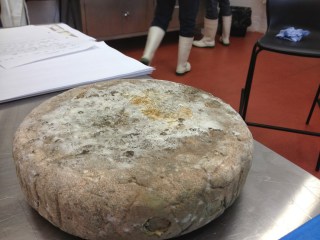
Back in April this year, I got a call from Lee Anna Rennie at the School of Artisan Food.
‘Hello!’ came the cheery greeting over the phone, ‘I think I have something that might interest you…’
She proceded to explain that the School and Ivan Larcherwere extending his Professional Lactic and Blue Cheese courses and that he had suggested that she give me a call since we were planning to make a blue cheese.  The course was going to be epic, she enthused, basic cheesemaking knowhow, lots of practical and a month’s maturation time so we could finish off by troubleshooting and looking at how to mature blue cheeses.
This happened to fall into my lap at a very opportune moment.  Before Christmas I had been in touch with Jasper Hill Farms in Vermont in the hopes of going on one of their internship programmesConstant Bliss is my very favourite Chaource style cheese (better than the original – sorry the French nation) and I also wanted to practice making blues as well in the form of their Bayley Hazen Blue.  I emailed Mateo who I had known from the NYD days and who I’d visited many years ago with Randolph Hodgson way back before their ambitious cellars had been built or indeed their current micro lab.  Mateo put me in touch with Emily in their HR department and we exchanged emails and talked about what sort of internship would suit.  It looked good for the prospect of a couple of months making cheese, maturing cheese and a little bit on quality systems and the farm for good measure.  Unfortunately then their audit from the government intervened.  According to Andy Kehler who I had a brief chance to chat to in Italy during Cheese, their whole system had to be turned upside down at huge expense and significant amounts of work had to be done and backdated which must have been hugely frustrating for them as it seemed like it was an amazing system in the first place.  An email from Emily let me know that they had managed to sort out a system for interns who wanted to apply from within the US but were stuck for people coming in from another country and she couldn’t really guarantee when they might be able to come up with something.  This had been a concern for me because although I had already made lactic cheese and felt reasonably confident going into lactic cheesemaking, I hadn’t made a blue cheese before and wanted to be better prepared.  Jasper Hill had been going to be my opportunity to get some practice in and since it fell through, I’d been racking my brains trying to think of another alternative.  Here it was.
The course fell into three parts: introduction in April, practical in May, troubleshooting in early June.
We all showed up in April, met in the kitchen at the School of Artisan food, poured ourselves a coffee and introduced ourselves.  My fellow students included: Rich Hodgsonfrom the Isle of Wight Cheese Company, Roger Longman from White Lake Cheeses, Afke Baukje Haanstra who was over on an almost last minute impulse from Holland, Fergus Ledingham from Thornby Moor Dairy and finally Gareth Derrick, retiring from the armed forces and about to begin a life of cheese (he has since started up Erme River Dairy).
Our first, three day, section covered the basics, but when I say basics, that gives the idea that it’s quite simple.  There was so much more information than that.  I’d heard Ivan teach about milk before when I did a cheesemaking workshop at Will and Caroline Atkinson’s farm and so all the topics weren’t entirely new to me, but I still left at the end of the theory day with a slight headache.  We covered the production of milk including how the udder is structured, how a milkline works and what happens in the udder during lactation;  a basic milk chemistry including a really useful conclusions that you can draw by taking pH and titratable acidity readings on your milk over time that I’ve described on a previous post , milk’s chemical composition breaking down its fats and protein components including handy tips for milk storage so as to preserve the fats and the structure of the casein micelle, lactose, milk’s mineral content (including calcium) and enzymes.
We spent quite some time on different starter cultures both those that develop lactic acidity and the yeasts and ripening cultures that are also added to the milk, or naturally present in raw milk.  Then covered various different ways of coagulating milk from the lactic set, animal rennet, vegetable rennets, thistle extract.
However, to say this makes it sound like it’s a very dry and theoretical course.  It isn’t.
‘I can only teach cheese,’ Ivan said when we entered the School of Artisan Food teaching dairy, ‘By making cheese.  So we’re going to make cheese.’
As a demonstration we made a fairly industrial recipe Camberzola / Blue Brie style to show the industrial modern soft cheese techniques and a hard cheese technique blue cheese like Bleu de Gex.  I have to be honest, the Blue Brie technique didn’t engage me that much because even though I would like to make a Gorgonzola, my plan has always been to make something a little more flavourful.  The trick with a cheese like that however is how to maintain the white rind with the blue interior.  It’s a skill, although to be honest not one that I’m interested in perfecting because I want a nice washed rind style outer on my cheese.  The Bleu de Gex was interesting however and both recipes taught us a few fundamentals to prepare us for next time.  Firstly, adding yeasts in our starter cultures to create gas holes in the paste so the cheese has an open texture through which the blue can travel.  Secondly the level of acidity that you want to reach for a blue cheese.  This obviously alters from recipe to recipe, however Penicillium roqueforti can tolerate acidity.  It’s one of the few moulds that can grow in very acid conditions.  If you think about it, the only mould you get growing on a lemon is blue mould.  So to advantage this mould rather than something else, you cultivate a certain amount of acidity.
Cheeses made and salted, lessons learned, we departed and returned again a month later for the practical.
This time, although we did more theory of course,  we made 4 different contrasting types of cheese: a Fourme d’Ambert (with Guernsey milk, thanks to Roger), a Gorgonzola Cremoso style (with added cream which allowed us to learn to use the Pearson square technique which can be used for calculating how much cream to add or how much skimmed milk to add if you want to standardise to a certain fat percentage), a goats milk Stilton style (or basically a slow acid development milled blue cheese based around lactic technology which by the way is what Stilton is – but also so is Bleu de Termignon, Blu del Moncenisio (in its really traditional form) and to some extent also Castelmagno) that last one was also thanks to Roger for supplying the goats milk.
Cheeses made, we had to decide on the recipe we would use for our next cheese.  To this end we learned how to re-create a recipe from the end point or ‘reverse engineering’ as it was not entirely romantically called.  Basically you start with the sort of cheese you want – soft or hard and you move back.  If it’s a hard cheese, you need a quite soft set that therefore has a long flocculation time and a relatively short hardening time.  If it’s a soft cheese, you need quite a firm set that has a short flocculation time with a long hardening time.  This is a bit counter intuitive I realise but the set locks the moisture in and a hard cheese wants to lose its moisture while retaining its milk solids in the form of protein and fats.  For blue cheeses, you need to consider how your blueing will present in the final cheese.  If you want marbling then the cheese needs to be milled.  If you want pockets of blue then you add yeasts to the milk with the lactic starters and create an open texture but don’t mill it.
We made a soft blue cheese (well we only had a month to assess it in and for it to have any semblance of how it might develop we couldn’t really choose a hard cheese – in a way more’s the pity) and called it Blue Wednesday.  Ivan has worked with Ruaridh Stone on his recipe for Blue Monday (when he worked with Alex James) and Blue Murder (when they parted ways – hmmm amicable break up do you think??).
Our final cheese finished, we set off again for our final break and then returned a month later for a final couple of days to taste, assess and finish off.  Along our way, despite making lots of cheese, we had also covered the business of what moulds to choose.  Did you know there are hundreds of varieties of Penicillium roqueforti a cheesemaker can choose?  The best varieties are sold in France which is unfortunate for the English cheesemaker because, for starters if you don’t speak French you’re in a bit of trouble, but also you have to get it delivered over from France which is a bit less reliable as far as courier companies go.  I’ve worked on the other side of couriering, trying to send things from England to France, and I know it’s fraught with difficulties and delays and lost parcels.  However a lot of the problems I’ve encountered were sending things to addresses in Europe which may or may not have been correct (you never realise how little the average person knows about their own postal address until you have to run it through a courier’s consignment system – myself included).  If you double check your English address (and you can do this on Royal Mail’s website) then there’s no reason that your parcel should get lost.  So just the general logistics difficulties then!  Ivan, as you would expect, gave us some good leads for interesting moulds, cultures and starters.  The key, however, should you be interested is that liquid mould cultures work best.  Also that Pencillium roqueforti may not necessarily be your best bet in blue cheese making.  Some Gorgonzola makers, rather than using roqueforti which can be too strong and break down the proteins and fats too quickly, use Penicillium glaucum which is a blue mould that is also used in goats cheeses, particularly cheeses like Valencay.  In fact, Mons Cheesemongerssell a cheese called Persille de Beaujolais which is a Fourme d’Ambert recipe but made using Penicillium glaucum they have procured from some friends in Italy who make Gorgonzola.  The technology is spreading.  It gives lighter, less alcoholic and more mushroomy flavours and, having sold the odd piece or two, I can tell you, it goes down well with the nervous blue cheese buyer as well as actually being rather damn lovely too.
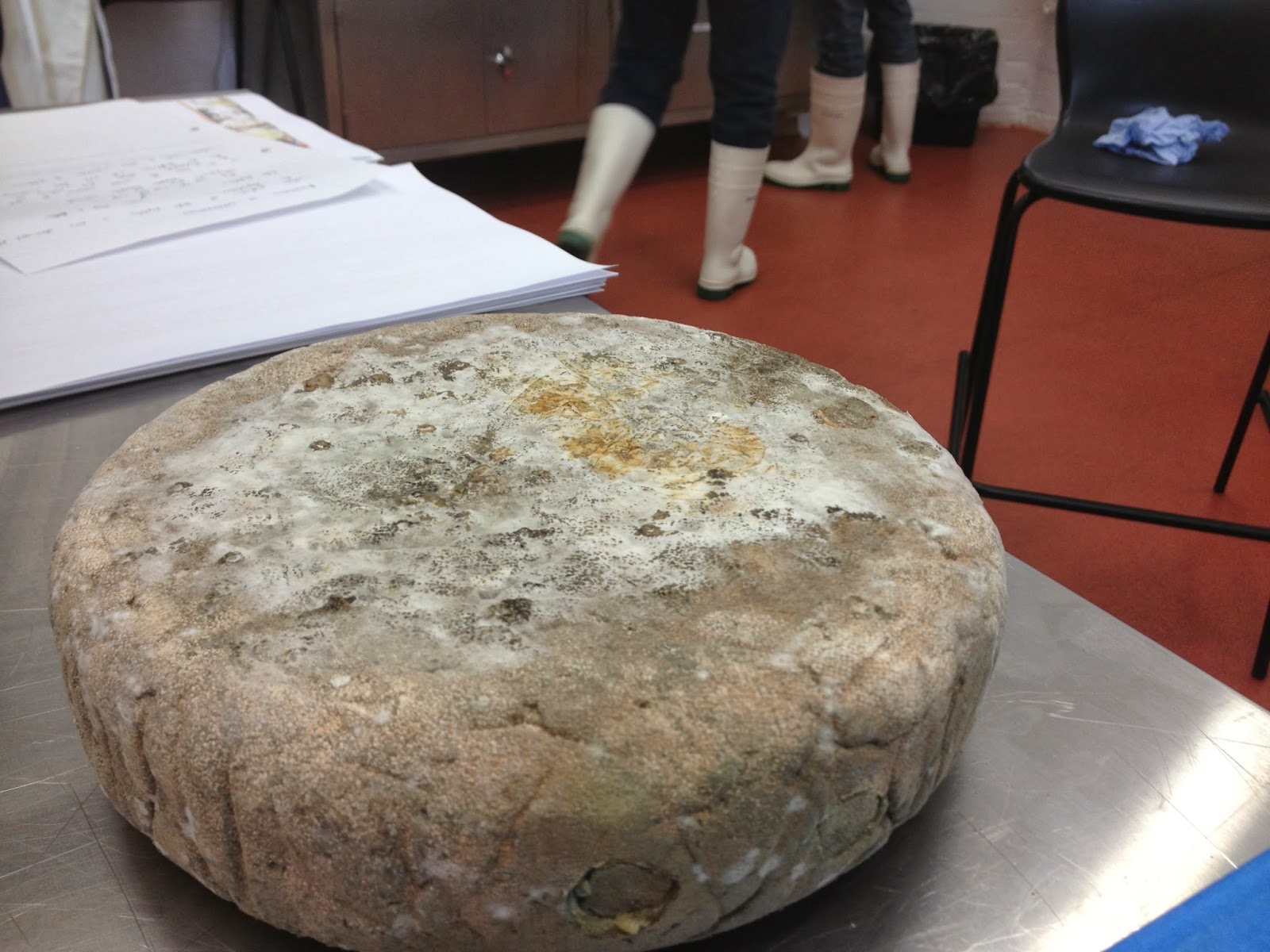
So June beckoned and we tasted the cheeses we’d made last month.  We cut the cheeses open and tasted them.  The Bleu de Gex from our first visit was generally considered really rather good.  I took some home and we ate them at home for quite some time.  I can concur, it was really good.  The Blue Bries had unfortunately suffered in maturation and dried out.  They became bullets.  The Gorgonzola had too much cream added (we used 7% but you would usually use 6% or less) and this inhibited the blue.  It was also undersalted and had the danger of going soapy.  The Fourme d’Ambert with Guernsey milk seemed good so far.  The goats milk Stilton or rather Stichelton as we never pasteurised it (Ivan doesn’t teach courses with pasteurised milk) were over-acidified (which we had known at the time) and the wrong blue had been used (we also knew this at the time too – it was a spot the mistake test).  For goats milk a less lipolytic blue should have been used.  The School of Artisan Food only had Penicillium roqueforti and at that a fairly standard strain.  Ideally we would perhaps have used Penicillium glaucum or at least a less lipolytic strain of roqueforti.
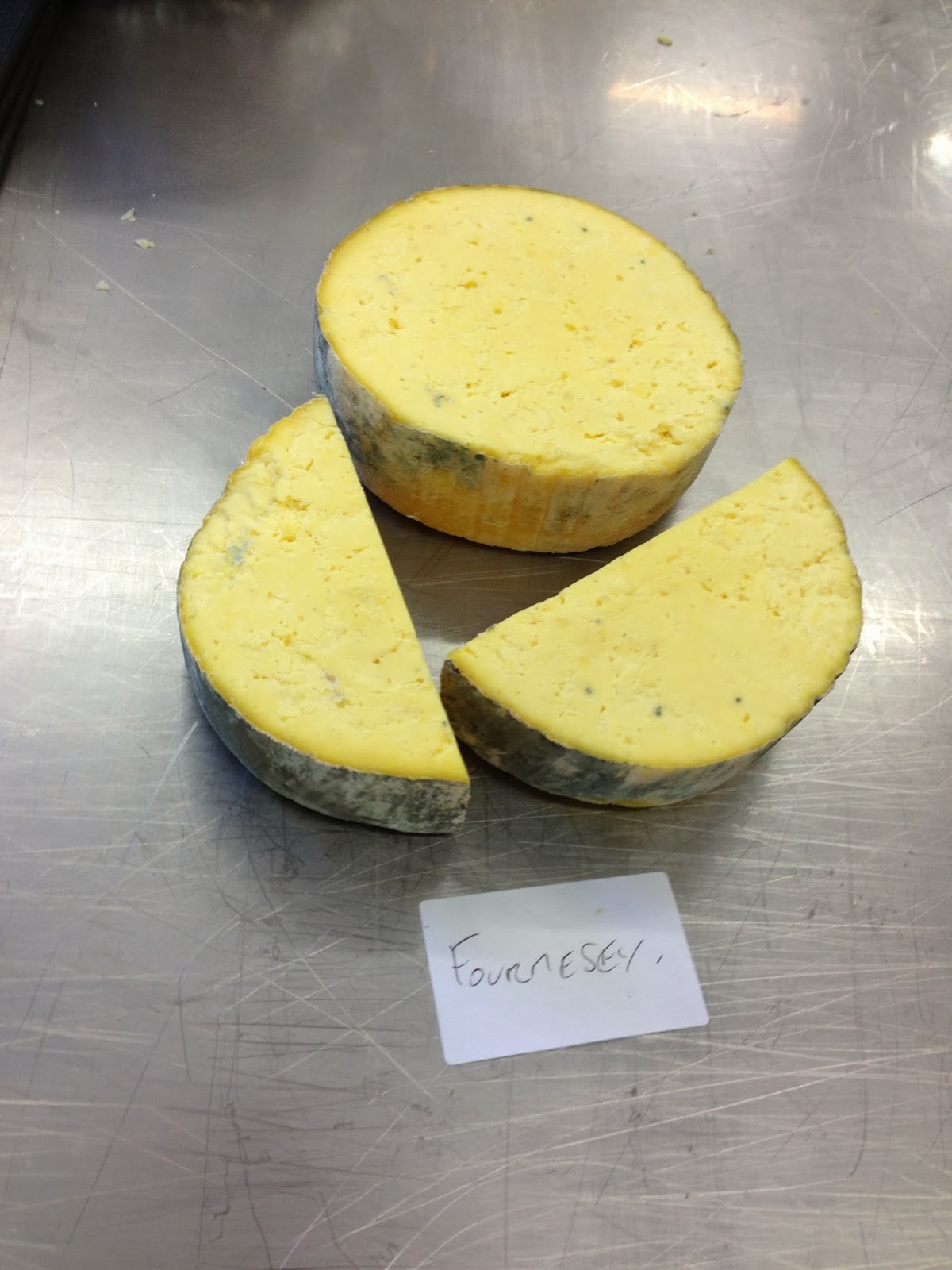
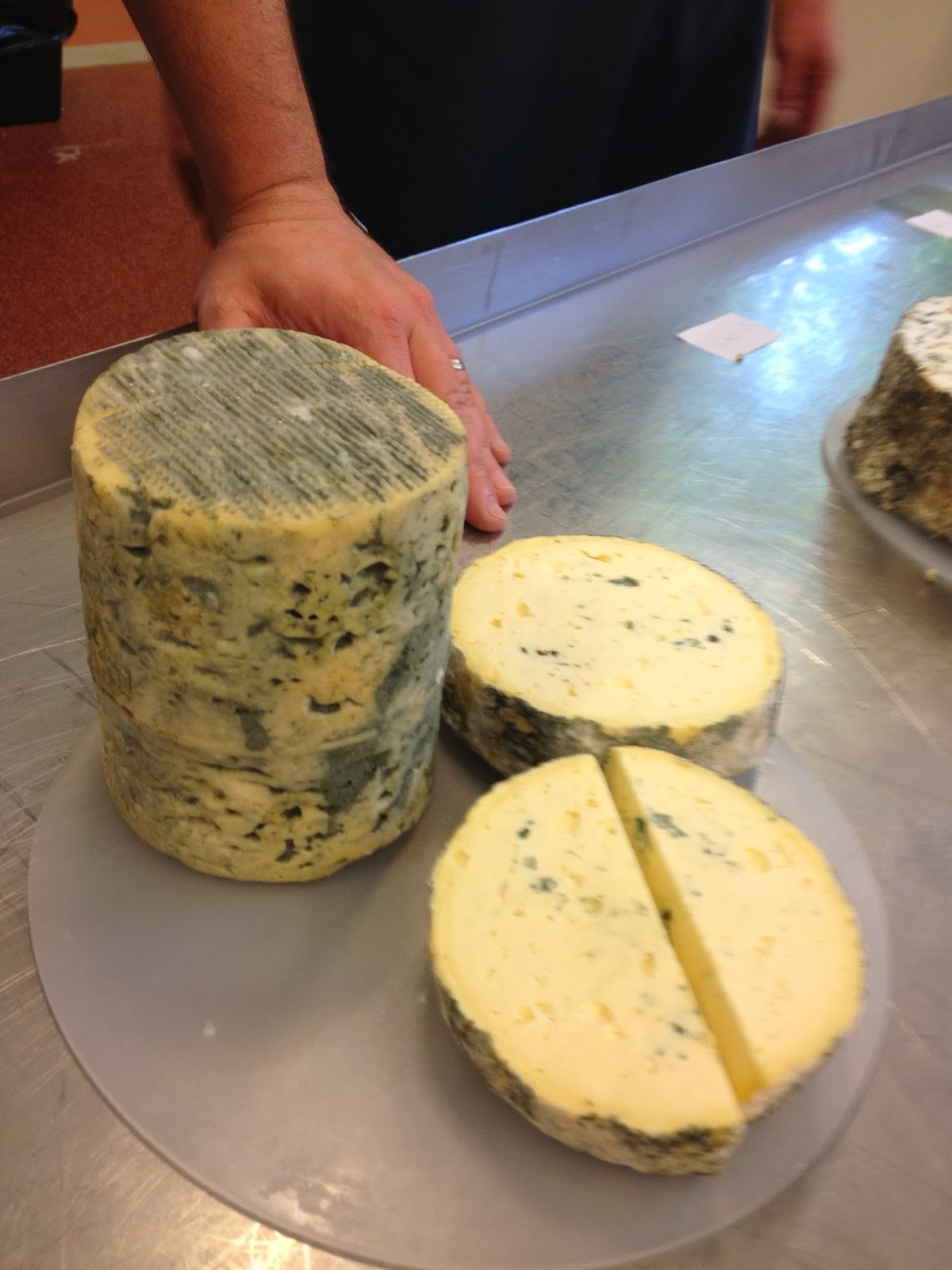
The Guernsey Fourme
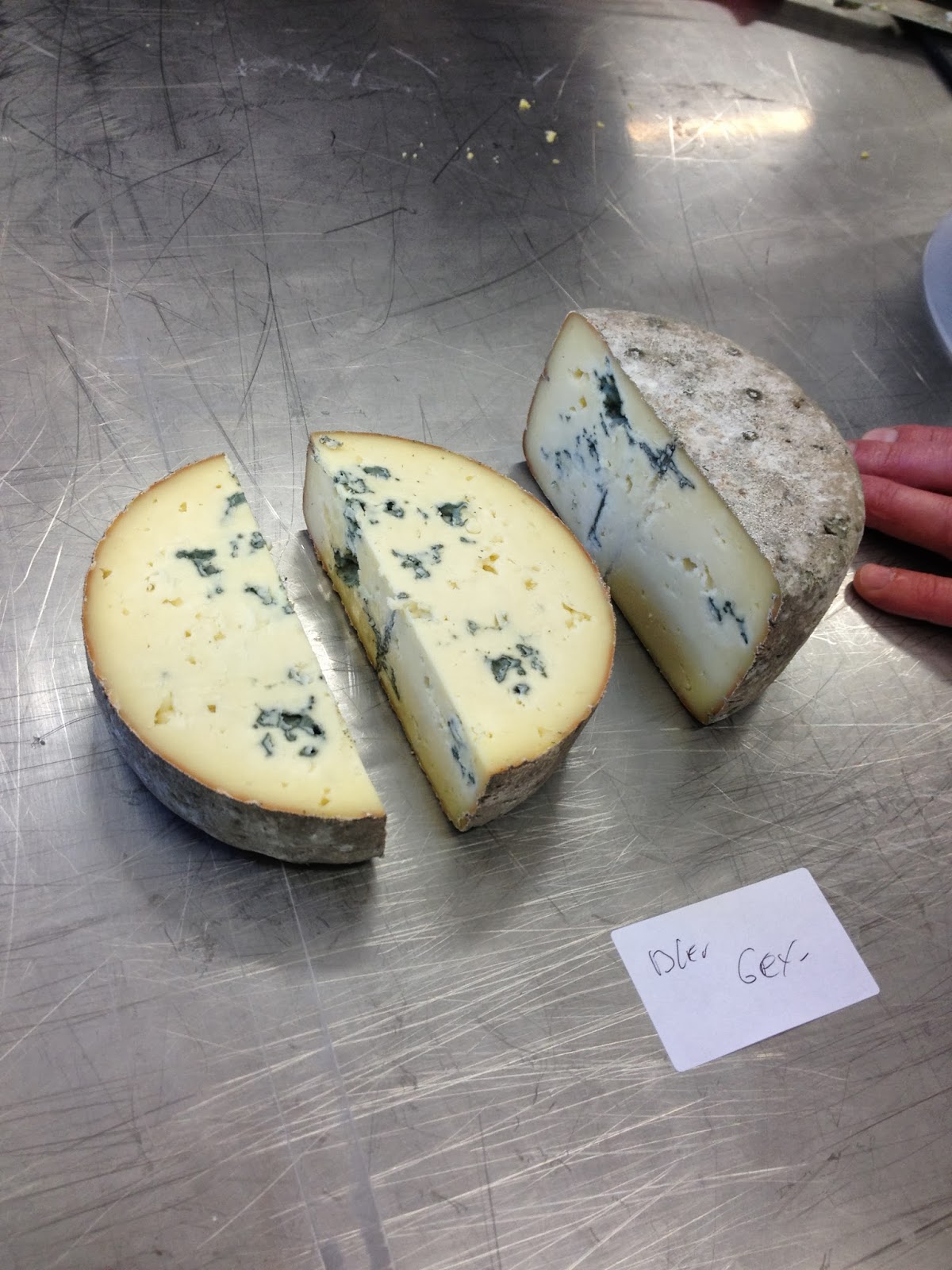
Our Bleu de Gex – not even blueing I think you could say but it tasted good.
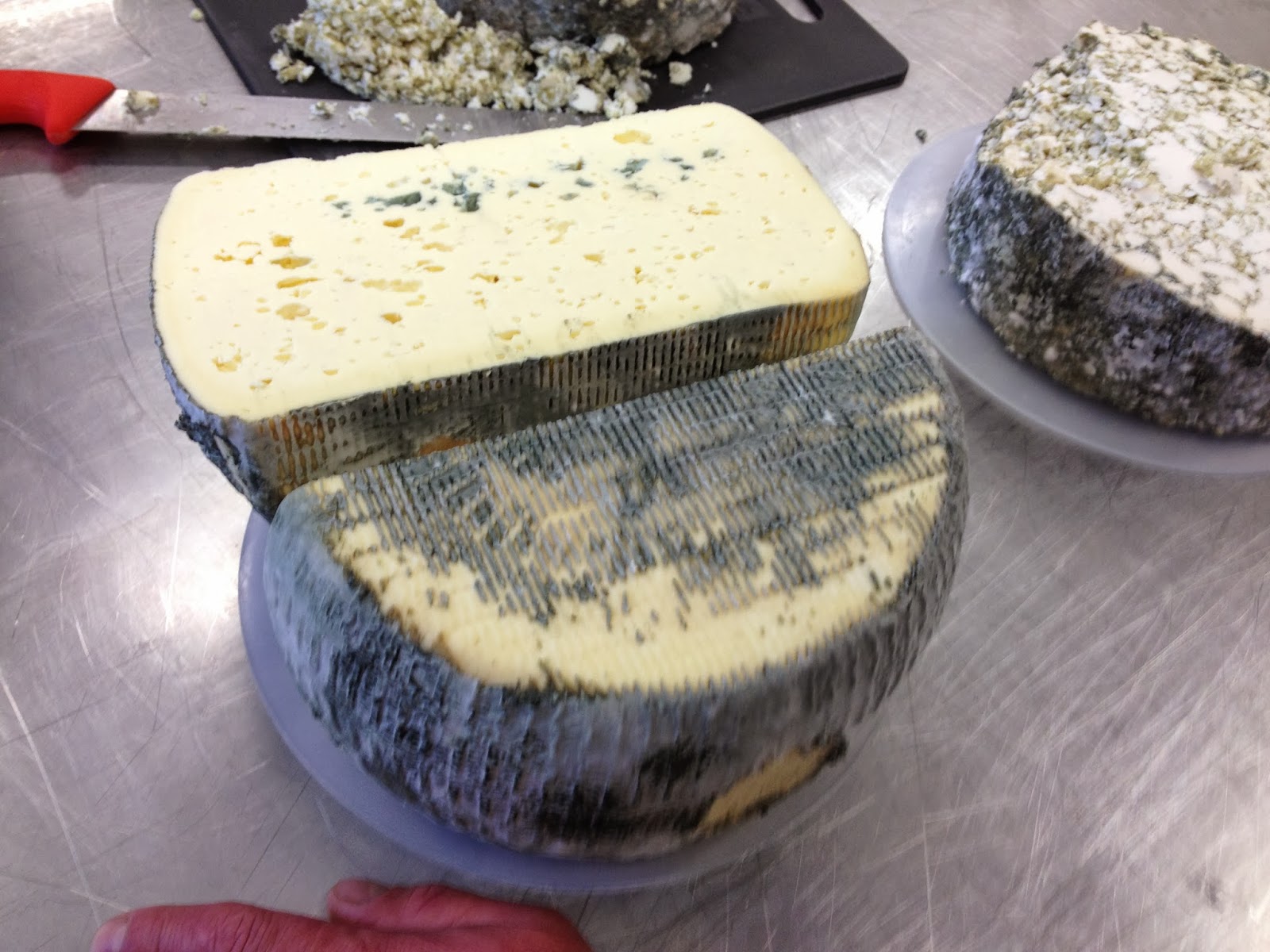
Gorgonzola with added cream – enough to inhibit the blueing perhaps??
Blue Wednesday!
The goats milk Stichelton.  Well marbled as you can see.  Bit too marbled if truth be told.
Assessing all those cheeses did give valuable information.  Could we have pierced the cheeses more to allow better blueing (we pierced by hand of course because we hadn’t made very many cheeses), what was the effect of the fat content of the milk, the effect of salting and how much you really do need when you add blue mould into the mix.
And should I forget, we also got to visit Sticheltonproduction where Joe Schneider and his team,, particularly Ross were really helpful with their information and even allowed us to try ladling some curd.  It is tough work believe you me.  I am no stranger to lifting heavy things or working hard but the strain of lifting a full ladle of curd gives you arm-ache that lasts for weeks.  I know, I had it.
Another peculiarity is that, of course, you have to use a particular side of the body to ladle.  This could lead to an overdeveloped arm.
‘So how do you keep both arms equal.’ Someone asked Ross as we observed them ladling.
‘I try to vary it,’ he replied, ‘but I can’t vouch for what Joe does to keep his left arm in training…’
And on that note, I will leave you to ruminate on blue cheese.

Studying Up on Milk

This year, at Slow Food’s Cheese, I noticed a new development that for once I had time to take advantage of, workshops on milk production.

I’ve been going to Cheese every year since something frightening like 2003 as part of the Neal’s Yard Dairy contingent.  Consequently my time has been spent on retailing, resting, staying up late eating pizza at Da Ugo or in club Macabre (when it still existed) and then necking strong but delicious coffees the following morning.
This time, however, I was here with purely the aim of furthering my cheese education.  Where better to comparative taste Gorgonzolas and Taleggios?  Where better to explore the concept of what a traditional recipe or make actually tasted like in the interests of developing the recipes I’d been trialling at the School of Artisan Food? Where better to learn more about cheese?  To which end, I trawled Slow Food’s website for tastings and discovered the milk workshops.
I’d helped Randolph Hodgson prep some of his own talks at Slow Food workshops in the past which were purely cheese focussed and with an element of pairing wine / beer etc and cheese.  I’d found them interesting but not hugely technical (not a reflection, I should explain, on what Randolph talked about – he was easily the most technical person there, it’s the other speakers who were a bit more pedestrian).  The milk workshops held in the piazza XX Settembre were more technical sounding, geared towards cheesemakers and milk producers and while there were some things that I didn’t feel the need to attend (a talk on adulteration of food and labelling regulations didn’t thrill me), there were some that were most definitely relevant.
The topics I thought it was a good idea to get clued up on were: animal welfare, the importance of pasture, milk quality that goes beyond simply whether it is raw or pasteurised, sustainable agriculture and the role of fermentation.

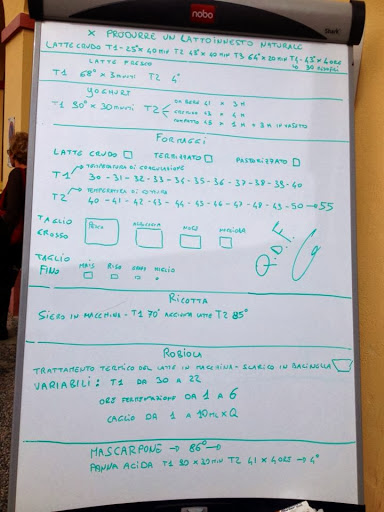
A white board displayed around town with loads of technically useful cheese facts and recipes on.  Just there for you to copy and to spread the cheesey knowledge.  This sort of generosity of information in the interests of the bigger picture is typical of Cheese.
It lead to a hugely interesting few days and a lot of food for thought and luckily for me, the happier the cows, bees and environment it would appear the happier the cheesemaker.  Let me elaborate:
The talk on animal welfare with speakers from Compassion inWorld Farming started by stating that animal health and human health are linked and animals farmed in a higher welfare manner produce better milk.  There are obvious examples of this:  animals on pasture have less instances of mastitis and cleaner udders than animals that live indoors.  To put it bluntly, in the fields, if they need to defaecate, they just walk away from it and to a nice clean bit of pasture.  In the sheds they can’t do that and although their bedding will be replaced frequently during the day, there’s more than just a chance that they will end up lying down on dirty straw at some point.   However, it goes beyond cleanliness.  The milk from animals that are grazed on pasture has been found to be more healthy with better levels of Omega 3 fatty acids and betacarotene.

The talk on pasture discussed milk composition in more detail, citing EU funded research projects that have demonstrated the effects of each different herb or grass or wild flower variety that the animals graze on the composition of the fats and the number of flavour ethanols in the milk and also its vitamin content.  One speaker, Roberto Rubino from ANFOSC (the Associazione Nazionale di FormaggiSotto Il Cielo), had particularly interesting data to demonstrate the different fatty acid composition between animals eating oats, borage, hawthorn (really), wild geranium and plenty of other plants.  His point was not that there was any one plant that was the cow / goat or sheep superfood but that the bigger variety the better.  Just like humans, a varied diet is better for the animal but we are able to reap the benefits of that through the composition of the milk.  He went on to also explain that the animals’ diet also affects the cholesterol in their milk.
Contrary to the thinking on nutrition that I remember growing up which had us ditching butter in favour of margarine and believing all cholesterol to give us heart attacks, current thinking now considers cholesterol a necessary part of the diet, provided it is not oxidised.  A diet of pasture contains 4 or 5 times as many antioxidants as the diet of animals on a zero grazing indoor farming system.  In other words, they consider that you can drink milk and eat butter and cheese without worrying about heart disease, provided it’s farmed a certain way.
A speaker also from the European Forum on NatureConservation and Pastoralism explained that the value of mountain pasture is precisely that it hasn’t been planted or farmed.  As a result, the plants are far more diverse than they would be even if planted with the most complex herbal seed mix.  They quoted that an intensively farmed and planted field would contain 2 or 3 different species whereas you’d expect to find 50 to 100 species in natural grasslands. They even explained that animals left to graze and pick and choose will even eat shrubs and leaves off trees sometimes for a bit of variety (presumably hence the hawthorn research presented by Roberto Rubino).
During the talk on raw milk, a speaker called Tom Baas a biologist from the Research Institute of Organic Agriculture in Germany (FIBL)talked about how research into raw milk in the past 10 to 12 years has shown a change in attitudes to unpasteurised dairy.  Statistical research demonstrated that raw milk could actually assist in children developing a healthy immune system and lower incidences of asthma, allergies and even hayfever.  Some of these points were rather circumstantial evidence, farmers children seem to be healthier than others, however, Basel University has done over 10 studies into the possibilities of raw milk against atopic conditions and other health benefits including that of a fatty acid called CLA (conjugated linoleic acid).  Their studies showed that CLA which is produced by herbivores will be different depending on the animals diet.  When fed to rats, the grass fed CLA did not make the animals put on weight or develop fatty liver while the CLA from animals on a different diet did.  CLA is present in raw and pasteurised milk but the heating process will affect it and at least make it less effective if not actually contributing to weight gain actively.Further to this taste studies had been carried out also assessing the smell, taste, aftertaste, viscosity and visual aspect of 4 different milks, 2 of which were organic (1 actually biodynamic) and 2 intensively farmed.  While the differences were subtle, a distinct difference was found.
The message of all of this?  Raw milk, varied pasture that is left to grow as naturally as possible, grass fed as much as possible will be the healthiest dairy food for you and will also have the best flavour potential for the cheesemaker.  Of course they were speaking in fairly black and white terms and you’ll find conscientious extensive farmers who do feed concentrates and silage who also manage to give their animals a varied diet while not using natural and unplanted grasslands.
Finally we moved to the role of fermentation.  This was an idea I’d first heard proposed at courses that Ivan Larcher teaches.  You have this amazing milk, with wonderfully farmed animals and all those aromatic flavour ethanols waiting to be liberated.  How to make the most of it? Well using a naturally fermented starter.  Just as the natural grassland is more diverse, so is the naturally cultured soured milk from your raw milk.  Most commercial starters will contain possibly 1 or 2 different organisms.  The more complex ones perhaps 4 or 5.  Your own natural culture from your raw milk will have many more and also all the ripening cultures too (yeasts and moulds).  It also renders your product truly a local and unique one.  The speakers gave a brief method for producing your own soured milk starter, something they called ‘latte inesto’ and tasted a range of 4 cheeses chosen to demonstrate that the latte inesto starter produced the more complex flavour.  Again, I’ve done enough tastings to know you choose your cheeses to demonstrate the point you want them to make so while the tasting was dramatic, it was also staged to be so.  The difficulty of naturally occurring bacteria is that you can’t be sure of what will grow, but if you have followed certain guidelines you will maximise your chances of cultivating good starter cultures rather than a big bunch of spoilage bacteria instead.
Most interesting for me, as we research our milk at Nettlebed, was the discussion on where the natural lactic acid bacteria come from.  The research in this case has not been carried out on dairy animals but on humans but it is extrapolated that other mammals will have similar processes.  The baby’s gut is populated with the appropriate bacteria by the colostrum phase but after that is finished, the milk produced is sterile.  Any lactic acid bacteria and other flora that get into the milk from that stage onwards are transferred from the skin of the udders which will be picked up from dust particles on their food and in the pasture, dust particles from the soil (this would be bad news things like E.coli and Listeria) or illness which would be mastitis (Staphylococcus aureus).
Further to that, a cheesemaker asked a question.  He had been making cheese with latte inesto for 20 years but recently in response to demands from the milk dairies he had been trying to reduce his total bacterial counts.  Ever since the counts went down, his latte inesto stopped working.  It wouldn’t sour and when cultured, the only thing that grew was coliforms (gas producing bacteria from the gut – harmless but no help to the cheesemaker).  It appeared that in pre-dipping the animals’ teats before milking, they were removing a healthy population of lactic acid bacteria and although there were very few coliforms present, in the absence of any competition, these became dominant.  By trying to clean up what had been essentially clean milk before, they had created ‘dead milk’.  The advice was to stop pre-dipping and do all they could to ensure lactic acid bacteria got back onto the teats (this can include wiping with hay before milking, making sure the animals are getting hay or natural grass as pasture) to make the milk come alive again.
In summary, what did I learn?  Well to sum it up in one sentence: diversity, diversity, diversity and leave it to nature as much as possible.  Naturally managed grasslands and animals kept as close to their natural state as possible will produce happy animals giving milk that is better both nutritionally and in flavour profile and potential.  Then allow your naturally produced milk to sour with what nature in its bounty has given you and you’ll get cracking good cheese!  In theory anyway….

The Lightbulb Moment

One of the exciting things about working with Merrimoles Farm on the Nettlebed Estate is the potential inherent in their milk.  The herd is a mixture of Friesian Holsteins with Swedish Red and Montbeliard bred into the herd for increased vigour.  Increased vigour is the immediate benefit for the farmers along with better health, less likelihood of lameness and better fertility.  However it isn’t just a benefit to the farmer.   The cheesemaker (that would be me) naturally gets better milk from healthy, happy animals but the breeding with Swedish Red and Montbeliard is exciting because the solids in the milk of both of those breeds lend themselves more to cheesemaking than that of the Friesian Holstein or Holstein itself.  In addition to that, the animals graze on organic pasture and, as a result, spend most of the year happily outside, munching grass, flowers and herbs in the fields, which in theory means that they should have a diverse diet which will lend to aromatic compounds in the milk and the potential for a diverse grouping of lactic acid bacteria derived from the bacteria present on the teats.
I had come into the discussions with Rose and with Merrimoles Farm with a mental ticklist of what I was looking for in a milk supplier, namely, interesting breeds (check), outdoor grazing (check), varied pasture (check), preferably organic or as near to as possible (check).  Part of this is ideological, I don’t want to be involved in an enterprise where there are unhappy animals and where the farming isn’t sustainable and respectful to the environment.  Part is flavour driven.  Interesting breeds, varied pasture and organic management of the herd and pasture should, in theory, translate to the most interesting milk.  In other words, if I can unlock it, there’s a lot of potential for good flavours in our cheese.
‘Our milk is really good’ Rose told me proudly when we first met.
We collected a sample from the bulk tank to drink it fresh and (naturally) unpasteurised.  It tasted lovely.  I agreed with her.  On other occasions that I have drunk it since then, it consistently tastes lovely with a milky sweetness, mineral undertones and a velvety creamy mouthfeel.
‘And we get really great test results too’ she continued, ‘Dairycrest actually say that our counts are really low.  For an organic farm it’s practically unheard of.’
When I first visited the farm, Phil, the farm manager showed me a printout of their milk results which included fats and protein content as well as their routine total bacteria counts.  Having looked over other milk results in the past when I was Quality Assurance Manager at Neal’s Yard Dairy, I too was surprised at how low some of the counts were.  I expressed my surprise to Phil also who confirmed that yes, they were often told how rare it was for an organic farm to hit those levels.  It was something they were all proud of and justifiably so.  For their current customers this is exactly what they need and want.
I was a little more cautious.  Low total counts, seemed to me a good starting point, but more important than that is what that total count breaks down into.  Ideally, of course, that total count is entirely composed of lactic acid bacteria.  Worst case scenario, it’s entirely composed of Listeria monocytogenes or another pathogen.  As we drove away from the farm, I mentioned to Rose that, before we got into cheesemaking, we needed to build up a history of testing the milk in more detail.
‘For raw milk cheese,’ I explained, careful not to cast aspersions on what was evidently, very carefully produced milk, ‘It’s not so much the total counts we’re concerned about, but what’s in there.  So we need to send off some samples for testing and cover all the pathogens: Listeria monocytogenes, Staph. aureus, E.coli O157 and Salmonellae.’
It wasn’t urgent to get started testing straight away and actually we are hardly going to go and find another milk supplier.  Our cheese business is being started to make better use of the Merrimoles milk.  Whatever the results, we were already committed to working with them, so to begin testing nearer our production time made more sense.  I took a bottle of milk away to do a lactofermentation at home.  They took 48 hours to set, tasted yoghurt-like, although a little bitter, and had about one gas bubble.  I would have been happier to find no gas bubbles and to not have tasted the slight bitterness, but I wasn’t too bothered at this stage.
When we did begin our testing in May this year, however, we had a bit of a shock.  The total counts were low, as usual, but the lactic acid bacteria counts as a proportion of that were also a lot lower than we had hoped for.  We thought, especially as we want to culture our own starters, that we would be aiming for 80% of the total count to be lactic bacteria.  We were finding considerably less than that.
This means for our cheesemaking, culturing our own starters is a project for a few years time and won’t be happening initially.  If you make your own starters, the argument goes, you will have a more diverse population of bacteria but, of course, you don’t know what you are getting and they are likely not to acidify as strongly as bought and proven starters.  Just at the moment, we need to use plenty of proven starter to get our milk to acidify.  This is fine, I can work with that and still do my best to use a varied and interesting cocktail of cultures.  What makes me a little nervous though is that not having a naturally strong population of lactic acid bacteria does mean that we don’t have a built in safety mechanism in form of the milk’s natural ability to out compete pathogens.  If something nasty gets in, it can have a little pathogen party, reproducing itself all over the shop.
‘What does this mean for your cheese?’, I hear you ask.
Well as I said, we’ll use bought in starters and in addition we will record our acidity curves with every make.  We will also prepare ourselves for higher testing costs as we will have to test each batch that doesn’t acidify quickly enough and higher wastage for the cheeses whose test results don’t make the grade.  In the longer term, we’ll begin learning a lot about the factors that encourage or discourage lactic acid bacteria, because, in theory, with organic production and grazing outdoors, we should have plenty of them and yet we don’t.  With that in mind, at Slow Food’s Cheese this year, I listened avidly to their workshops on milk production.  But that is a blog-post for another day.
More importantly, all of a sudden, all the arguments in defense of raw milk that I have trotted out obediently, on behalf of Neal’s Yard Dairy to officials and other quality assurance managers, clarified in a moment of epiphany.
If you don’t want to bottle milk and offer your customers long shelf life of what is naturally a short shelf life product, pasteurisation is irrelevant.
It doesn’t make sense for a cheesemaker to seek out milk with low counts or be encouraged to use pasteurised milk which it is perceived as being safer than raw milk.
If the raw milk has a healthy population of natural bacteria, it’s the safer choice.
A lot of what a laboratory scientist may consider to be a risk and that has been worked into HACCP and the food safety risk analysis we all do, suddenly seems misdirected and possibly dangerously so.  Pasteurising doesn’t sterilise.  It doesn’t make milk a perfectly clean slate, there are still some organisms in there or organisms can get in there even if you think you’re doing everything at the very pinnacle of hygiene.  With low counts, it’s key to your cheese quality that your starters work quickly.  If they are slow to start, then they can be out competed and potentially they don’t get the upper hand.  This doesn’t neccessarily happen – you might be lucky but it’s like driving without your seat belt.  It isn’t a given that you’ll have an accident but if you do the consequences are worse.
I now see very clearly, that it’s not a question of absolutes and black and whites.  It’s not that low counts of staph aureus or enteros are automatically good.  It really depends on what they compete against.  Cheesemaking is a question of managing populations and communities of organisms.  It’s so much more complicated, nuanced and subtle than low counts good, high counts bad and it’s not a question of limits and levels but of balances.  This is as necessary for food safety every bit as much as to get the recipe to work.
I thought I understood this when I worked at Neal’s Yard Dairy.  I was only half way there.
Now, I really get it.