The Taleggio Experiment

The decision to rent the School of Artisan Food was made, a recipe was researched, whilst attending a course there, I was able to work out what equipment we’d need and finally our dates rolled around.  Rose purchased containers, filled them with milk and sent them off with a refrigerated courier.  I drove myself off to the School of Artisan Food and got ready to receive milk.
I spent a day sanitising equipment and writing up a HACCP plan for our trial production and the following day was in bright and early for the milk to arrive.
Taleggio is an interesting make from my point of view, in that it uses thermophilic bacteria as a starter culture and yet doesn’t use the temperatures at which thermophilic bacteria tend to work best.  Like all washed rinds, the curd doesn’t want to acidify very much and it wants to retain a calcium rich, pliant structure.  The thermophilic bacteria therefore are used precisely because they will start working but as the temperature of the make cools off when the cheeses are in their moulds, they will stop going, the acidity will level out and won’t develop further.  This in theory and coupled with curd washing, should mean that the cheeses remain pliant with their moisture locked within the curd structure and soften when ripe to a gloriously oozing texture.  That is the theory anyway.
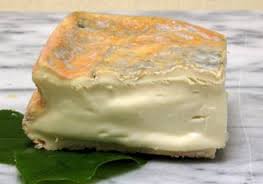
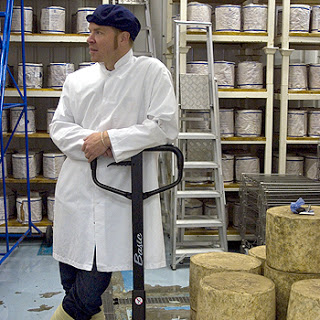
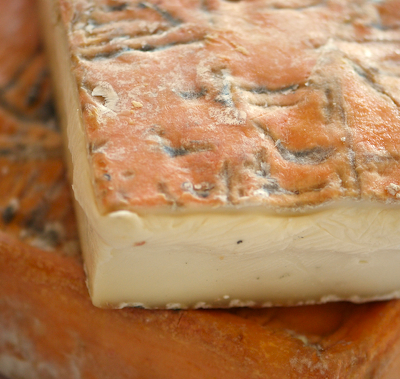
Taleggio photo courtesy of the thefiftybest.com
Within this, of course, there are many parameters to play with.  So many, in fact, that I wish we were in full production right now in some ways so I could be happily making cheese day after day, tinkering with a whole multitude of variables.  Would a degree or 2 more or less in terms of temperature affect the rennet set and the texture as the cheese matures?  How would the flavour and acidity be affected if I remove a bit less whey at curd washing?  What if I add in more starter cultures at stirring?  What if I stir for longer?  That’s not even getting started on how much starter we need to use to work with our milk and how much rennet will get me a 15 minute flocculation and 45 minute hardening time (which, I believe, is what I’m aiming for).
First challenge and challenge not yet overcome at that, is the quantity of starter.  There are no hard and fast rules for this of course because the amount of starter you use is entirely related to the numbers of lactic acid bacteria in your milk.  Thinking back to my Holker Farm days and remembering the drainage battles we had balancing acidity and calcium, I figured that if I wanted to have a slow acid development, even though I was using thermophilic bacteria this time rather than mesophilic ones, I should be using pretty small quantities of starter.  In retrospect, I’m not sure that was the case, but you live and learn.  I remembered that when I left Holker, we were using tiny quantities of bulk starter, having been advised to drop to around 0.025% and before that had been using still pretty tiny quantities at 0.05%.  I decided to start at the higher of these values, having made up a yoghurt culture in skimmed milk the night before and incubated it overnight.  Yoghurt cultures, for those who didn’t realise, are thermophilic bacteria.
Now, at this stage, the benefit of recording values of acidity began to hit home.  In all my time at Holker, we never recorded a pH.  The pH meter had broken before I arrived and they are very expensive bits of kit to replace.  We took titratable acidity of course but the TA of our starter cultures which I took every so often, are hard to correlate with that of this yoghurt because of the buffering factor.  Our starters at Holker were made up in sheeps milk, which is high in protein – it can be up to 3 times that of cows milk.  My yoghurt cultures were made up in UHT skimmed cows milk.  As you all no doubt remember from the pH and Titratable acidity post last autumn, protein captures Hydroxl ions (OH-) when you add the alkaline solution looking for a pink colour produced by its reaction with the indicator, phenolphthalein.  This distorts the correlation between acid and pH because it is non-uniform.  The more protein the milk has, the more Hydroxyl ions it can capture and the more Sodium Hydroxide needs to be added before a reaction with the indicator will register.  In other words the TA value will be higher in sheeps milk than in cows milk just down to the protein.  In fact, at Holker when we began making cows milk and sheeps milk cheese side by side, we noticed a huge difference when recording the TA at 24hours (or thereabouts) between the two.  Our sheeps milk St James regularly recorded 80-90 ’D while the cows milk Brother Davids struggled to reach 40’D.  You would think that the majority of the protein in the sheeps milk had been locked up in the curd by then but just as the milk is higher in protein, so is the whey and so the titratable acidities ended up being quite dramatically different.
Anyway, returning to the matter in hand and hope I didn’t lose too many non techno cheese geeks along the way.  There was no point, to my mind, trying to correlate vaguely remembered TA values of starter culture with a yoghurt I had just made as I didn’t have any of those values recorded for reference.  So I took a pH reading of the starter and was conscious it was more acidic than my notes from Ivan Larcher’s course suggested was ideal (pH 5 – to make sure you catch the bacteria while they are multiplying happily and before the lactic acid they have produced can denature them and kill them off), but otherwise didn’t have much to relate it to.
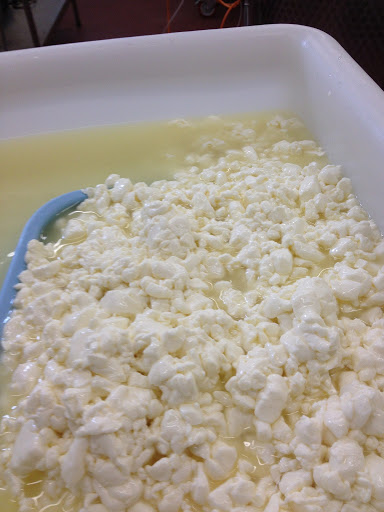
On the first trial, 0.05% in quantity was added to 50 litres milk, the milk was heated to 34’C, rennet added at the appropriate pH change and I filled my pot of water to look out for flocculation times.  The flocculation happened right on time, the hardening more or less followed the pattern it was supposed to.  I pre-cut, then cut to hazelnut size (more or less – it’s a bit hard to use a cutting harp designed for a big vat in a 50 litre tub), let if settle, took off the 25% whey, added back the appropriate quantity of water at 32C, added some starter back in for flavour and stirred.  The recipe was one I’d found online and frankly has already been adapted.  At the time, I queried curd washing with Ivan Larcher and he replied
‘Good luck settling the pH at 5.2 without it.’
Later on, I asked for clarification on quantities and adjusting those parameters only to be told that it’s an industrial technique and he didn’t recommend me doing it.  I have therefore stopped.
However I was doing so on this trial make, and at every stage, I was recording pH on the spreadsheet Ivan had emailed me after our Blue Cheese course so that it would track the pH curve.  Unfortunately my pH curve didn’t curve.  It was more of a wobbly straight line.   Short of leaving the whole thing for 24 hours to acidify on its own, there wasn’t much I could do but proceed, pre-draining the curd on a mat and then filling the moulds with the drained curd pieces and turning, turning, turning throughout the afternoon.
All looking quite convincing so far – unfortunately it’s all in the maturation.
They looked pretty convincingly like cheeses.  They were draining.  But who knows what was going on below the surface without much acidification.  The problem is, all sorts of other bacteria could be enjoying the quantities of lactose and developing to undesirable results.  Unfortunately despite doubling the starter cultures the following day, the same acidification pattern followed.  Evidently at Holker Farm the starter culture had very minimal effect and acidification was largely governed by the lactic acid bacteria naturally present in the sheep and cows milk.  Further unfortunately, I already knew from a lactofermentation we had done a week or so earlier when Rose drove up (bringing a bottle of milk with her) to SAF to meet Ivan and me after one of the days of the course had finished, that we didn’t have a lot of strong lactic acid bacteria in our milk at the moment and that other things tended to become dominant.  To say I was nervous of the test results we would get from milk and curd samples would be an understatement.
I left SAF; the samples headed to the lab; we waited for the results.  As I had feared, without enough lactic acid bacteria from the starter or naturally present in the milk itself, enteros and pseudomonas had had a field day.  Staph. aureus hadn’t done so badly either.
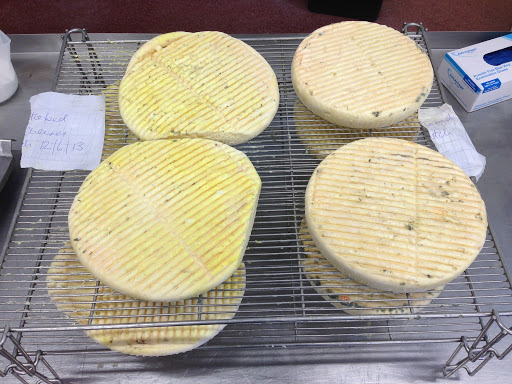
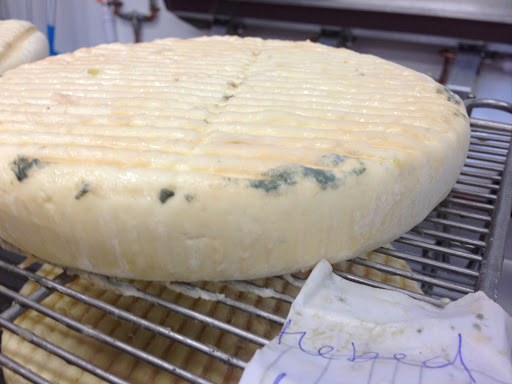
Not quite what I was hoping for but still looking relatively like cheeses
After a couple of weeks, I drove to SAF to collect the unfortunate cheeses.  I did not have high hopes to be honest, particularly as one of them had pancaked overnight and collapsed – a bit of a surprise for me and also for Lee Anna.
However, I had known, that I had more cheese than I was expecting, which I suspected meant they were too moist.  This raises the likelihood of crazy things happening during maturation.  What I didn’t know however until I began to think and mull it over was that those rather too healthy pseudomonas might also have played a part in this too.  Pseudomonas, as I had discovered thanks to the very knowledgeable Paul Thomas, are caseolytic (they eat casein).  Could that mean that they might increase the speed and amount of protein breakdown in our cheeses?  One quick email and a reply later and yes, by no means the only factor but, if there were large numbers of pseudomonas, then there was much more chance of pancaked gooey cheeses that fall apart.
All in all, I wasn’t sure what I would find at SAF but although one batch had fallen to pieces, the other did seem to be holding some shape and smelled convincingly washed rind.  Not the best behaved of washed rind, I’ll admit, but I’ve smelled worse in my time.  We tasted one of them and to my surprise there wasn’t a strongly bitter flavour that I was expecting due to the pseudomonas, in fact the predominant flavours were beery, yeasty and fruity with a hint of meaty and savoury in the background and perhaps just a touch of the bitterness on the rind but certainly not overpowering.
Now let’s be clear, it’s not the flavour profile I want but then again, the recipe didn’t work, so for it to have turned out to be not only edible but while a bit raucous, actually not too bad, was a definite bonus.  That said, a valuable lesson was learned for Cheese Trial no 2: use a hell of a lot more starter!

Cheesery on Wheels

Somewhere around February as we were delayed in our site planning permission by the Highways Agency and considering renting an industrial unit, Rose’s mother asked
‘Why don’t you just try and make a few cheeses?’
Although we had no site in which to make cheese, we both loved the idea and began to test out various options.
Option 1:  Use a catering kitchen on the estate
Option 2:   See if a friendly cheesemaker would like to rent us their space
And Option 3, which presented itself while booking in on a course for learning about Blue Cheese:
Rent the training dairy at the School of Artisan Food.
Option 1 was abondoned quite quickly as not only was the kitchen not available but we also had no maturing space for anything we made (although we did consider purchasing a few wine fridges for the purpose).
Option 2 was investigated but bringing non EHO approved milk into someone’s work space to make a completely different type of cheese which the cheesemaker had no HACCP for was a can of worms that the people we approached would rather wasn’t opened and, to be honest, that’s understandable.  Option 3 however had legs.
Enter Lee Anna Rennie Dairy co-cordinator for the School of Artisan Food, who loved the idea and researched us a price and set about working out what the School would need from us in order to make this idea reality.
At the same time, we also looked into the possibility of hiring the Little Cheesery, a mobile cheesemaking unit which has been developed by a company in Derby.  They actually specialise in stainless steel work and custom making as well as assembling food standard production lines.  The Little Cheesery is something they knocked together to show what they can do in terms of cheese equipment and it has proved really quite popular for demonstrations and fairs as well as for people like us who want a home for some trial batches.
A visit to both was necessary so off I drove to the School of Artisan Food for a look around and then a few days later off I drove again to Derby to look over the Little Cheesery.
It was a tough choice to make, actually, in the end.  The Little Cheesery is remarkably well equipped and fits a lot of stuff into a small space, actually rather more than we needed.  The dairy at the School of Artisan Food also has a lot of equipment, far more than we need, but of course they run professional cheesemaking courses covering every type of cheese from hard, mountain-style cheese to soft lactic cheese so diverse equipment is required.  It has many other attractions too, the possibility of a milk supply if we had wanted, their extensive research library, the waterbath for controlled lactofermentation tests and the cheese care services of Lee Anna as well.
The thing that really made the decision crystal clear in my mind, though, was just the fact it is a permanent building with its own functioning infrastructure.  The basic things like not having to plug a trailer into three phase electricity or connect up to a water supply etc are taken care of meaning that when it comes to the problems you have to troubleshoot (because let’s not be so naïve as to think there won’t be any) they are related to the milk, the make and the cheese and not fixing the electrics.
With any decision, you choose what problems you’d rather be dealing with.  We chose to focus on understanding the milk and the cheese.  I’m glad we did.

Choosing a Cheese: The Neal’s Yard Dairy Dilemma

When I left Neal’s Yard Dairy, I had a vague idea of learning how to make a traditional dales type of cheese like Cheshire (the house cheese where I grew up) or Lancashire (the fabled house cheese of my dad’s childhood).  I also had a pipe dream of my own orchard and market garden and a yoghurt making facility where I made yoghurts and fruit coulis to be sold together using  rare and interesting varieties of cherries, pears, apricots, strawberries, rhubarb or whatever other fruit took my fancy.  A visit to Caroline Atkinson at Hill FarmDairy to make Stawley, reminded me how much I enjoy the pace of a lactic cheese make.  Nine months at Holker Farm Dairy getting my head around drainage of a washed rind cheese made me wonder if I really did want to put that all to one side and make something entirely different in future.  Equally, memories of the sticky, greasy, gloopy and slimey business that is rind washing cheeses did put me off the idea of making a washed rind of my own.

When I first got in touch with Rose, they had made a Chaource on a very much ‘in the kitchen’ basis which tasted really pretty darn good.   I was very keen to make a lactic cows milk cheese and to be honest this did encourage me to keep the email correspondence going in those early stages.  The fact that she also was interested in making yoghurt (albeit for a frozen yoghurt range primarily) was an added bonus.  Should it ever be even a remote possibility, Oxfordshire is a considerably better place climate-wise to try and plant the odd fruit tree than Cumbria.
I did my market research too – by which I mean I got in touch with Jason Hinds and Bronwen Percival at Neal’s Yard and asked them what they suggested would be a good choice for a dairy that was just setting out.
‘Bloomy rind soft cheese and continental style blue’ came the reply.
‘Does a lactic cheese qualify as bloomy rind?’
‘Yup’
Emboldened, Rose and I set about our sales projections and planning with a soft lactic cheese in mind and to then bring on a gorgonzola style blue a year or so later into production.
‘What about doing a washed rind though?’ she asked.
‘Well I have made one before,’ I said, reluctant to abandon all that I’d learnt in Cumbria for projects new, ‘I could probably be up for doing one again if we could have a bit of help on the rind washing.’
We tentatively pencilled it in for year 5.
‘I’d quite like to do a hard cheese too’ Rose ventured.
‘I think we’d need to think about that further down the line when we’ve got more money.  It will probably need more equipment than our soft cheeses…. but we could definitely have a go.’
So we were decided.  Year 1 would be a delicate little lactic cheese, year 2 would see the launch of our blue and we would then let those establish themselves for a few years before embarking on anything new but a washed rind and a hard cheese were a possibility.  The Cheshire / Lancashire or Cotherstone type of cheese was still in with a chance.
Why so many cheeses?  Wouldn’t it be better to just do one cheese and do it right?
It’s a very valid and good point, but I think if we don’t take the possibility of maintaining the quality of all of our cheeses lightly and are always trying to improve, then we can manage it.  It also appeals to my nature to have a variety of work to do and have the challenge of doing it all well.  It’s not the easy path.  There are risks that we’ll take our eyes off one of the cheeses and mess it up.  There are plenty of examples of cheesemakers who make a large variety of cheeses and make a range of decent but not amazing cheeses.  There are also compelling examples of people who sensibly limit their product range to only one cheese and just make it good: Kirkham’s Lancashire, Stichelton to name but two.  However being nothing if not fussy about what I make and obstinate to boot, I believe I have the tenacity, doggedness and pig-headedness to make it work.  Although not commonly seen as such, I think, in this instance, these will be positive character attributes.
So, all set, we begin finding our site, getting our plans together and preparing for our planning application and build.  We call in Ivan Larcher and he designs us a beautiful layout in which we can make a lactic cheese and a blue cheese with a little yoghurt room off the side for playing around with yoghurt making and lactofermentations.  It’s all good.
But time moves on and while we are battling the planning process and pursuing the all important question of where our dairy should be (it’s going to be a permanent structure so we’d better get this vital point right), the industry waits for no man or woman. Julie Cheyney is making a lovely lactic cows cheese, St JudeDavid Jowett is alternating his mountain cheese makes with Alscot, his lactic cheese.  Jason also knows of a couple in Suffolk experimenting with a Brie.
So, one day, after heading in to meet Bronwen and ask if they might be prepared to mature on some of our lactic cheese trials that we hope to make later this year before the dairy is built, I get home to discover 2 missed calls from one Mr Jason Hinds.  I call back.
‘Anne,’ he says without preamble, ‘ I’m about to throw you a curveball, but you know me and curveballs, so I’ll carry on…’
‘Go on, I’m listening.’
‘What we really need right now isn’t a white rinded cheese.  We could really do with a washed rind.’
Gulp.
He carried on, explaining what they felt they needed on their counter and I mentally reversed our white rind lactic cheese to year 5 and brought forward the washed rind to year 1 to see how I felt about that.  Although I’d been entirely decided about the lactic cheese, I found that I actually didn’t feel particularly upset about switching things around and we ended the conversation by agreeing that I’d talk to Rose and we’d both consider the matter further.
Meanwhile I had a Blue Cheese course to go on at the School of Artisan Food where I’d have chance to talk to Ivan Larcher about the idea so I emailed him to ask how it might affect our dairy plan and to warn him I’d be asking him about it when I saw him.
‘What do you want to do?’ Ivan asked, getting to the point with clear sighted accuracy and without beating about the bush, ‘Make a cheese you want to make or sell to Neal’s Yard?’
A good question.
I examined my motives and in doing so, I realised that, having spent 16 years at Neal’s Yard, I did want them to sell my cheese.  In part, I wanted the friends I have there to be excited about what I’m making, but also I know from working at Holker with Martin that if anyone can be relied upon to push you, always ask for the cheese to be better and make sure you aren’t resting on your laurels, it’s Neal’s Yard Dairy.  I want someone to be a pain in the arse and insist that I make them better cheese.
That said, I want to make what I want to make.  So in answer to Ivan’s question, I want to do both.  I want to make what I want to make and I want to sell to them.
In terms of a washed rind cheese, I want to look to Italy for inspiration, just as I did with our blue cheese.  Italy is my second home.  I’ve spent about a tenth of my life there over the years and in many ways I’ve grown up there.  It doesn’t matter which city I arrive in or whether I’ve been there before or not, I am at home.  While France boasts wonderful washed rind cheeses (and I’ve been helping out with Mons at Borough Market recently so I’ve been getting to know some of them in much more detail), I don’t have the connection with France that I do with Italy.  So if we’re talking washed rind, then I want to make something based on Taleggio with its sweet, milky, honeyed, savoury flavour profile and its silky texture.
In terms of lactic cheese, well we’ll see, in Year 5, if they are interested.  They can plan and look for gaps in their range as any efficient shop or affineur would but that’s not the only thing that makes your product choice for you.  Sometimes you just respond to a cheese that’s damn good.  In other words, if I make it delicious enough, they will buy it.  I do like a challenge.

Musical Chairs or Where to Site a Dairy

When Rose and I first spoke about their cheesemaking plans, she explained that one of the big obstacles was that they had not yet found an appropriate place on the estate to build the dairy.  A couple of places had been proposed.  She had her favourite.  Neither one was without its problems.

Chair No 1, Manor Farm

Manor Farm, was close to Rose’s house and the main road through Nettlebed, with a lovely view over the hills looking to the south west, but, unfortunately, also with a tenant..

Chair No 2, The Grain Dryer

The other site, known to us as the Grain Dryer Site, was basically a field next to a sawmill and a barn with grain drying silos, hence the name.  There were no tenant issues here but equally the build would be much bigger and more expensive.  There was no structure we could use, so everything, including the foundations and hardcore needed to be put down.  It was also potentially more difficult to get our planning permission too, as it would need to be a completely new build.
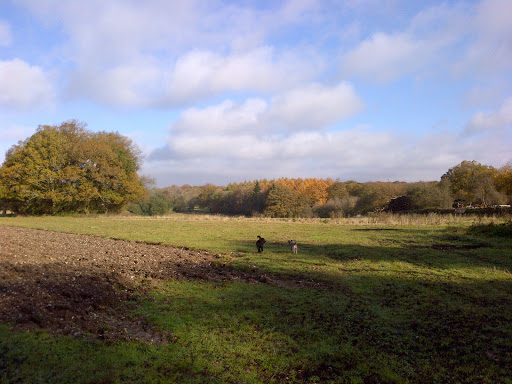
The Grain Dryer site, looking back to our potential neighbours
Looking north to the copse, our potential view from the make room

Chair No 3, At the Dairy itself

Both sites offered a challenge but a third possibility presented itself.  There was a field adjacent to the milking parlour and the cows on the farm itself.  It wasn’t a popular option with the farm managers as they need to expand the milking parlour sometime in the next five years and need their space as much as possible, however in theory it was an option.
Around this time, we called in Ivan Larcher to advise us and help design the dairy.  He visited all 3 sites and pronounced in favour of the field by the milking parlour.  A dairy should be close to the milk ideally after all.  However shortly after Ivan’s visit, the farm managers decided that the field was too valuable to them to give up.  The other sites on the estate were on flinty soil, no use for grazing land and not particularly easy to farm for arable too.   This field was good grazing land for the cows and they needed it.  It was a very fair argument and one we accepted.  Back to our first two sites then.

Chair no 4, Off the Estate

With both of these sites problematic for the moment, we were considering going with the latter when Rose’s cousin made an offer of a barn on his farm, just off the estate.  It was a big, wooden clad barn, attractive to look at and with plenty of space.
The problem here was that Rose has a major business rule:
‘Don’t go into business with friends or family but become friends with people you go into business with.’
While an element of family involvement had to be on the cards if she wanted to build a creamery that would buy from the estate’s farm (itself a family business), using her cousin’s barn seemed unwise in case he had cause at any point to regret his offer and discovered, a couple of years in, that actually he didn’t like having cheesemaking on his doorstep.  Lest family relations become strained, his kind offer was declined.

Back to Chair no 2 then

So we returned to the Grain Dryer site.  We adapted Ivan’s drawings to the new site and its orientation and investigated what we would need to get together in order to present an application for planning permission: a business plan, architects drawings, an ecologist’s report stating that we would not be damaging the environment. We emailed the highways agency to check they would have no objection.  Along the way we made the unfortunate discovery that in Oxfordshire the council requires new builds to conform to BREEAM which sets out requirements for the new building to be as energy efficient as possible.  Unfortunate, that is, in that it would involve an audit to a standard that is as thick as Thackeray’s Vanity Fair, only with A4 pages and that it would add at least £10k to our costs, the principles of being as sustainable and environmentally friendly as possible and keeping our energy consumption as low as we can are actually pretty key to our whole ethos. While it largely applies to buildings larger than the one we planned to build, the council were still keen to enforce it.  Then the Highways Agency got in touch – the access road had insufficient visibility, in their view, given the speed limit of the main road at that point.
This bombshell dropped just before Christmas leading to a slightly dispiriting atmosphere over the Christmas break and many a curse was sent the way of the Highways Agency in my house.  Damn them , what were they trying to do, make sure people didn’t die on the roads or something?  They  needed us to cut down 250m of trees in both directions to improve the vision splay and unfortunately some of those trees were ancient woodland which would make the ecologist, who, until now, was very happy with our plans, because we are putting in a wetland system that will have a positive impact on wildlife, very unhappy indeed.
the yellow lines show the potential tree destruction – a very long way along the road in both directions
In the New Year we found a Highways Agency consultant (no I never knew they existed before now either) and they arranged to visit the site and look at the road.  Meeting them was very positive, they pointed out that because the road was curved (although it doesn’t look that way on the maps), the cars were slowing down and drove at considerably less than the sixty miles an hour that was the speed limit.  In their opinion this meant less trees needed taking back and the ancient woodland would be safe.  However we still had a case to fight and despite the report and speed survey they intended to carry out we had no guarantee that the Highways Agency would agree.  In addition, the architects and BREEAM consultant had indicated that we would need to raise around £600k to build the place and have it conform with the expected standards.

Chair no 5, The Temporary Home

With a long and potentially complicated planning application in the offing, ever more reports that needed to be generated and a lot of cash to be raised, Rose’s mother came up with the extremely sensible suggestion that we look for a temporary home, so that we could at least start making cheese even though our planning application and build wasn’t finished.  We looked at nearby light industrial units and found one that had potential.  Not as picturesque as the dairy we wanted to build but perfectly functional if the costs stacked up.
We wouldn’t be able to stay in it for all that long as it wasn’t big enough for us to make more than one type of cheese and we wouldn’t have much maturing space but it was worth doing the number crunching.  Rose’s mother was also able to let us know that the situation at site no 1, Manor Farm had changed and it was now potentially a possibililty..

Chair no 6 or is it no 1 again

A second and third visit to the industrial unit revealed some rather unpleasant and food tainting smells coming from a metalworks next door which ruled that site out of the running.  However, good news, the site at Manor Farm was indeed possible.
So the twisting turning route of our game of musical chairs has spun through the full 360 until we’re back at the place we first thought of.  It has a structure already and hard foundations so the building costs won’t be as much as at the Grain Dryer site.  It also only needs change of use planning permission rather than full planning permission for a new build.  The signs are good.  Ivan is designing us another dairy layout, ecologists are reporting, the highways shouldn’t have a problem with access as the road leads out into the village where the speed limit is a very sedate speed.  The aim is to apply for planning permission in the next month.
Keep your fingers crossed.

Nettlebed Creamery

Well, first off, apologies for a long absence.  It’s not that I’ve been doing nothing worth writing about, it’s pure disorganisation.  However to remedy this, it’s time to put pen to paper or rather fingers to keyboard and talk about something I’ve been superstitiously not blogging in case of jinxing the operation…. Nettlebed Creamery.

So, what has changed?  Well, it’s fast becoming the worst kept secret in my life anyway, as I talk about it to everyone I meet and progress is being made, so it’s time to set it out on the world wide web for all to see.
What is Nettlebed Creamery I hear you cry?  Well, are you sitting comfortably?  Then I’ll begin…
Back in the winter of 2012 as I sat surrounded by snow up a hill in Cumbria, I began looking for my next cheesemaking venture.  The time had come to move on from Holker, Martin and Nicola needed someone local who would be able to be a more permanent fixture and believed they had found someone, I wanted to try other types of cheesemaking.  A couple of possibilities presented themselves, Old Hall Farm in Cumbria which as we all know now didn’t work out, and the tantalising possibility of cheesemaking with Rose Grimond in Oxfordshire.
I had met Rose, on a number of occasions, through my sister Jane who, while working on the Mons Cheesemongers Borough Market stall way back in about 2007, had been introduced to the stallholder next door and got chatting.  Rose, at that time, was acting as a representative, promoter, wholesaler and retailer of produce from Orkney.  Part of that involved a stand at Borough Market which sold meat, cheese, oatcakes and smoked fish but probably most excitingly for Jane and me, the sweetest, juiciest scallops (‘as big as yer heeed’ as Jane remarked) and fresh sea urchins.  We had many a delicious weekend seafood treat courtesy of the Orkney Rose stand.  However, fast forwarding about 5 years, Rose had wound up her retail and wholesale business, moved to her family home of Nettlebed in south east Oxfordshire and had her first little boy.  Surfacing from new motherhood as her son grew a little older, Rose began to look for another business to get her teeth into.
Nettlebed Estate, the family estate run by her mother and her aunt, has an organic dairy herd of Friesian Holsteins crossed with Montbeliard and Swedish Red.  The milk of this carefully managed and farmed herd was and is being sold to Dairycrest for drinking milk.  Dairycrest delivered the bad news that the organic milk market was at capacity, so they would be cutting the organic premium they had been paying and would quite probably be looking at further cuts in future.  The farm and estate owners met to discuss how to proceed.
The wisdom in farming is that to succeed you have to get big, get different or get out.
Options A and C didn’t appeal but getting different did.
‘We should be making cheese!’ Rose opined with enthusiasm.
At first they pursued the idea with a local lady looking to change career and make cheese, but ultimately parted company due to different ideas of what to make.  Around this point, I entered the scene.
Initially, I contacted Rose because I was looking to arrange a month or so perhaps, working at Grimbister Cheese on Orkney making Seator’s Orkney cheese.  I still haven’t done this, but priorities have changed a bit since then.  I wondered if she had contact details and any recommendations of somewhere to rent for the duration.  During those enquiry emails we skated around the topic of cheesemaking:
‘Oh so you’re making cheese, how interesting….’
‘Oh so you want to make cheese on your estate and need a cheesemaker, how interesting….’
Finally, after meeting the family and farm managers, Rose and I began work in earnest to get the cheesemaking enterprise off the ground.  We looked at potential sites for a creamery and chose one, then changed our minds, then changed our minds again, then again.  Each had its advantages and disadvantages.  One of them seemed on balance to have more advantages than disadvantages until we got down the planning permission route and hit a dead end over an access road.  Finally we are back with the one we first thought of and that Rose had always had her eye on.  Planning permission applications are being drawn up again and the business plan that Rose created a year or so ago is being revised yet again to accompany our application.
This time, I am pretty confident that we won’t change our minds again.  Maybe that is what prevented me putting fingers to keyboard before.  This choice of site is for keeps… unless the council say otherwise.
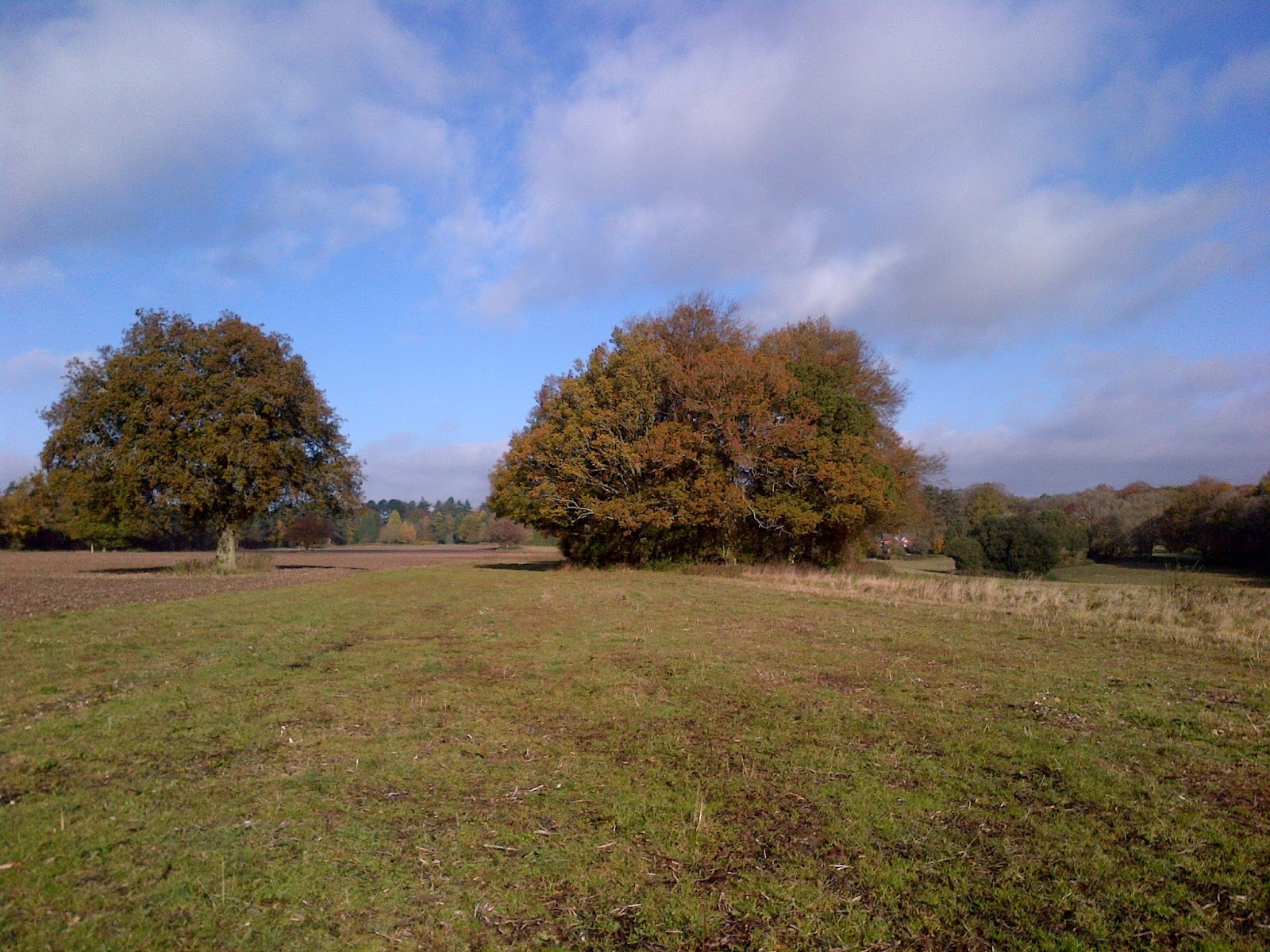
The view from one of our former sites because I’ve not got a picture of the current one yet.