Alex James – why is everyone so up in arms?

The current storm in a teacup that has hit the cheese world this week has definitely been the launch of Alex James (ex bassist of Blur who is now lending his name and media profile to launching different cheeses just in case anyone doesn’t realise) new range of cheeses in Asda which seem to include cheese slices flavoured with Tomato Ketchup, Salad Cream and Chicken Tikka as well as a bag of cheese bits you can put in the microwave before pouring the resulting melted goo over baked potatoes.  I should point out before continuing, I have not tasted any of this range and to be honest I’m not likely to be trying the Chicken Tikka unless by accident.However, if Alex James wanted to stir things up a bit and get a load of media attention (which he undoubtedly did) he has certainly succeeded.  Opinions range from bemusement on the part of his former collaborator Juliet Harbutt who was quoted in The Independent as saying: ‘There’s so much potential for fabulous cheeses that I was surprised Alex decided to go down this route’  to ‘Alex James Must Die’, the latter a joke on Facebook.  Martin Gott himself has entered the fray too having tweeted the opinion that ‘Alex James is to the cheese industry what Jedward is to the music industry’ and received a storm of response exhorting him to try before criticising.

Apparently James wants to make cheese accessible to everyone, so along with the artisanally made cheeses he has lent his name to, he also wanted to hit that part of the market that would never go into a deli, because it’s a snobby shop, and would shy away from a cheese matured in leaves and washed with cider brandy and even more so if made from goats milk (Little Wallop, the first cheese he put his name to).  If that’s his mission then he’s certainly got people’s attention and brought cheese into the news so good luck to him.

That he has diverted from the artisanal side of the cheese industry to go the industrial and flavoured route is no huge surprise to me.  Although when interviewed he usually falls short of out and out admitting this, Alex James is not a cheesemaker.  He is an enthusiast who in collaboration with independent consultants and cheesemakers themselves develops cheeses which are a little on the gimmicky end of the artisanal spectrum and now are on the rather gimmicky end of the industrial spectrum too.  For all that, the artisanal ones do taste good, if not quite demonstrating the complexity and ‘x factor’ that Randolph Hodgson and Bronwen Percival of my former employers Neal’s Yard Dairy looked for in sourcing a cheese.  The point is though, if you want your cheese to hit the headlines purely because of its quality, you don’t name it Little Wallop or Blue Monday.  Little Wallop may be an actual place name, as Stinking Bishop is an actual variety of perry pear, but in both cases the people behind the cheese have chosen the name because it’s eye catching and comment worthy.  It’s an easy sale because the sign bearing its name will stand out in a deli counter.  Montgomery’s Cheddar or Kirkham’s Lancashire don’t need a quirky name to get talked about, they simply taste good and attract sales for that reason alone.

This creation of image rather than relying solely on quality is where Martin’s Jedward analogy comes in and particularly applies to the new range where image is more dramatically courted over product quality.  Jedward are image over substance, but enjoyable in a bubblegum, music-lite sort of way.  There are certainly bubblegum pop acts out there that are a hell of a lot worse.  There is a place for them in their industry and they do what they do well.

The same can be said of the current range ‘Alex James presents’.  The ‘Alex’s Best-Ever Mature Cheddar’ from the range is made by Barbours who are a six generation farmhouse block cheddar maker and they make good block cheese and waxed rounds.  They also, crucially, have kept alive the traditional pint starter cultures that artisanal Somerset cheddar makers like Keens, Montgomerys and Westcombe rely on.  ‘Best Ever’ it may not be, when put next to something produced by the three aforementioned, but Alex James could have collaborated with a much more industrial dairy and one making cheese of a much lower quality.  As for the flavoured cheeses, it’s all in the balance and if Alex James range has succeeded in adding flavour into a base of well made if not particularly characterful or complex cheese (as might be suggested by the Financial Times tasting) then, of their ilk, again they could be worse.

Just as music purists don’t really rate the oeuvre of Jedward, the cheese purists are not going to get behind a chicken tikka cheese slice or even the less controversial but also less newsworthy elements from his range like cheddar with spring onions, but they have their place.  The Jedward comparison is not overtly a criticism, although to be fair it’s not a ringing endorsement either.

I am not the target consumer for this new range and nor really are most people I know; it’s cheese for those who normally don’t like cheese.  I also have to admit that to be honest the idea that someone out there needs a bag of cheese bits to microwave rather than being able to make up a cheese sauce for their baked potato or indeed just being prepared to grate or crumble up some cheese does make me a little depressed as to the standards of cooking ability in some homes in this country.  But, as Jedward to music or a Starbucks Caramel Frappucino to real coffee, if it gets someone who otherwise wouldn’t be interested in cheese to eat cheese and then leads them to branch out, try more complex flavours and even perhaps venture into a deli or Neal’s Yard Dairy sometime, then it’s the first step on a journey to discovering a whole world of great cheese.  In my youth, I had a fondness for industrial and bright green sage derby bought in the Marple branch of the co-op and look where that’s lead me in the end!

Even if the journey stops in Asda with the salad cream cheese slice, it’s still helping to keep part of our dairy industry alive by providing a customer for the dairy that makes the cheese which, in turn, means that the dairy farmers who supply them won’t be joining the numbers selling off their land and barns to commuters looking for a house in the country, giving up the farm and taking up bed and breakfast instead.

So at the end of the day, he may not be using his media profile to shine a light on the side of cheese making that inspires and excites me and yes, to me, given my tastes and indeed life choices, that does seem a wasted opportunity but it will play its part to support our dairy industry.

Alex James knows good cheese, I’ve sold him cheese in Neal’s Yard Dairy back in his Blur days.  I’ve seen him visit their maturing arches, looking as awe-struck and wide-eyed as any of his fans would given a backstage pass at a Blur concert, as he saw what happened behind the scenes one of one of his favourite cheese shops.  And he’s not only at peace with his decision to venture into the world of flavoured cheese and a range explicitly designed for the supermarket customer, it’s a valid part of his mission to get people talking about cheese.

And talk they are, myself included.  Just as he planned.

Home made Starter

A couple of years ago, Martin tried out making St James cheese using acidified Swallet whey as a starter and also souring his own milk.  It gave interesting but inconsistent results and his EHO got worried so he stopped and returned to his old DVIs.  He didn’t forget the idea however and with the use of pint starters this year, it’s something that we’ve talked more and more about.The argument for using your own starters is to achieve as complex a starter as you can.  The most basic starters are the DVIs which are designed to acidify efficiently and exist in a freeze dried powder that’s easy to look after and simple to apply.  However in terms of containing complex cocktails of bacteria, that’s not what they do.  Pint starters like the MT36 that we use at the moment are a more complex bunch of bacteria with more of an emphasis on flavour production than ease of use.  Souring your own milk will have a greater cocktail of bacteria because it is everything that’s naturally present in the milk itself.  The advantage of diversity of bacteria is that each bacterium will break down proteins using slightly different enzymes which affects the way the proteins are broken down and the combinations of single amino acids they are broken down into.  This in turn of course affects the flavours that are produced.The flavours we want in cheesemaking are primarily a result of the breakdown of proteins rather than fats.  Initially the protein will be broken down to peptides and at this stage the flavours are very basic – salt, sweet, bitter etc.  The enzymes continue breaking the protein down smaller and smaller.   From peptides, they get penta peptides and finally amino acids themselves.  At each stage the flavours develop in complexity and become more aromatic and savoury.  So a complex bunch of bacteria and by extension a complex bunch of enzymes should mean richer, more savoury and complex flavoured cheese.

So we took 100ml of milk, warmed it up in water heated to about 30C and then left it at the room temperature of the dairy which is about 26C for 2 days.  By this time it had thickened into a smooth yoghurt-like consistency.  From this 100ml, we added 10ml to a litre of milk we had pasteurised in a bain marie, stirred and poured it into 8 sterilised pots leaving some left over in a jug.  After 20 minutes for the bacteria to grow accustomed to their new medium but without giving them enough time to start reproducing, the pots were frozen.  The left over mixture in the jug was covered and left overnight to acidify which it duly did – and it tasted great too.  I ate some of it for lunch.  We then sent 1 of the frozen pots off for testing for pathogens and total viable count.  From this we can tell if there are any nasty bacteria present and if so if they are present in quantities that will mean they get the competitive advantage when added to our fresh milk at the start of cheesemaking.  The test results were, we thought, satisfactory and emboldened by that, we gave it a go and used it for just 1 batch of cheese on Saturday 16th July.

Having called in a bit of advice from the clever clogs that are Hodgson and Cordle, we were prepared for the cheese to acidify at a different rate and indeed it did just that.  A much slower acidification happened despite the starter itself having quite a high acidity at the time we used it.  This has meant quite a different cheese which probably at the moment isn’t reaching the potential you might’ve hoped for.  However we have tested it too just to double check the test results on the starter and again they are satisfactory.  We’re doing another test with a different lab just to make sure before selling it, but signs are actually pretty good to do a few more experiments using larger quantities of starter to get the acidity developing at the same rate as our MT36 starter does.

Most importantly, how do they taste?  Well they seem to have a firmer centre than our other cheeses with the normal acidity profile and I’m not entirely sure they’ll break down completely but the flavours so far are good.  There’s a creamy breakdown under the rind and certainly the flavours of the curdy centre aren’t too acidic and are quite mellow and rich.  It’s too soon to say for definite that this will be the way forward but equally it’s encouraging enough to try it out again and see what happens.

Milk – the most underrated food in the world

So many people have either decided they don’t really like milk as a drink or just don’t think about it other than to put a bit in their tea or coffee.  When you taste the sort of milk you buy at the corner shop or in the supermarket frankly that’s not a surprise.  What comes out of those cartons is watery, vaguely mineral in flavour if you can really detect a flavour and when it goes sour, it’s chemical, aggressive and unpleasant.When I worked at Neal’s Yard Dairy, we used to hold regular tastings of the milk from our supplier Geoff Bowles at Ivy House Farm.  While this milk was and indeed still is pasteurised, it’s Jersey milk, organically farmed and has a whole heap more flavour than your standard supermarket pint.  Jersey milk has higher fat and protein levels than regular milk which more than likely comes from a rather intensively farmed Holstein herd and is therefore what people in the dairy world refer to as white water.  As I mentioned in the post about cows, Holsteins are very efficient producers of large amounts of milk but it’s not milk that’s particularly rich in fats and proteins and let’s face it, that’s where the flavour is.  Jersey milk therefore has a much richer and creamier mouthfeel but even in the skimmed milk because it has more protein too, it has much more flavour.  We tasted the milks side by side and the Ivy House Jersey milk was naturally sweet, creamy, savoury and mineral.  The supermarket (probably Costcutter actually cause that was the nearest corner shop / mini supermarket) milk was thinner textured and had none of the sweetness or savoury flavours more of a mineral that verged on the metallic.  In part this will be down to the breed of animal but also the freshness.  We knew that our milk delivered to us on one day would have come from the milking the day before.  With the supermarket milk who knows how old it was by the time we bought it.  It would have been collected from various farms, pasteurised all together with lots of other milk and bottled, sent to a distribution centre and from then out to the shops.  It was more likely to be a few days old at least.Since moving away from London and getting access to really fresh milk (minutes old in fact) that is unpasteurised into the bargain I can safely say that the difference between what I’m making cheese with and what you put in your coffee is like night and day.  In fact it’s hardly fair to even call them by the same name.  Of couse I’m working with sheeps milk which is different to cows milk in consistency, it can have rich and creamy fat content but because of the way the fats are structured, it doesn’t feel heavy and the savouriness has a different flavour because it’s sheepy in a subtle and fresh way rather than say beefy.  Those are tricky adjectives because truthfully that is what I find it to taste like but equally I can see those who are unconvinced by milk not warming to the idea of a rich sheepy or beefy thirstquencher.  Anyway, pressing on regardless, I shall continue.  My main point is that if you ever try unpasteurised truly fresh milk it is a revelation.  It has sweetness, fresh, clean creaminess, savoury animal flavours and and mineral restraint but as well as that, it has another aspect in that it tastes lively, which is perhaps a reflection of the freshness.  Supermarket milk with its age and pasteurisation is flat even at worst case perhaps slightly stale tasting.  Geoff Bowles’s milk had sweetness, creaminess and rich savouriness but damn fine stuff though it was and is, by comparison to milk that’s unpasteurised and just milked a few minutes ago, it had lost an edge.

Of all the foods that have lost their character by industrialising the manufacturing process, which include bread, beer, hydroponically grown veg, flavourless battery-farmed chicken and plenty of others too, I now feel that milk is the one that has suffered most in the loss of flavour and perception.  The fact is, most people who reckon they don’t like it, would happily drink a glass of the milk Nicola and Martin produce because it’s bloody delicious.

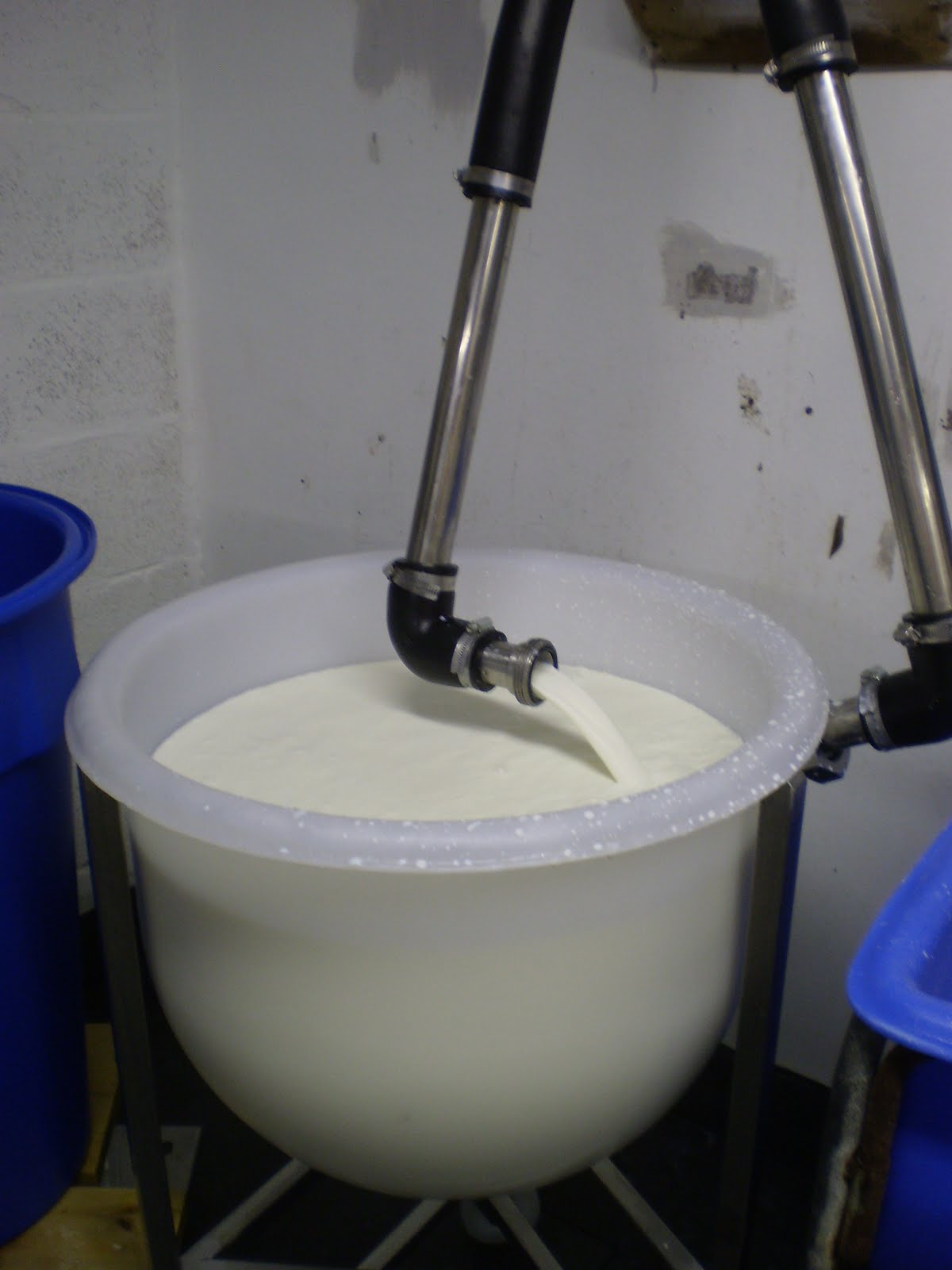
Milk being piped into the vat from the milking parlour – minutes old.

Temperatures

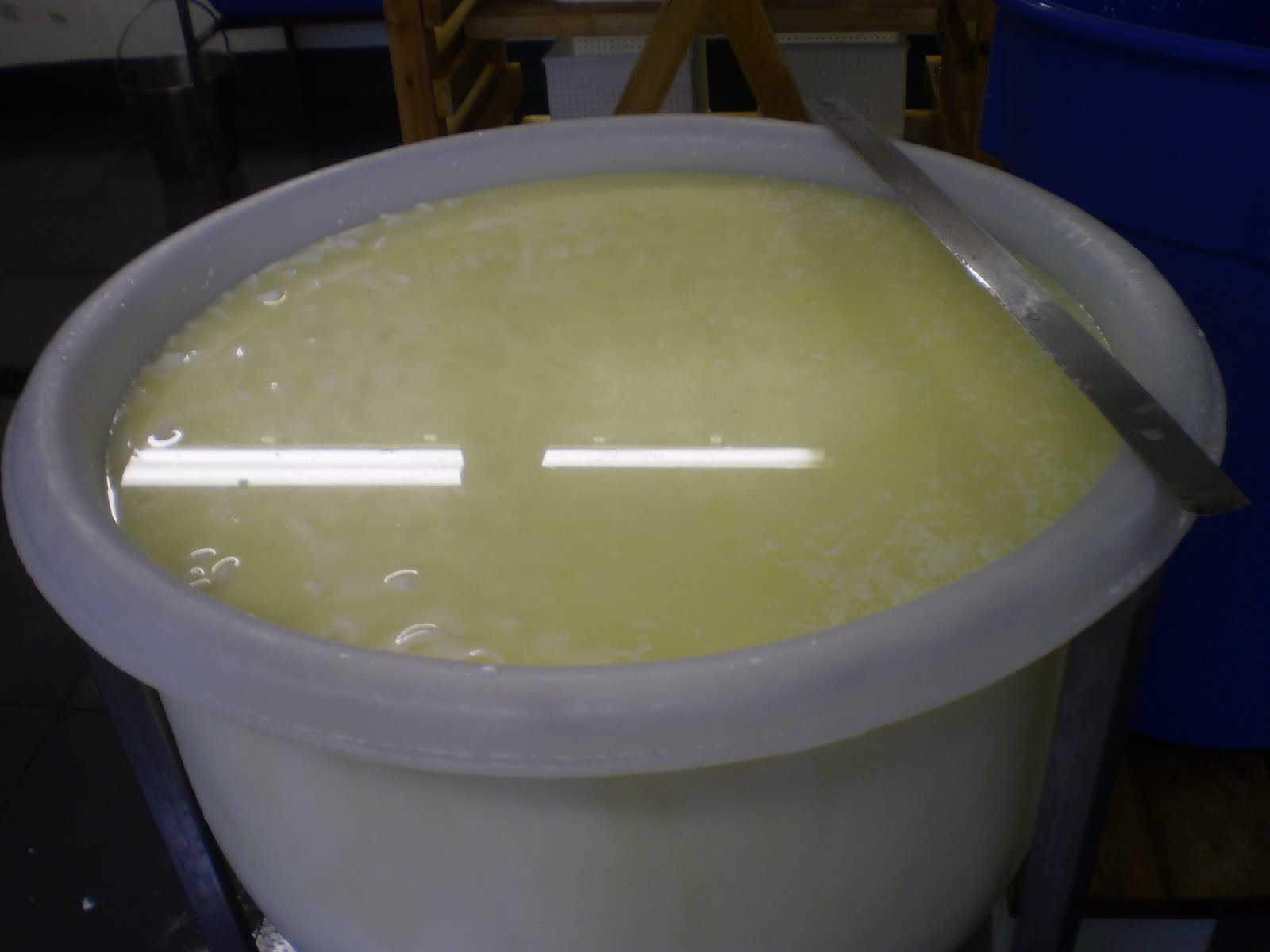
As the sheeps milk decreases and due to a phone conversation Martin had with Randolph, we have been looking at temperatures of our make recently.  Out at Randolph’s country residence Old Kate’s Farm, Dr Jemima Cordle has been conducting cheesemaking experiments.  According to Martin, she’s been making cheese to roughly a St James recipe but playing with different temperatures and amounts of rennet to see what gets the best results in terms of producing heavier cheeses and a greater yield of cheese.  Obviously as we have less milk, that’s quite an attractive idea to us too.Perhaps a little ambitiously we thought we’d try dropping the temperatures slightly before we had a truly accurate way of recording the temperature.  The floating thermometer we have been using is about 9 degrees out.  The recipe for St James calls for setting the milk at 31C and by the thermometer we had been using, we were setting it at 23C.  You’d think that knowing this, we could drop to setting at what the thermometer tells us is 22C and try experimenting.  However, as it turns out, the thermometer is inconsistently inaccurate – great.  The first 2 days experiments have had to be discounted due to too much yeast in the starter which lead to gassy cheeses.  Dropping the temperature just a little slowed down the drainage and allowed them to take advantage of the extra moisture and get going far more than we wanted.  Experiment abandoned we invested in a good digital thermometer and realised that our previous 23C was in fact about 33C by the new equipment standards.

The temptation at this point would be to return to 31C set straight away, but by setting at 33C we had actually been getting a set time of about an hour and sometimes longer (which is not too short a time for this recipe) and more importantly the cheese has been good.  The NYD mongers have been reporting good things and the cheeses on Martin’s counter at Cartmel have also been tasting good.  So while that’s hotter than we’d intended, if it ain’t broke don’t try and fix it all at once.  We agreed to drop to 32C set temperature for starters and gradually reduce it from there on.

The temperature and set time that Jemima had found to yield most cheese is 28C and a set of an hour and a half which is longer than we have yet achieved.  By setting at what is probably 33C (it was with the old thermometer) and using half the usual quantities of rennet by mistake (1ml to every 10 litres rather than to every 5 litres) I did manage to get a set of an hour and a half.  The curd did set and it was a nice consistency at both cutting and ladling but the texture of the cheese is quite different to the usual St James.  It’s moist and succulent but sandy in texture.  In fact it reminds me of young Stichelton which considering that that is a cheese made with very small quantities of rennet is perhaps not entirely surprising.  However until it matures, we can’t be sure if dropping the rennet quite that drastically is a good thing or not.  Sometimes by making mistakes, you stumble on something good.  Sometimes, you don’t.

However armed with new thermometer in hand, I have been dropping the temperature a little by degrees.  For a few days I was renneting at between 32 & 33C (we can measure in decimal points now) and in the past couple of days I’ve dropped it further to between 31 and 32C.  Martin remains nervous about gassy cheeses, but by adapting the draining cloth work, I think we’re avoiding them.  In fact even the yeasty cheeses we made about  a fortnight ago haven’t remained gassy although they haven’t drained as I’d like either.  But they’ll be ok – not amazing but ok and for a while we weren’t sure that would be the case.  As far as set time goes, the magic hour and a half has eluded me so far but the set is a little over an hour – generally about an hour and a quarter.

The effect of dropping the temperature on the draining was the biggest difference I noticed.  It’s manageable but the curd drains less freely.  This really should be expected.  As I understand it, the reason for this slower and longer set is that rather than forming a number of stronger bonds as the curd solidifies, it forms perhaps weaker bonds but more of them and this at the end of the day forms a more effective net in which to trap moisture and fats so that the curd releases less whey when it is cut and left to rest and it needs more encouragement to continue draining after ladling.  The texture at cutting and ladling is less firm and it actually feels really nice to work with – more like gliding a knife through it than making the effort to cut.  After the curd is in its moulds however this means that it’s delicate and you can’t pull the cloths up as tightly as quickly.  So the cloths are pulled up and tucked in gently after ladling is finished.  The second cloth pull is 20 minutes later and whereas since then we’d been waiting for an hour to do it again, I now find that it needs looking at anywhere from half an hour to 40 minutes later instead.  At this point the curd is getting firmer and can stand a tighter cloth pull in which I aim to have pulled the curd in from the side of the mould so that it doesn’t touch the sides of the mould all the way round.  I won’t neccessarily have it pulled in so that it stands alone all the way round but certainly on some sides or corners it will.  The final cloth pull is then an hour after this and again can be pulled up quite firmly with the aim of standing alone from the sides of the mould as much as possible.  I usually have some cleaning or cheese turning to do after that and I’ve been keeping in mind the idea of a 4th cloth pull but so far by the time I get to cloth pull 3 I feel it’s probably drained enough.  The following morning, in general, the cheeses feel firm and well drained, perhaps a little softer than those made at the higher temperatures but no squelching that indicates free moisture.

In terms of yield and weight and whether we are getting more cheese as a result, my gut feeling is that we are.  Certainly in the last couple of days when I dropped down to between 31 & 32C, I seem to be getting more cheese than I’d expect.  I am not sure about what they weigh, but they seem to be perfectly reasonable sized cheeses and as they are well drained, it’s not trapped whey making them that size.  What I have noticed is that where I’d expect to get 11 cheeses by a process of calculation alone, I get 12 and where I thought I would get 10, I got 11.  In part this can be explained by the composition of the milk – it has higher solids in the latter half of the season than at the beginning but my gut feeling is that it is helped by the temperature and length of set too.

Certainly at this stage of the season when we’re very nearly down to 1 vat of milk only, every little extra is going to help.  The downside is that the longer set and lower temperatures can favour things like yeasts if the drainage doesn’t work so getting those cloths attended to turns out to be pretty vital.

Resting curd just before ladling.  This is the stage at which less moisture releases naturally at the lower temperatures and so more attention is needed to the cloth stages later.


Cows

One of the projects we’d hoped to attempt before my arrival was that with another person in the dairy we might get a chance to play around at making a cows milk cheese.  Martin has done this in the past with a cheese called Jewnywood (a St James recipe with cows milk basically) that was made using Friesian milk from a farm nearby with a small herd.  Unfortunately they are tied into a contract to supply liquid milk and can’t sell just the odd kit to a cheesemaker.  There are other farms in the area of course but ideally Martin hasn’t wanted to use Friesian-Holstein milk as it tends not to have the solids that you need for cheesemaking as crossing with Holsteins ups the milk production but also produces a more watery milk.  The ideal breed for this area is Dairy Shorthorns which were once ubiquitous and in the 18th century, I believe, Holker Estate had a renowned pedigree Shorthorn herd.  The farm opposite Holker Hall is still called Shorthorn Farm today.Currently the sheeps milk is decreasing.  We are half way through the season and the sheep that lambed early are beginning to dry up.  In August, the tups will go in with the ewes that are ready to get in lamb again and we’ll be looking to the next season already.  Time flies huh?  But from having had about 120 litres a day at the peak of the season we’re now down to about 80-90 and from making 17 or 18 cheeses to a batch we’re now at 11.  As the milk decreases, we’ve been thinking further about the whole idea of making a cows milk cheese and extending the season so that Martin & Nicola are selling cheese through the winter.  About 4 weeks ago when the Neal’s Yard Dairy crew visited, we floated the idea over our evening meal together to gage reaction.  The idea we proposed was to buy in local milk and make a soft washed rind cheese.  The idea had a mixed reception.  Bronwen and David who urge caution and not running before you can walk, were interested in the idea if the cheese was good but also conscious that buying in milk requires a level of testing and therefore expense that we don’t currently have because the sheep are milked by Nicola and the milk is super fresh when it’s used.  There’s a quantity issue too – there is a minimum amount you can buy milk in and Martin suggested that’s around 500 litres so it would need a bigger vat.  The evening ended, Martin talked a bit further to me after we left the NYD crew about the practicalities of buying in milk and how we might adapt our equipment to cope with it and then we parted ways.

The following day was my day off and by Thursday a newer idea had planted in the brain of Mr Gott.  Cows.  This seems like a rather radical idea when you first hear it but actually makes more sense at the end of the day than buying in milk.  They are already set up to milk animals and a milking parlour is not so hard to adapt.  They don’t need to buy more than 6 cows in order to have enough milk to be making the equivalent of peak sheeps milk season over the winter and these cows can be bought from a breeder, already in milk a couple at a time.  And finally, if it does all go wrong, the cows can be sold at pretty close to the amount for which they were bought while a new vat will depreciate and also could be difficult to shift too.

Of course the other bonus of buying the animals is that we can make cheese from Shorthorn milk too.  Why Shorthorn?  Because the older breeds of cow are better suited to the older ways of using milk – ie cheese.  Modern dairy farming assumes that the farmer wants to sell liquid milk and the more he (or she) can sell, the more he (or she) can earn.   So cows are bred to produce higher quantities of milk but at a cost.  There are higher incidences of fertility problems both getting in calf and delivering the calves and in birth deformities as well.  They are often taller but lean and rangy needing large quantities of food and in concentrated form in order to keep up with their milk production.  They can go lame a lot more easily.  In other words they are bred to be very specialised for the purpose of giving large quantities of milk.  For a farm like Martin & Nicola’s however they need a smaller animal that requires less veterinary attention and certainly less intensive feeding as their animals are largely pasture fed.  They also don’t need a lot of milk but do need milk with good solid content.  Again the older breeds score highest here too because the cows giving large volumes don’t give the highest fat and protein contents per litre so while the amount of milk is greater, the yield in terms of cheese doesn’t increase in the same ratio as production.

So Nicola and I went to the Great Yorkshire Show on Wednesday to look at livestock and see the sort of cows they’re likely to be buying.  Important for Nicola in particular as she’ll be doing the lion’s share of the milking and purely practically speaking, she can’t be milking a big animal.  I was largely along for a day out and out of curiosity and the chance to say hello to a few people I know there.  Meanwhile after having made the day’s cheese, Martin headed off to Kendal to a local Shorthorn breeder and found that there were cows available from August to November and that they could buy the smaller, plumper, docile and lower yielding animals they want.  On Saturday, they ordered the new milking parlour equipment to be able to milk 2 cows at a time through the parlour.  There’s no going back now!

Shorthorn at the Great Yorkshire Show
Somewhat blurry photo of a nice manageable sized Shorthorn.  The disadvantage of taking photos at speed.

Hospital Corners

It’s been a crazy few weeks since the last post on the 22nd May with Cartmel Races and Holker Festival pulling all hands to the shop and leaving me a cheesemaking flying solo a lot of the time.  However just because at the end of that I haven’t really had the spare brain to write anything, doesn’t mean that work has not been being done.  Far from it in fact.Shortly after the last post we had a visit from the Neal’s Yard Dairy crew which on that occasion were Bronwen (the buyer), David (one of the directors), Sarah (cheese maturation and allocation of correct age profile and flavour profile for each sales department) and Charlie who works in the shops.  They came with an issue to discuss – moisture levels in the cheese and drainage.  This of course was something we were looking at ourselves but the issues at NYD were that they were maturing the cheeses longer and finding on the cheeses from end of April that they became very very runny at the rind to the extent in fact that the rinds weren’t stable and fell off very easily if handled.  Unfortunately we hadn’t had that issue ourselves in our stores but certainly it was a problem.  We shared a few ideas about storage (are we storing drier than them?) and age of selling but ultimately didn’t reach a conclusion, especially as we’d made quite a few changes since the end of April already.  By the time of the visit we’d moved on from turning out cheese from the moulds onto shelves on day 2 to having a day draining on racks in the dairy in the moulds still then a day draining on racks again while 1 side is salted, then on day 4 finally making it onto the shelves for salting on the other side and then after that on day 5 a further day out on shelves to allow a nice coating of yeasts and fledgling B. linens to grow before they went into the cold store.  Since that visit we have also turned the cold store up a little so the temperature is warmer and the rinds develop quicker.

However having heard back from London and given that we’d been worrying about drainage now for a few weeks, I decided to go for advice to the dynamic cheese duo of Hodgson & Cordle (Randolph Hodgson & Dr Jemima Cordle that is) who had visited Martin earlier in the year to get him started with the MT36 starters and had given some advice on use of the cloth liners to the moulds to help get better drainage.  They had made their own test cheese and taken it away with them after the day but the experiment had made them both feel strongly that using the cloths enough was pretty key.

First off I checked whether they had done more cloth faffage (pulling really) than we were currently doing and at what intervals it had been done.  Pretty much the same as we were doing, yet their cheese had ended up pretty darn dry (admittedly partly due to being kept in an unrefrigerated and unhumidified environment but partly drainage) whereas ours most definitely weren’t.  It had also had a close knit texture and again that wasn’t something our cheeses were doing at the time – they were quite open textured.

Going back then to ask what they’d done differently, Randolph came back with the suggestion of pulling the cloths tighter.  He said ‘We are talking about hospital corners and taught sheets’.

The aim of the exercise therefore was to give a squeeze and put pressure on the curd rather than agitate it.  Fortified with the information I set off to give it a go the following day and pulled the cloths up so damn tightly that every morning still (as the cloth pulling continues to be tight) I have fingers that won’t bend properly from the muscles being so stiff.  And I have to say it did work and continues to work.  It also highlighted that we really needed new cloths as the older ones had weakened through use and were ripping with every cloth pull.  More were on order and in fact had been for a fortnight but the suppliers were being rather slow about getting them to us.  Even with daily chasing, it took a further 10 days for them to arrive!

So what has the change been?  Well there’s still the odd bit where the curd doesn’t knit together.  The problem with relying on cloth pulling so much for drainage is that if your tension isn’t equal across the cloth and the whole side of the cheese then you get a less drained area.  Sometimes the constraints of the space you’re working around on the draining table and number of moulds you need to fit onto it, just means that some are harder to get at and work with than others.  As a general rule though, they are more closely knit together in texture and certainly smaller at the end of the day than the cheeses I used to make.

We just had a follow up visit from Bronwen and the NYD crew this time with Joe Schneider (Stichelton cheesemaker for those of you who don’t already know) which meant our discussion had another point of view in the mix too and was very interesting.  Joe also uses cloth liners when draining his curd although they are used at a different stage and before the curd makes it into the moulds, but it means he knows what the aim of the exercise is.  That is, reducing free moisture (pockets of it in the open texture of the cheese) so that the starter bacteria can’t continue acidifying the curd as much and as a result the curd retains calcium.  If there’s enough calcium, the curd will hold onto moisture but it will be locked into the curd structure and will allow for the cheese to breakdown better during maturing.  If there’s too much acidity, the calcium dissolves and the curd, having lost its calcium, has less ability to lock in that moisture and it won’t break down so well.   Or to put in another way, here is what Jemima Cordle emailed to me as an explanation and I won’t try to paraphrase any further:

‘Basically the quantity of calcium left in your final curd along with the moisture content give you your texture. The more calcium you have the more elastic or rubbery the cheese will be. British cheeses contain less calcium than the continental types due to the fact that the curd that makes them loses its moisture over a greater portion of the acidity increase.  The curd that makes Comte for instance loses most of its moisture before the pH has dropped further than  6.5 whereas for cheddar to reach the equivalent moisture level the pH will have got down to about 6.0. The bit of chemistry that is important is that as the pH decreases calcium is released from the casein into the surrounding whey. As the whey is lost the calcium goes with it.
It is this loss of calcium that gives all our cheeses their characteristic textures so it is important to achieve. However it is very easy to overdo. If too much moisture is still being lost when the pH is much below 6.0 too much calcium will be released and the cheese will end up being chalky. It will also be dry because the decalcified curd cannot hold the moisture correctly.
More often than not this happens because too much starter is added so that the curd acidifies too quickly for the drainage to keep up and the moisture is not got out in time. In the case of St James, with the starter quantity you are using, this is not an issue as long as you give the curd the help it needs to drain.’
The help needed is those cloths and making sure they are hospital bed tight.
It’s been a fun & exciting few weeks as well as a crazy few weeks!
Cheeses just ladled and ready to start draining.  Photo taken on 21st May and I’ve been cutting and ladling smaller pieces since then too which also helps drainage.
Drained cheeses the following morning, also from 21st May.  The cheeses with cloths pulled tighter are about half the height of these ones.

Making Starter Culture

This week we were down to our last pots of frozen starter and needed to culture some more ourselves. We had done a trial run about 4 weeks ago which seemed to have worked so on Monday & Tuesday we made up another couple of batches.  Monday’s was made using St James whey and Tuesdays’s was made using milk.  As yet I’m not really sure what the difference will be between the 2 of them or indeed if there will be any.  One theory says that the starter will work more powerfully in a less fat rich medium than milk as the fats can inhibit starters whereas in whey, there is available lactose for them to consume but hardly any fat.Some cheesemakers culture up starter every 2 or 3 days and don’t freeze it, but for the quantities that Martin needs to use it in, this is simpler and if it’s frozen at the right time you don’t harm the bacteria.  They need to be put in to freeze in the lag phase before they start reproducing because once they start to reproduce they’re vulnerable.

So on Monday we made the starter up in whey (largely to be honest because I’d already set both vats of milk by the time Martin came down to the dairy).  And on Tuesday I took out a  litre of milk from one of the vats before I added the starter or rennet and we made up starter in milk.  The process was basically the same though – we poured 1 litre of whey into a sterilised stainless steel container which was then put into a pan of water and put on the hob.  The water in the pan boils but the whey doesn’t reach the same temperature and is basically pasteurised.  It then needs to cool down of course because the bacteria in the starter work best at around 30C and will be killed off at the sort of temperatures involved in pasteurisation.  Interestingly when heating whey, of course, you make ricotta, so the curds need to be strained out after it has cooled and before the starter can be added.  This doesn’t happen when making milk starter but you do have to dispose of the skin that forms on the top of it as it cools.

Each day we take a pot containing about 100ml of starter and in general we tend to use only about 65ml at the most so there is some spare. Once the whey had cooled down, therefore, we added 10ml of this starter to the whey and stirred it around to distribute.  If making in larger quantities, the rule would be 1% starter.  Then the whey and starter was poured into pots which were chilled in the cold store for about 20 minutes before going into the freezer.

To use, we take them out of the freezer the day before at ideally about 12 or 12.30 and it takes about half an hour to thaw out and then the bacteria get to work.  By the following morning when we’re ready to use them, they will have acidified.  If using the milk starter, as it acidifies it will also thicken to look less like a pot of milk and more like yoghurt.  The whey starter however doesn’t so we have to do a titratable acidity test on it to check it.

So far I’ve only used the new starters twice though so it’s hard to draw any meaningful conclusions on which is more active and effective from 2 TA readings but it will be interesting to see if the theory that the fats in milk inhibit the starter does actually work out in reality.

Monday’s starter made in whey
 Tuesday’s starter made in milk

And Introducing Swallet

This week saw the return of Swallet for a couple of days.  Swallet is a little disc of lactic set cheese which if all goes to plan has a creamy white wrinkled geotrichum rind and the recipe is more or less the Perail recipe but with a little adaptation.  The process actually takes a day and a bit until there is anything that looks like a cheese, but it actually requires not so much intervention from the cheesemaker.  Basically your job is to help the curd do what comes naturally to a certain extent.The milk is collected on the day of milking.  It is cooled a few degrees from the sheep temperature that it comes in at and starter is added.  It’s the same yoghurt consistency bulk starter that we use for St James and it is left then to grow and for the acidity to build.  A very small quantity of rennet is added that afternoon and it is left to set slowly overnight.  The following morning the curd has set and about 24 hours from the addition of the starter, we begin to ladle it out into moulds.  Each mould takes about a couple of ladles full of curd and it is then left to drain for about 4 hours before being turned in its moulds and then left overnight again to drain.  The following morning we turn the cheeses out onto racks and sprinkle salt over one side.  The cheeses are moved into a humid and warm room which has the right conditions to encourage the geotrichum to start growing and then turned and salted on the other side the following day.  After that it’s a matter of judgement as to when the cheeses are ready to move to a colder and drier environment once the rind has established itself.

Making Swallet basically uses the natural souring of the milk with a little help from additional starter and although a small amount of rennet is added, it also uses the setting ability of milk when a certain acidity is reached.  This means that actually these are technically fascinating cheeses because you are relying on the action of the acidity and the rennet enzymes to squeeze moisture out of the curd rather than, as with St James, cutting the curd to let whey out before ladling.  To be honest, it takes a bit of understanding, because there isn’t the same human intervention and it also relies on some quite subtle observations of the curd, in particular, ideally, monitoring of the curd pH which we aren’t able to do at the moment (the meter is broken).  The pH reading can of course correlate to observations on the appearance of the curd but it does take a practised eye.  Martin says it took him a few months to get his head round how to make it successfully and I suspect that may be the case for me too.  So whereas last week’s introduction to St James could be quite lengthy, this is very much just an introduction.  I have more questions to ask over the next few weeks as we make more of Swallet perhaps once a week if not even less and when I have got my head round what we’re doing a little better, I’ll return to why we do what we do.


Introducing St James

St James is a square shaped washed rind cheese weighing from about 1.5 to 1.8 kilos.  Milk is pumped through the wall into the dairy from the milking parlour and into a 70 litre hemisphere vat and a 65 litre curdling tub (which fills up to about 45-50 litres full).
Martin & Nicola only milk in the mornings – most people I’ve been aware of milk twice a day in the morning and the evening but they only do it the one time.  The milk never hangs around, even for a few hours, and is completely fresh. If milk is kept overnight, it usually has to be cooled down to limit the possibility of any unwelcome bacteria growing, either simply spoilage organisms which could create some bitter or stale flavours or in the worst case the sort of bacteria that cause food poisoning (although in a healthy flock which are well managed this is pretty unlikely).  I think another important consideration as well is that it never needs to be cooled either, so it only needs a little gentle heating at the start of the day to get it to the right temperature for the cheese recipe.  Cooling the milk down and then heating it up obviously has an effect on the fats and proteins in the milk and does disturb them a little.  The risks are that the fats or proteins might become damaged with a rapid temperature change or too prolonged a temperature change such as one from about 4C (the temperature of many bulk tanks) to the one at which the recipe needs which could be in the 20s or 30s.  Again this can affect the flavours that the cheese develops later.  Gentle handling is key and as Martin and Nicola don’t store any evening milk, it’s one less stage that they need to worry about.  So the milk is about sheep temperature to start with and is gently heated up a few degrees and starter is added.
All starters are not equal.  This year they are using a bulk starter culture which has a texture a little like drinking yoghurt.  It’s called MT36 and is generally considered by those in the cheesemaking business to be a pretty sexy little bunch of bacteria.  It has an impressive pedigree; some of the cheeses made with it include Kirkham’s Lancashire, Stichelton, Gorwydd Caerphilly and Duckett’s Caerphilly.   Charlie Westhead at Neal’s Yard Creamery has used it in some of his Ragstone to pretty great effect and he also uses it for his Creme Fraiche (officially the best creme fraiche I have ever eaten…ever).  On the more technical side, it is apparently a very complex bunch of bacteria.  Those who know about these things (I’m afraid it’s a level of detail beyond me at this stage) speak in reverent tones about the different organisms in it and of course the potential for unlocking flavour from the milk as a result.  The bacteria in the starters release enzymes to break down the proteins and fats of the milk and the flavours are unlocked primarily from the protein breakdown. Each enzyme releases a different potential for flavour and the more different types of bacteria you have and by extension the more different types of enzyme, the more you have possibility for creating complexity & depth of flavour which is what makes the variety of bacteria in MT36 so exciting for the cheese geeks out there.  Another way of looking at it is that it tastes delicious.  At Gorwydd Farm they make up a batch of starter to have in the house for breakfast instead of yoghurt and I am toying with the idea myself of taking home the leftover starter that we don’t use in the day’s cheesemaking to culture on and have it for breakfast myself.
Returning to the recipe however, the starter is added and left for about half an hour before the rennet’s added.  By this point the bacteria haven’t really got active so their growth and the build of of acidity that accompanies this happens not only in the set curd but largely happens once the cheeses are moulded and are draining overnight.  The rennet starts to change the milk structure after anything from about 12 to 15 minutes where you can see particles of curd developing.  This point is called flocculation and however long it takes to get to flocculation is a quarter of the full set time.  In other words if it takes 12 minutes (like it did yesterday), then you’ve got a further 36 minutes until the curd should be cut.
If you leave it too long then the rennet has set the curd too hard and it can be difficult to release the whey when the cheeses are draining overnight and if this happens then the rate at which the acidity develops, changes.  Whey trapped in the drained cheese will lead to acidification after the cheeses are turned out of their moulds.  This means that when they are turned out, they are quite soft and bendy but whereas you might think this would lead to softer cheeses, actually the reverse happens.  The trapped moisture means the bacteria can continue to work even though you actually no longer really want them to and as they work they create more acidity.  The acidity then attacks the minerals in the curd and in particular the calcium and you end up with harder, brittle textured cheeses.  Demineralised is a term that gets quoted to describe this texture and it can be desirable if you are making something crumbly like Cheshire but St James is meant to be supple and to break down to a completely full oozing texture and for this, keeping the correct amount of calcium in the curd is the aim.
So as we’ve been spending the week making St James, drainage has been a key consideration.  Given that I’ve been making most of the cheese this week and it would be fair to say I’m quite a novice, that we’ve not exactly got it right yet.  I’ve managed to heat the milk a bit too high so the rennet went too quickly.  I’ve missed the flocculation point because I was washing up the moulds the curd would later be ladled into so the whole measuring of when to cut became an element of guesswork rather than something I was on top of.  Yesterday I was happiest with it on 1 vat, but because we’ve been setting 2 lots of milk, I then missed it for the 2nd one.  Martin said the other day that the technical understanding is only part of successful cheesemaking.  He reckons good time management is actually a more important consideration.  I think he’s probably right.
So assuming you do hit the flocculation point and make the right calculation, you then cut the curd into long strips which are a little more narrow than a finger’s width in first one direction and then across that so that they are cube shaped.  Cut them too big and again it will drain slower and you risk those brittle cheeses.
We have then been experimenting with leaving the curd so that the whey can begin to drain off before we ladle this cut curd into the cloth-lined square moulds.  The experiments this week have shown that if you leave the curd too long, that too can set the cut pieces too hard and they don’t drain so well later.  The ideal time so far appears to be about 20 minutes which allows about 7 litres of whey to rise to the top but leaves the curd cubes still soft enough that they will knit together well when they are ladled into the moulds and again the whey can drain out.
Cut to the right size and left for the right amount of time, the whey is poured off in jugs and the curd is then ladled into moulds.  Here again, the ladling technique also affects how big your curd pieces are and again how well the cheese will drain.  We’re aiming for relatively shallow ladle scoops and smallish curd pieces.  Also you want to ladle relatively quickly as the longer you take, the longer you leave the final curd bits and they are firming up all the time.  Martin has said to aim for 15 minutes to ladle the 70 litre vat.  It would be fair to say I haven’t managed that yet although I think I’ve got it to roughly 20 minutes so that elusive  15 minutes is in my sights.  Maybe next week.
After ladling, the draining cloths that line the moulds are pulled up and folded gently over the top.  20 minutes after that we pull the cloths up again, quite decisively and then fold them more tightly over the top.  The cloths are then pulled up again an hour later and a further hour after that.  This too helps aid drainage – you can hear the increase of whey dripping off the end of the draining table as you start pulling the cloths about. Then that’s my part of the job done as the final stage for the day is done later by Nicola or Martin if he’s not working in the shop that afternoon.  At about 5ish, the cheeses are unwrapped, turned, re-wrapped in the cloths and put back into the moulds with a wooden  block on the top which will press it just slightly and encourage more whey to drain out overnight.  Put the blocks on too soon and although you’d think you were allowing more time for the pressure to drive the whey out, again (it’s a bit counter intuitive), this actually keeps moisture in!  It presses the moulded curd mass at the edges but before it’s had enough time to all settle down and knit together enough so actually by forming harder curd at the edges the whey is trapped in and yet another way of getting those brittle cheeses that we don’t want.
So then the cheeses drain overnight and first thing in the morning, they are turned out of the moulds, turned over and assessed.  If they are still soft and whey filled, they are kept in their moulds on a trolley in the dairy for a day to drain further.  At this stage however we know that they’re holding too much moisture and they aren’t going to be the supple cheeses we’re after.  If they have drained well overnight, then they don’t need the support of the moulds but they do sit in the dairy for a day on boards before they are salted.  Salting happens one side at a time and over 2 days.  By now we’re on day 3 & 4 of the make so it isn’t until day 5 that they go into the cold store and get their very first rind wash.
Rind washing is another parameter that we’re playing with.  Until yesterday, Martin was waiting for the joiner to put a door in between his 2 cold rooms.  Until that happened we had the St James store running quite cold in order that it would help the Swallet development (as they were drying in the room next door).  Now we’ve put the temperature up a bit and the fans don’t kick in as often which means it’s a stiller, more humid atmosphere in there and this should help the rind development.  While the store was colder and dryer, we were needing to wash the cheeses daily but with more humidity, we should be able to do less washing once the rind has started to establish itself.  The washing develops a pink / orange rind of Brevibacterium linens (among other things) which likes the extra moisture.  This releases further flavour as the bacteria that for the rind also release enzymes which break down the curd further, softening the texture from the outside in but also unlocking flavour as they go – characteristically quite savoury, meaty and sometimes smoky flavours.
So next week our plan is again to make St James only and no Swallet so the focus again will be getting that rennet temperature right and the curd cut and ladled to the right size and left for the right amount of time in the whey and the draining cloths faffed around with sufficiently and the blocks put on at the right time and not too soon.  Of course, it has rained this weekend and just in time too as Nicola was running out of fields to put the sheep on as the grass wasn’t growing back quickly with the sunny weather.  Rain will mean more milk for one thing – the sheep move around more and eat more so produce more.  It will also mean that as they’re eating the new grown grass the fat and protein levels of the milk will vary.  This is the final variable piece of the jigsaw.  Whereas with feed, you can’t really increase the protein content of cows milk, you can in sheeps milk.  With cows, what you can influence is the balance between fats and proteins in the milk by feeding so that they produce greater or less fat content and therefore because of that the ratio between the 2 can be tailored to the protein’s advantage.  This is important for harder cheeses like Cheddar for instance. However sheep can be fed to produce more protein which means there’s even greater capacity for variability of the milk and therefore a whole new set of parameters to consider when it comes to the milk we’ll get next week and how we will have to adapt those parameters of the recipe that we’re already juggling to get the cheeses to drain at the rate we want them to.
It’s going to be interesting.  Life as a cheesemaker, would appear never to stand still.PS – A sort of disclaimer.  This is St James cheesemaking as best I understand it so far.  That’s not to say I’ve got it right yet so if you know something I don’t or can see where I’ve not understood something correctly, please tell me!  Thanks.
 

Grim up North? Hardly!

Well it’s a month on since I last wrote and it seems like eternity – in a good way I hasten to add.  After leaving the cosy family of Neal’s Yard Dairy, I spent a couple of weeks packing a very large number of boxes and loading them into a van which my sis drove up to my parents house (currently the place where my worldly goods reside) as she had her own cunning plans to return with some of their old kitchen cupboards.  However I have to say I am indebted to her and Jon for kicking me up the ass to make me pack when I really really didn’t want to and for helping pack and load the van and strong arm some of the larger items like chest of drawers and (dismantled) bed not to mention the ginormous mattress.  It’s lovely to sleep on but my god is it a bugger to move!  So I had a couple of weeks around and about London using up my gym membership (thank goodness I did prepare myself for the lifting to come) and just enjoying London as a sort of holiday rather than the way you see it as a commuter.  I even started to wonder if I really did want to move but I have to say that feeling didn’t last long once I’d got back to Marple and the parental home and any vestiges of it were entirely banished once I’d got up to my current lodgings in Newland, outside Ulverston in Cumbria.
I know everyone loves the Lake District but can I just add to the adoring voices and say it is absolutely beautiful here.  Admittedly it’s barely had a rainy day since I arrived a fortnight ago (I know – who would have thought it?) and that never hurts but I get home to sit outside my back door and drink a cup of tea looking out at hills, the wind farm over to my left which may be a contentious issues for some NIMBYs but I love them as they spin around in the wind, the sheep grazing outside my garden and the Southern Fells of the Lake District in the background.  My daily commute these days sees me driving down twisty lanes and over the river estuary before heading down into the section of land the other side of Morecombe Bay where Martin & Nicola’s farm is, just onto the Holker Estate outside Cark.  I get coastal and mountain views in the one thirty minute drive (I don’t drive very fast I should point out – most people manage this in under 20 minutes).
But enough of the rural idyll, onto the cheese.
I’ve been working at the dairy on Holker Farm for a couple of weeks now and Martin did warn me on day one that I was going to be thrown in at the deep end.  In addition to making cheese, he and Nicola’s father Ian run Cartmel Cheeses in Cartmel which has taken off in popularity and sales rather quicker than they expected.  That combined with spectacular weather over the Easter weekend and the fact that there has just been a four day Royal Wedding Bank Holiday weekend for the beginning of May has meant a rather unprecedentedly busy shop in the past fortnight.  To be honest this has not bothered me, it has just meant I needed to get with it a little quicker than I might have otherwise and that’s no bad thing.
We are making two cheeses side by side both of them sheeps milk using Lacaune milk from Martin and Nicola’s flock.  St James is a square washed rind cheese weighing about 1.6kg and has a rennet set and Swallet is a little lactic set disc and in flavour probably the milder of the two.  St James is the first one I’ve got my head around the recipe of, largely because it’s quite immediate and there’s a routine to learn.  The mystery and fascination of lactic cheeses is that it largely happens due to the milk just doing its own thing.  You add starters and leave it to its own devices then later that day add some rennet and a combination of temperature, time and acidity does the rest until the following day when you ladle it out into moulds and the whey drains out.  St James on the other hand sees you adding starter and following this on with the rennet quite early on so that it sets in about an hour or thereabouts.  Following that the curd is cut allowed to give off a litttle whey and then ladled into cloth lined moulds where it drains comparatively quickly. I’ve been cutting it a tad on the large side on the days I’ve been training up on curd cutting – yesterday is I think the first time I got the sizing right and this is important for the cheeses to drain properly later.  But I digress, my point is that at the end of day one you have something that recognisably looks like it’s going to become a cheese and with the cutting and ladling under you belt you feel like you’ve made something whereas the lactic cheese just does what it does and you steer the process.
For the first fortnight, my main impact has been to up the cheese care ante in the cold stores and I’ve been doing a lot of rind washing.  In the dairy we’ve been concentrating on St James drainage which is impacted by the size the curd is cut to, manipulation of the draining cloths that the moulds are lined with (I call it faffing around with them and it basically means pulling them up at regular intervals and therefore yanking the curd around a bit as it knits together and thus getting more whey out) and finally leaving the finished cheeses an extra day to drain in their moulds with wooden blocks (followers) on top where we used to turn them straight out onto shelves.  Draining the whey out at the right stage in the process means that the cheese does not then acidify too much during maturation which in turn affects the calcium content and that itself affects the texture and would take it from a lactic cheese type texture which is firm in the centre with runny edges to the texture Martin is aiming for which is an even creamy breakdown right the way through.  There is obviously more to the technical side than that, but I’ve only just finished week two so there’s a fair bit for me to understand in the whole balance of acidity, drainage, texture and flavour development.  One thing’s for certain though, I’m in a great place to learn.  Martin’s a very patient teacher and he knows his technical shit so he’s happy to explain along with graphs of acidity / time curves drawn into the condensation of the dairy window.  We have to keep the place hot and humid for the Swallets to drain well and for them to then grow a nice wrinkly coating of Geotrichum candidum so condensation is a way of life until the heat of the day gets up.
Well frankly that, I think, is enough to be getting on with.  In the next couple of entries I’ll introduce the cheeses a little more fully so next up will be an introduction to St James.  Stay tuned.