Cheese Grading

Chris George, like me, also ex of Neal's Yard Dairy, sampling cheese on a tour of their maturing facility, back in 2009
Chris George, like me, also ex of Neal’s Yard Dairy, sampling cheese on a tour of their maturing facility, back in 2008 (thanks to NYD for the photo – oh yeah and Chris)

‘A Cheese Grating Course?’ asked more than one of my non cheese friends when I told them I was going to learn more about cheese grading.

‘No, GRADING,’ I replied, realising again that I have indeed entered the realms of cheese nerdery that doesn’t quite translate to the outside world. ‘That’s the process by which cheeses are evaluated either during maturation in order to determine which market they should be sold into (retailers, wholesalers, exporters) or also during judging at a cheese show.  You assess the cheese for texture, body and flavour and note down your observations for review later.’

‘You eat cheese all day?  Wow, my kind of course.’

Not exactly, but I must say it was a very pleasant way to spend the day and yes, cheese was consumed…in the interests of education you understand.

About a fortnight ago at the beginning of February, Julie Cheney hosted a day’s course in her house on the subject of Cheese Grading.  The course was being taught by Jayne Hickinbotham of Dee Dairy Services who is one of the UK cheese industry’s unsung heros.  After years in manufacturing with big creameries like Dairycrest, she went freelance and now operates as a consultant who can pretty much do anything from calibrate your thermometers to write your HACCP to train your staff in Dairy Hygiene to help you write up risk analysis justifying the more traditional of cheese techniques like use of raw milk and use of wood in maturation rooms.  She is also a trained RPA auditor and Cheese and Butter grader and until she stood down from it, was the Chief Steward responsible for the Cheese and Dairy Show at the Great Yorkshire Show.  As if that wasn’t enough, she co-wrote the Specialist Cheesemakers Section of the SALSA + SCA standard and is one of their Dairy mentors and auditors as well as sitting on the SCA’s Technical Committee.  She knows her stuff.

The course, which, to give it it’s proper name was ‘Sensory Analysis (Grading and Selecting) and Managing Variation of Hard, Soft & Blue Cheese’ was attended by a very interesting bunch of people.  Again, we left a cheese function with Rose remarking, ‘Cheese people are all so lovely!’

Our fellow learners were Julie herself, Paul Thomas of Thimble Cheesemakers, Ned Palmer (my ex colleague from NYD days and now a freelancer himself), David Jowett, Francis & his wife from Taste of the Vine who are thinking of taking up cheesemaking, Robbyn Linden from The Cheeseboard in Greenwich, Patricia Michelson and Sofia from La Fromagerie, Jonny Crickmore of Fen Farm Dairy, a couple from Lyburn Cheesemakers whose names I never got (sorry) and a Neal’s Yard Dairy triumvirate of Adam Verlander, Terry Warner and David Holton.  I hope that was everyone!  It was certainly all quite cosy in Julie’s sitting room.

Jayne began by explaining the purpose of grading and how it was different from tasting as a sales tool.  This is a topic that I know she feels strongly about from her experiences as judge.  If you are tasting as a sales tool, it’s ok to think ‘I don’t like that,’ or ‘I really like that’.  If you are grading, subjective descriptions like that only lead to arguments and get you nowhere.  Grading needs objective and descriptive records.

For instance, a grader might record: ‘metallic, acidic, sour flavour, weak body’.

A sales taster would be more likely to communicate: ‘Don’t like that much, metallic, acidic and sour.’

You can’t really argue with the objective description.  It is what it is.  You can however argue with the subjective one and by being subjective it’s more likely to put the manufacturer on the defensive into the bargain.

‘What do you mean you don’t like it?  I don’t think it tastes at all metallic.’  And so on.

An interesting point too was that Jayne even refined it down to the choice of vocabulary.  ‘Astringent’ for instance we discovered was something that some of us identified as bitter and others as tannic.  That means it’s not clear or objective enough for grading.

Remaining with vocabulary, we discussed the difference between ‘body’ and ‘texture’; body being mass, solidity, density and something you can touch while texture is formation of structure and is visible.  We talked about use of certain words and their associations during grading.  You don’t use the word ‘sweetness’ as a positive descriptor with cheese.  It describes a fault relating to whey retention or adding potassium sorbate as a mould inhibitor (in industrial block cheeses).

We covered analysis procedures and hygiene – including personal hygiene.  You can’t accurately judge flavours in the presence of strong perfumes and you particularly can’t if you’ve just used very perfumed handsoap.  This latter is especially relevant to hard cheeses where you don’t just taste the cheese but also hold the sample between your fingers and knead it to assess the texture.  Then you taste it.

‘Mmmm – tastes like…um…freesias???’

Jayne even warned us about the planning a professional grader puts into their packed lunch.  She once suffered by having packed an orange to eat and realised only afterwards that the smell of orange oil on her hands which persisted after handwashing was distracting her from the product she was grading.  Several further washes of the hands in neutral soap were required.

It wasn’t all theory though, we also had the milk drinking challenge.  Six different milks were poured out and handed out in a blind tasting.

First was the control: standard full fat milk from the supermarket.  It was, white and uniform in appearance with a buttery and slightly animal aroma, tasted slightly metallic but with a caramel note and was relatively weak in body.  Jayne pointed out that it left a slightly drying sensation in the mouth.  This, she explained, is very common in all milk sold in our supermarkets nowadays.  The milk itself will have been collected from the farms and then moved to the processing plant.  It will have been pumped at milking, then pumped again to fill the milk tanker, then pumped a further time to empty it into the silos at the processing plant.  The time frame for this can be 3 days before it is pumped through a pasteuriser and then homogenised.  During this time and especially with all the pumping going on, the fat particles in the milk are damaged, oxygenised and this drying mouthfeel is the very beginnings of what would become rancidity if it were butter.  It won’t get that far as milk because there’s relatively little fat and in any case it won’t be kept that long.  This is one of the reasons that organic unhomogenised milk tastes better.
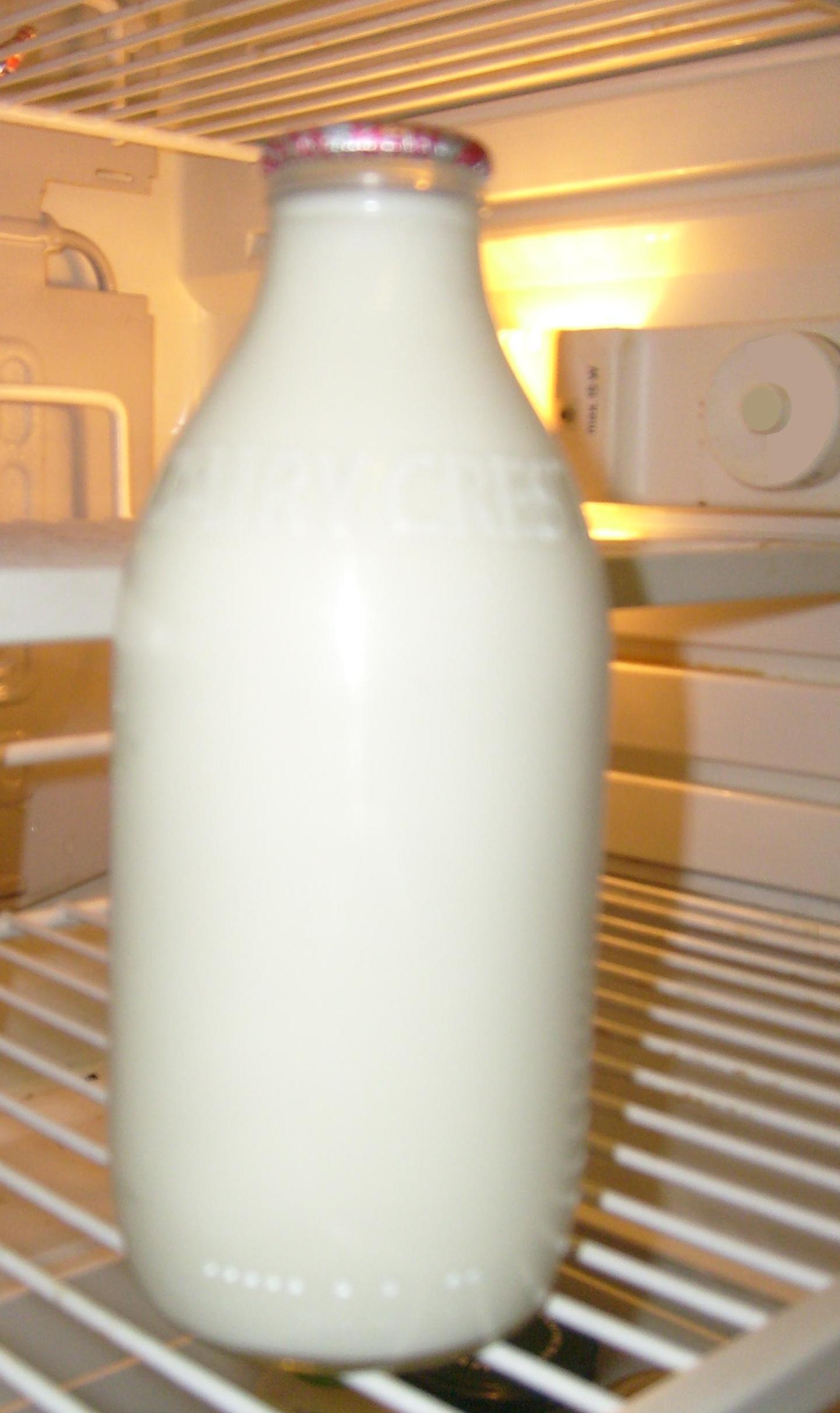
Our second sample was slightly pinky off-white and smelled distinctly caramelised.  It had flavours of coconut, malt and caramel but was also more strongly metallic.  The mouthfeel was most definitely drying, more so than our control sample.  It was more viscous in the mouth as well.  This, we discovered was UHT.  The caramel flavours coming about because the milk is heated to 135C in which process the milk sugars, not surprisingly, cook.
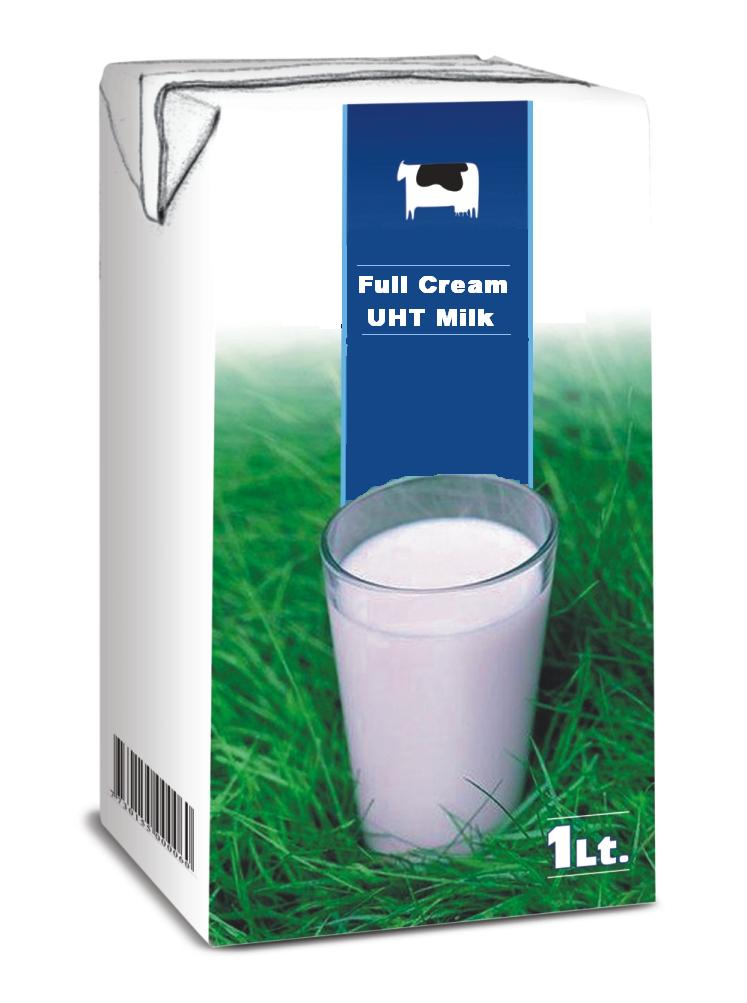
Uht_Milk

Our third sample again was off white and smelled slightly of caramel.  It tasted rather odd, distinctly of vanilla and sugar and at the same time, watery.  The feeling in the mouth was powdery and drying and the body was most definitely weak.  Turns out it was rice milk – vanilla is added as a flavouring to make it palatable.
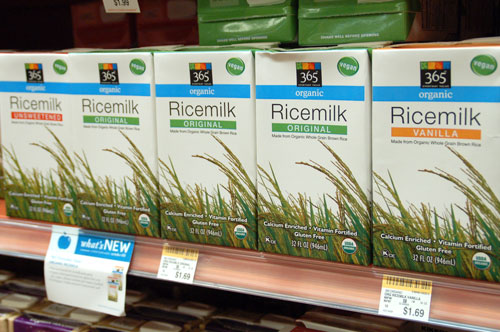
ricemilk

Sample number four was pure white and glossy, almost reflective.  It smelled yeasty and had a very distinctive taste: slightly salty, caramel, coconut and most definitely GOAT.  The mouthfeel was not drying – it was quite neutral – however the caramel was an indication it might be being pasteurised at too high a temperature.  This often happens with all animal milks we consume ‘just to be on the safe side’.

goat-milk

Sample five was cream in colour and smelled buttery.  It tasted very sugary, mineral and nutty.  It produced a definite drying sensation but was quite creamy.  This was soya milk which I normally find very difficult to actually swallow so it was a pleasant surprise – well as pleasant as soya milk can be which, frankly, isn’t very.
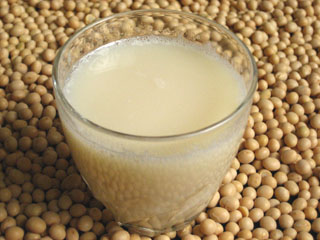
Soya Milk

Finally we came to sample six.  It had a creamy white colour, barely any odour at all and tasted mineral, salty and slightly sour.  The sensation in the mouth afterwards was most definitely drying.  Jayne ‘fessed up.  This was milk with dilute hypochlorite solution in it.  That is, milk with bleach.  You may be wondering at this moment if it’s safe to drink milk with hypochlorite in it.  In fact it is.  Hypochlorite and bleach work by blasting open the cell walls of the organic matter they come into contact with.  In that process the solution however breaks down into its individual components which are salt, water and chlorine gas.  The gas escapes of course so all that is left is water and salt.  The milk therefore was completely safe and largely unaffected in flavour.  I described it as being a little more salty than our control sample but not everyone did.

hypo

Just as we were about to ask Jayne, ‘If that’s the case with hypochlorite, how come you can end up with food that tastes a bit like bleach?’ she went on to say:

‘So hypochlorite in itself doesn’t taint, but you know sometimes when you make tea with chlorinated water, you get a bleach taste?  That is a reaction with the phenols in the tea.’

We’ve all, in our years of cheese tasting, encountered cheeses that tasted a bit chloriney.  This would likely be the same issue.  As the milk is broken down by its starters it releases phenols and flavour compounds.  Some of these can react with hypochlorite.

With our milk tasting over and a lot of information imparted, we had a go at ironing cheese and then stood up to help ourselves to lunch – a particularly tasty macaroni cheese Julie had hand crafted which was made all the more flirty by the addition of crispy bits of bacon and artichoke hearts.  Returning after lunch, we settled down to the serious work of grading sample of cheese brought by our fellow course attendees.  I didn’t get round all of them, but I happily made objective and descriptive notes on: St Jude (of course), Paul’s Little Anne & Dorothy, Jonny’s Baron Bigod (incredibly edible – in large amounts), David’s St Oswald (which I could also eat a lot of with alarming ease), Old Winchester, a lovely Gouda-esque cheese from Lyburn, David Holton’s experimental John Littlejohn and Innes Log.  Perhaps inevitably, however, given the quality of cheese on offer, assessments became less objective and more subjective.  We may have been writing descriptively but it was hard to stop the exclamations of ‘Wow that’s amazing!’ that seemed to crop up with every new cheese tasted.

Maybe, at heart, we’re all salesmen.

We live, We learn … About Lactics

Image
The herd supplying Neal’s Yard Creamery (also a herd with some Montbeliard influence) lining up to be milked.

As prospective cheesemakers working with a milk supplier usually do, Rose and I have been sending off milk samples for microbiological testing for some months now.  While we’ve had generally good results regarding absence of pathogens, I was taken aback to discover that we also seemed to have an absence of lactic acid bacteria…or certainly we had a lot less then we wanted.

‘Most milk in the UK now is not good for cheese,’ pronounced Ivan Larcher at one of my SAF courses, ‘It is dead milk.’

‘A little damning, surely,’ I thought.

Lactic, if my dictionary is to be believed, means ‘relating to or obtained from milk’. It derives from the latin ‘lactis’ genitive form of the word ‘lac’ or milk.

Doesn’t milk just HAVE lactic acid bacteria in it?

Well, apparently not always and if it does, 1 day in a bulk tank and they are not very happy bugs.

Image
One side of the milking parlour at Merrimoles Farm showing the stalls in which the cows stand, the pipework and the clusters below.
Image
For any of my non cheese industry friends reading this post. First off, well done for making it this far into a pretty cheese-geek technical post and good luck with the rest of it. This, should you be wondering, is a cluster and it goes on the cows udders.

Our milking system is like most in the UK Dairy industry.  It has a series of clusters along parallel milk pipes.  Vacuum pumps pulsate to remove the milk from the cows udders and it is piped out of the parlour, through a filter, then a plate cooler and finally into the bulk tank where it’s held at 4C until the lorry comes from Dairycrest to collect it.   They come every 2 days and collect 4 milkings.

Image
The Bulk Tank.

When we test, we take our samples from the outflow pipe of the bulk tank.  We also send off the milk filter from the last milking which the lab immerse in water and then test the rinsate.  We don’t know anyone else testing the milk filter so when we got our first set of results back and discovered literally millions of bacteria on it, we didn’t know whether this was normal, really bad or even really good.  We certainly knew that millions of the little critters looked pretty alarming on paper.

Our bulk tank milk samples seemed to show a happy grown of Pseudomonas (we don’t want happy Pseudomonas) and a rather less happy growth of Lactic acid bacteria.  The milk filter results seconded this.  In the autumn, we called Ivan back for advice and subsequently did a big clean through using peracetic acid.  Following that we have used a weaker peracetic acid solution for the final rinse of our pipework.

To start off 2014 in the way we intended to continue, with some more testing.  This time, we were hopeful for better results and to be a bit flirty we were going to get Andrew the kindly milker to hand milk a couple of cows for us to see how they compared for lactic acid bacteria.  These cows were a black and white cow that looks more Friesian Holstein in appearance who goes by the name of 266 and a brown and white one that looks more Montbeliard in appearance with the name 258.  266 was docile and calm when milked.  258 was disconcerted not to be in her usual clusters and stamped about a bit. We could identify the test results later because Andrew got less milk from her before asking if he could give up.  The cows that were hand milked were only given a dry wipe to their teats before milking.  Normally when they are milked into the parlour, their teats are given a wash before the pumping starts.  It has reduced the total bacterial counts of the milk right down but rather unfortunately we think it may be washing off our lactic acid bacteria.

The bulk tank contained 3 milkings at this stage.  The fourth was about to take place as we tested and Dairycrest were due that night to collect.   The milk filter was from that morning’s milking.

The samples were posted, results duly came back and we emailed Paul Thomas for advice and guidance in their interpretation.

RESULTS:

Milk:

The bulk tank results were better than we’ve had at other points in the past in terms of Pseudomonas.  Before now we have had counts of 21,000 per ml of milk.  This time we had a count of 170 per ml.  However it did show us some staph aureus too which is less than ideal.  According to our lab (Microtech Wessex) we would hope to see around 80% of the total bacterial count being lactic acid bacteria and unfortunately still on this sample it is considerably less than that.  With a total count of 53,000 total bacteria per ml of milk, this would mean we’d like to see 42,400 of these to be lactic acid bacteria.  According to the test result there are 1,200.

The hand milked samples were very different one from the other.  No 266, the black & white cow’s sample was extremely low in everything.  Almost nothing grew on the lab plates according to the lab.  Its counts are 0 in everything except yeasts.  So it has no coliforms, pseudomonas or staph aureus but unfortunately no lactic acid bacteria either.  I imagine Dairycrest would love it.  For making cheese it isn’t ideal.

No 258, the brown and white cow’s counts however were about spot on what we want.  It had a total count of 8,800 total bacteria which isn’t huge.  However, according to our ideal 80% we would be hoping to see around 7,100 lactic acid bacteria and we have 7,040.  There are 10 yeasts which is good, no Pseudomonas, no Staph aureus.

The two cows results, while interesting and raising a few interesting ideas, thoughts and questions only really give us a snapshot of the milk of 2 animals.  Importantly, though, it does show us that we have got the right balance of lactic to everything else in some of the animals in our herd.  Interestingly, Paul suggested that according to some of the papers he has read, the animals that line up to be milked first, being in general the livelier and healthier animals of the herd, often have lower somatic cell counts (an indicator of health) and as a result often have higher amounts of lactic acid bacteria.  If, as we are planning to do, we take our milk from the animals that are milked first, not only will we be using the pipelines at their cleanest but we will also be getting milk that is better suited to our cheese.  In addition, we will be taking the milk away without it being cooled.  This makes sense from an energy standpoint – why cool it to heat it back up to 38C – but also allows the lactic acid bacteria to compete with the Pseudomonas.  Cooling the milk to 4C and then storing it at that temperature for 36 hours has stopped the small numbers of lactic acid bacteria growing and reproducing but at those temperatures, the Pseudomonas can still grow.  According to survival models Paul referenced we could probably knock that 1200 per ml down to 120 just due to the storage time at cold temperatures.

Milk Filter:

The Milk filter results have always looked rather alarming to us in terms of Pseudomonas.  But corresponding with Paul Thomas meant he helped us by analysing the results so that we can compare them more easily against our milk results.

The relevant results are (per filter):

  • 1,500,000 Pseudomonas
  • 10,000,000 Enterobacteriaciae

So – big numbers.  But, as Paul said, we have to interpret them based on the amount of milk that has gone through that filter.  The most recent milk report I have from the farm dates back to December but if levels are similar to those in December’s monthly report, we are looking at 120,530 litres of milk for the month.  This means a daily total of 3,888 litres.  Each milking there’s a new milk filter so while I expect there’s a difference in quantity between morning and evening, for the sake of mathematical ease, let’s say half of that quantity is applicable to our filter tests: 1944 litres.  1944 litres works out at 1,944,000 ml which has gone through the filter.

Assuming the filter removed 50% of our bacteria, this then suggests that before filtering the total quantity of milk (all 1,944,000ml of it), it contained:

  • 3,000,000 Pseudomonas.
  • 20,000,000 Enterobacteriaciae

So per ml of milk we have

  • 1.5 Pseudomonas and
  • 10 Enterobacteriaciae.

Which makes it all look rather a lot better.

Even if we assume the filter only removed 10% of our bacteria, this still suggests that the levels in the milk weren’t huge.  If that were the case, we’d be assuming pre filtration numbers of:

  • 15,000,000 Pseudomonas
  • 100,000,000 Enterobacteriaciae

So per ml of milk we have

  • 7.7 Pseudomonas
  • 51.2 Enterobacteriaciae

However this doesn’t take into account the fact that the filter had been in the parlour during the day and we didn’t have fully frozen ice packs in our insulated box.  The sample was 10C when it was tested and apparently we can knock at least a couple of zeros off our total counts on the filter based on the time it had rested at that temperature since milking and whilst being posted to the lab. All of a sudden, this makes our Pseudomonas and Enteros presence not alarming at all.

THOUGHTS, CONCLUSIONS:

Pseudomonas:

The reason the bulk milk samples have been high in Pseudomonas in the past is that they are able to grown at 4C whereas lactic acid bacteria aren’t.  If there aren’t that many lactic acid bacteria in the milk in the first place and even on our brown and white cow friend 258, there weren’t huge numbers then the bulk tank is the worst conditions for them to grow and the best conditions for something that is happier at cold temperatures to get a head start.  Lactic acid bacteria like a range of temperature around body temperature basically but can grow from 20C – 50C.  So the bulk tank is giving an advantage to the wrong bacteria for cheesemaking.  In other words it is entirely worth it to arrange for the pipework we are planning and have our cheesemaking milk taken off before it goes through the plate cooler, and not just because of the energy use considerations.

There is still the cluster wash and some of the pipework which remains a concern as it will reduce lactic acid bacteria and potentially if there is doubt about the cleanliness of the water, will add in pseudomonas and possibly listeria.  In order to investigate this, we need to do a further milk test or water test.  I don’t know if it’s at all possible for the cluster wash to be switched off ever?  I am imagining not but it’s worth asking.  For the cheesemaking, it’s all about balancing the lactic acid bacteria against the pathogens and spoilage bacteria and the better we preserve the lactic acid ones the less we worry about the others.

Staph aureus:

The test results on this occasion aren’t hugely helpful but they basically indicate that they are present in the bulk tank and passing through the milk filter.  Evidently they aren’t present on every cow as there were none on either hand milked cow.

Paul Thomas’s theory based on some studies he has read (but I’d have to ask him if you wanted to know which ones) is that the animals that line up to be milked first tend to be the more vigorous, healthier ones which will be less likely to have Staph. aureus infections even at a subclinical level.  The less healthy ones will lag behind.

This suggests that our idea of taking the first bit of milk that goes through the milkline is probably a good one from the point of view of getting milk that is better suited to our cheesemaking.  Interestingly the animals with lower somatic cell counts (according to Paul), also tend to be the ones with higher counts of lactic acid bacteria as well.  Again, I’d have to push him for which papers supported that theory but it seems to indicate again that we will get more suitable milk for the cheese if we take the first lot of milk rather than from later in the milking.  Which means I will be getting up bright and early to collect.

A possible thing we could investigate as well is to look into the mastitis records to see if there are any patterns.  Paul (again) has had previous experience where with his milk supplier’s animals each cow that developed mastitis got it on the same quarter for a whole 2 week period.  It turned out that there was a contaminated rubber on one of the clusters.

Lactic Acid Bacteria:

The hand milk results do show that on individual animals we have pretty much perfect milk provided we can then manage the process so that we can get hold of that.

There’s no scientific basis for this that I know of but it’s a commonly held opinion that Friesian Holsteins are not as good producers of lactic acid bacteria and other breeds like Montbeliard are better.  Interestingly our results showed the perfect milk from a brown and white cow that Andrew felt would have more influence of Montbeliard in her genetics.  I don’t know how true that is however and it’s something to try and find out more about.

By taking milk from the livelier, healthier first milkers and keeping that milk warm we’ll give the growth advantage to the lactic acid bacteria as well as the other organisms.  Conventional wisdom sounds a loud klaxon at this point and shouts

‘What about growth of pathogens??? Re-frigerate!! Re-frigerate!’

And were it in isolation with no lactic acid bacteria, they’d be right to be cautious.  But by keeping the milk warm we are giving our lactic acid bacteria an even chance to consume that lactose and reproduce.  Then, when we add our starter cultures into the mix as well it should mean that lactic acid bacteria as a proportion of the total bacteria as we start to make cheese, out competes any pathogens or spoilage organisms.

The hand milking results also reassure us that the milk when it hasn’t gone through the cluster wash system does have enough lactic acid bacteria in it to try the experiments of making our own starter cultures from the milk.  This has always been an aim of ours which we thought we would have to postpone for a year or so at best but now seems much more possible.  It is, however, a discussion for another day and will involve a lot of hand milking and some careful selecting of suitable cows.

So, at the end of a rather head-hurting few days of analysing, emailing and thinking very hard, it’s good news.  We can try out making starter – hooray!! Obviously we won’t be using it unless it passes micro testing but for a while it didn’t look like we’d be able to even try.

It’s also a new list of questions to research.  Do the brown and while more Montbeliard looking cows like 258 give us better milk for our cheese?  Do the black and white cows have less lactic acid bacteria?  Does it all relate to their Somatic cell count levels?  Does the cluster wash still remove too many lactic acid bacteria and can there be an alternative?  If we can hand milk cows to make our own starter, does that matter?  And so on and so on.  Then there’s an off the wall ideas that Paul suggested too.  There are some studies in humans indicating that before giving birth, the nipple duct microflora is influenced by apparently deliberate movement of bacteria from the gut to the mammary gland by dendritic cells.  Perhaps this happens in all mammals and may account for the transfer of lactic acid bacteria into the baby’s and calf’s stomach with colostrum?

Who knew milk could be this complicated and this fascinating?  Just as well I never wanted a quiet life.

Building Begins!!!!!!

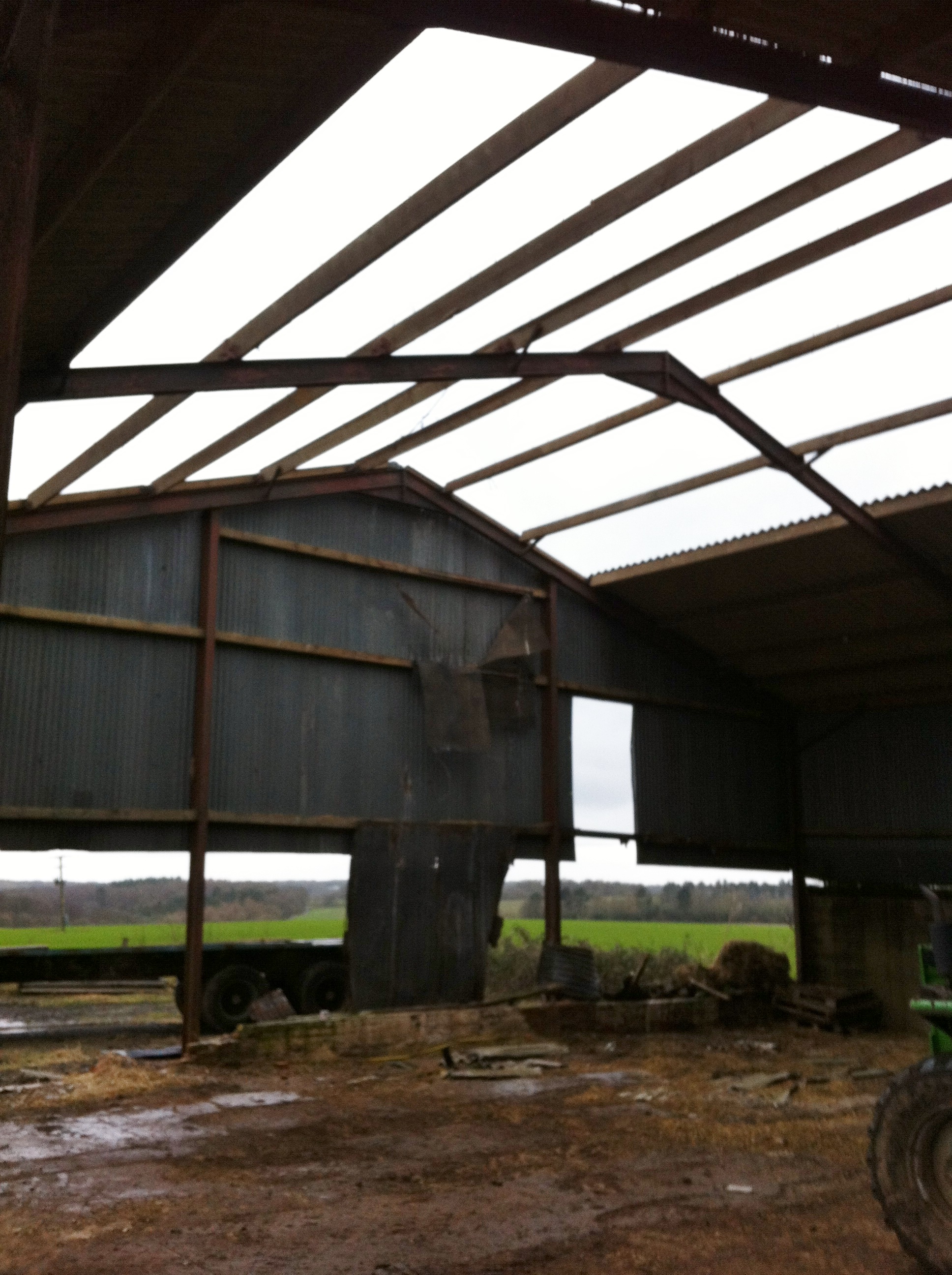
The builders begin by removing sections of the roof which needs to be repaired.  Tuesday 11th February 2014.
The builders begin by removing sections of the roof which needs to be repaired. Tuesday 11th February 2014.

Digging and Delays

Manor Farm old photo
Manor Farm as it used to be. This land is now the house and garden of our neighbours.

It takes the working world a while to get going again after its Christmas break.  Having felt like we were making progress on the build just before Christmas, January proved to be a very slow month of chasing up people who had said they would do something to see if they had done what they said they would.

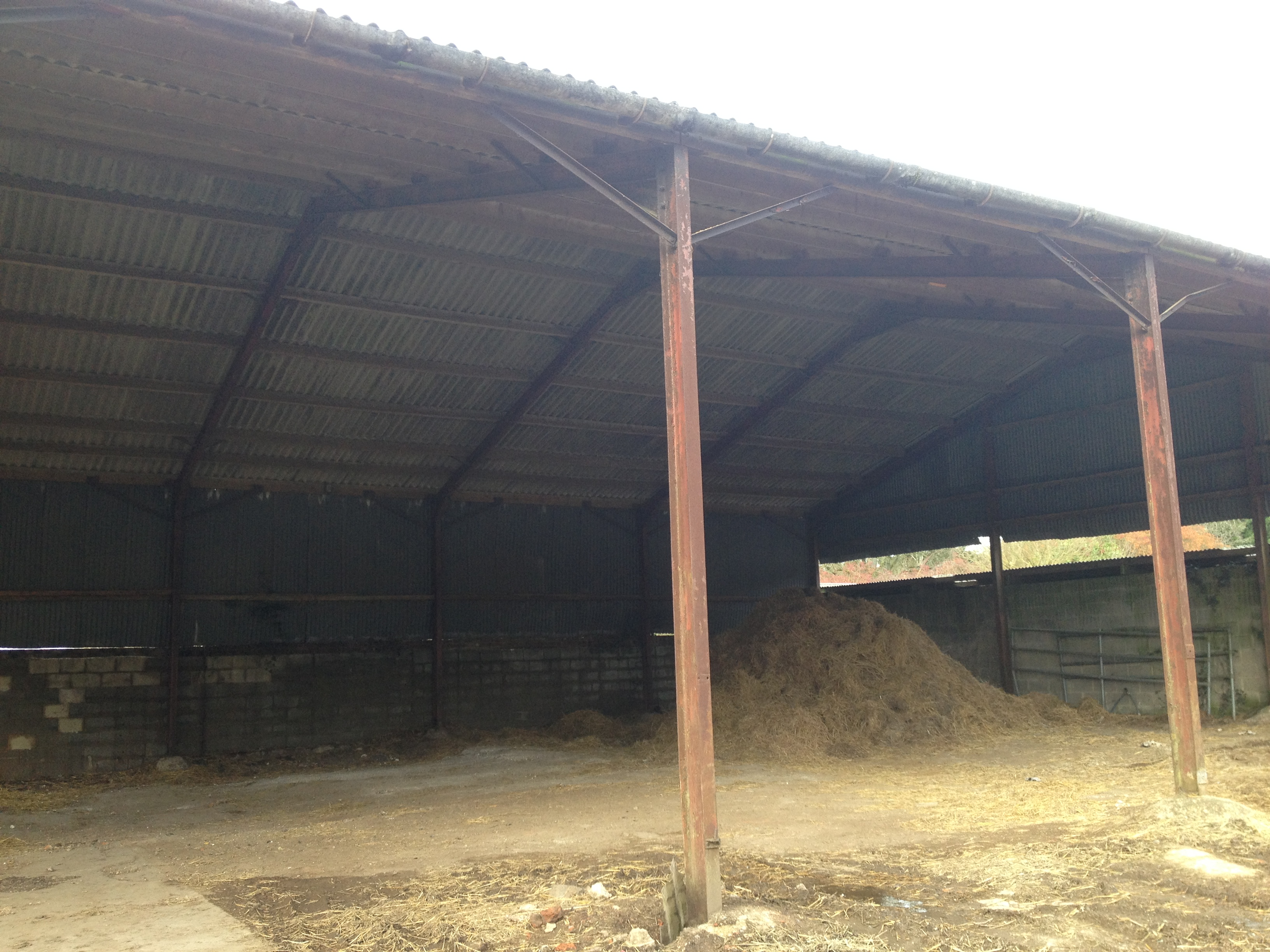
Our first delay was waiting for straw to be moved from inside our barn which we thought needed to happen before any assessment of the existing structure could take place.  As it was slow going, Rose tried to organise a site meeting and a digger to look at the foundations of the steel framework holding up the roof around the straw and did manage to find out a few basics.  The aim, having agreed on an interior layout was to check how stable the existing barn structure was and what would need repairing.  A cherry picker ensured that she was able to assess the existing roof and that it would need repairing extensively – in other words a new roof.   The digger revealed that the concrete bases to our steel stanchions were a bit hit and miss.  Some of them were in place and working fine but others had eroded away and as a result water had accumulated at the base of the steel, weakening the structure.  More repairs would be necessary.

Rose also held talks with our neighbours with whom we share a party wall and who are also installing a wood chip boiler that we are going to be able to use for our hot water and heating requirements.  Negotiations over the wall and any ramifications from our building were carried out amicably and they were able to show Rose a picture of how Manor Farm had looked in the early 1900s when it had been a working dairy farm (above – the photo shows what is now their house and garden and our dairy will run to the south of that).  Building a cheesemaking dairy on the site of a dairy farm feels very appropriate somehow.

When the straw was finally removed and the site boundaries marked with metal gates, further information could be gleaned.  The concrete floor was revealed showing sections with a herringbone pattern which we believe is the floor of the milking parlour of the original dairy at Manor Farm.  Drains have been discovered.  Although the existing drain onion that they would have fed into isn’t usable any more, it is still handy to know there are channels there for us to start from.  A long deceased and dessicated stoat has also been discovered – not a feature we intend to preserve.

Image
Our barn, ready for construction to begin.
Our concrete floor.  The herringbone bits are apparently from the original dairy at Manor Farm.
Our concrete floor. The herringbone bits are apparently from the original dairy at Manor Farm.

A local structural engineer undertook to take on our structural drawings so that the builder who will be carrying out our external cladding and roof repairs could get going.  He seemed to move rather slowly getting a quote out for the work.  Unfortunately after a further fortnight of chasing and reminding, he admitted to being swamped with other work and had to give up.  Alan Tucket to the rescue (the builder) as he has a structural team who have taken that over.  As a result, work should start very soon.

In short, a funny period of meetings and activity for Rose and not so much for me.  A lot of chasing, hassling, reminding and getting bits and pieces ready so that the build can start.  Progress is being made.  We are getting closer to the day that building begins but as yet the earth hasn’t moved (quite literally).  It’s a bit like that stage before you go on holiday where you’re doing the packing and trying to remember everything you might need; a little nerve wracking and tense as you hope you’ve planned everything as well as possible and still too early to have set off and be able to say to yourself

‘Sod it, if I haven’t thought of it by now, I’ll just have to deal with it when it happens.’

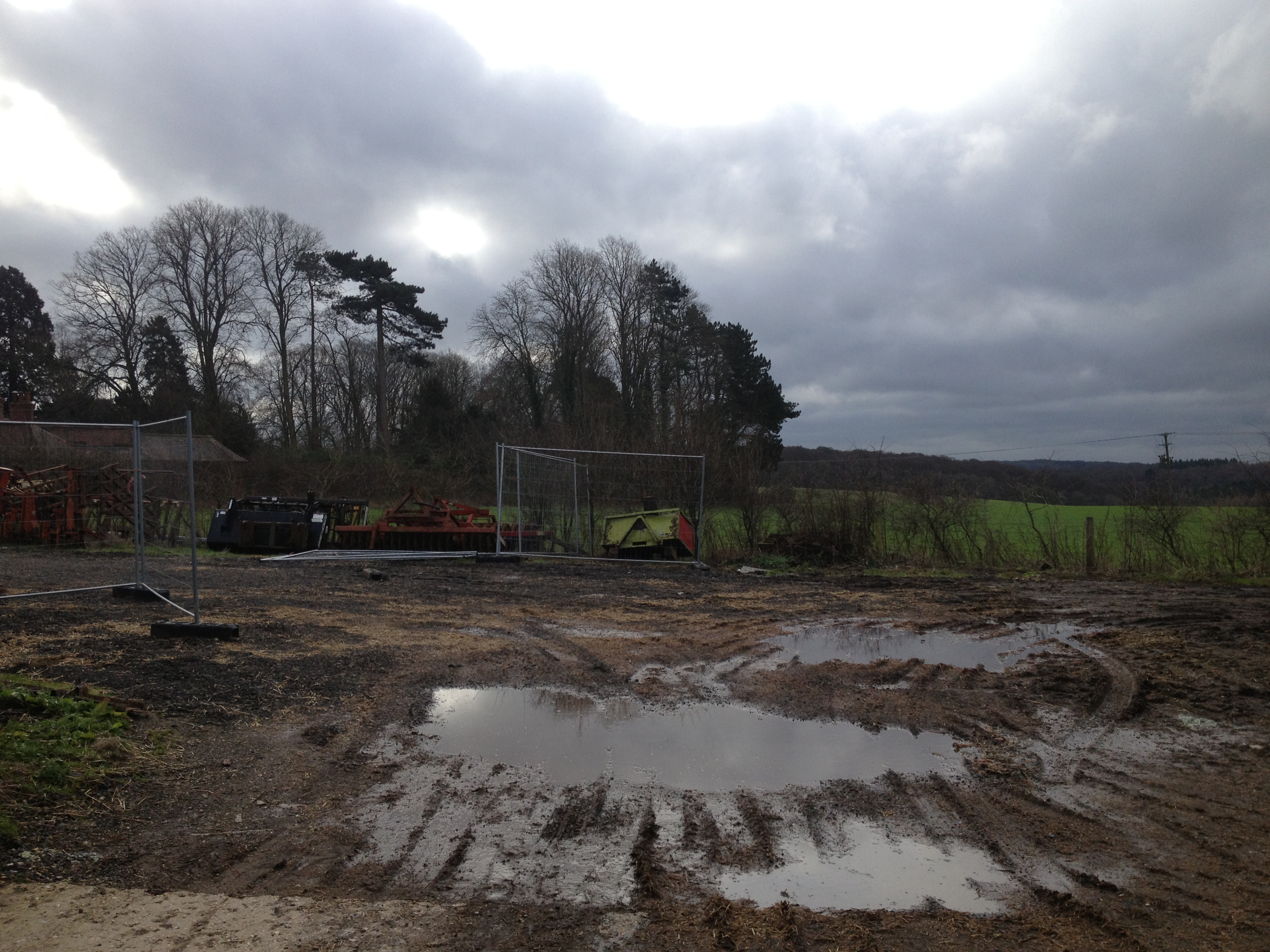
Looking west from our barn - note the metal barriers that indicate the site boundaries.  This is our land!
Looking west from our barn – note the metal barriers that indicate the site boundaries. This is our land!

The Naming of the Cheese

Trial cheeses - the prototype (sort of)
Trial cheeses – the prototype (sort of)

It may be Christmas and I may be having a well earned break after a frantic couple of weeks of the Mons mongering but time and cheese wait for no woman.

When Rose and I made our decision to change our plans from making a lactic cheese to a washed rind, we knew we needed to name our cheese.  The lactic cheese had had a name but it was one that suited a little cheese.  We needed something with more heft.

However that was probably the least important bit of the process for then.  Building the dairy seemed to be a rather more pressing matter.  We put the matter of the name onto a back burner, every so often looking up local names on the map and considering them and then dismissing them.  Should the name be something that carried echoes of Rose’s grandfather, Jo Grimond, who apparently returned from fighting in second world war France, carrying a huge Brie de Meaux?  Should it be something local to our dairy, as the name for our lactic cheese would have been?  We felt that time would probably answer these questions for us.

And so it has proved.  In response to my ‘Happy Christmas’ text to Rose, I received this interesting message in return:

‘Hope you’ve had a wonderful day.  All good here.  Eaten a lot of Hafod over the last few days.  Was in church this morning and thought as I looked upon the donation envelope that the name of the church, next door to our facility, would work quite well for a cheese.  What do you think?  St Bartholomew’s.’

St Bartholomew’s.  St Bartholomew’s.  I tried it out in my mind and out loud a couple of times and I like the way it sounds.

It’s extremely local, the church is going to be our next door neighbour, and on quickly googling St Bartholomew himself, I discover that he is the patron saint of Florentine cheese.  Wikipedia and the internet at large differs in opinion as to whether he is the patron saint of Florentine cheesemakers or cheese merchants but quite possibly the merchants were in fact also the makers.  In any case the details are less important than the fact he’s (one of) the patron saint(s) of cheese!

It seems like a most auspicious omen.  Bring on 2014!

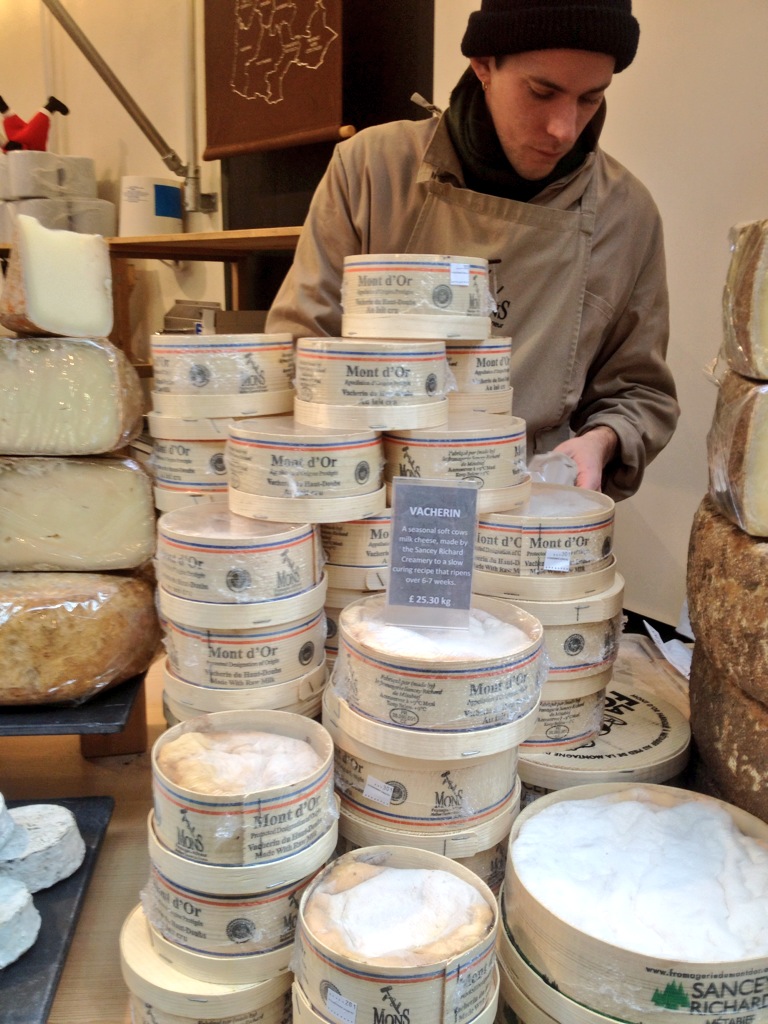
Vacherin, Sancey Richard

V500.1

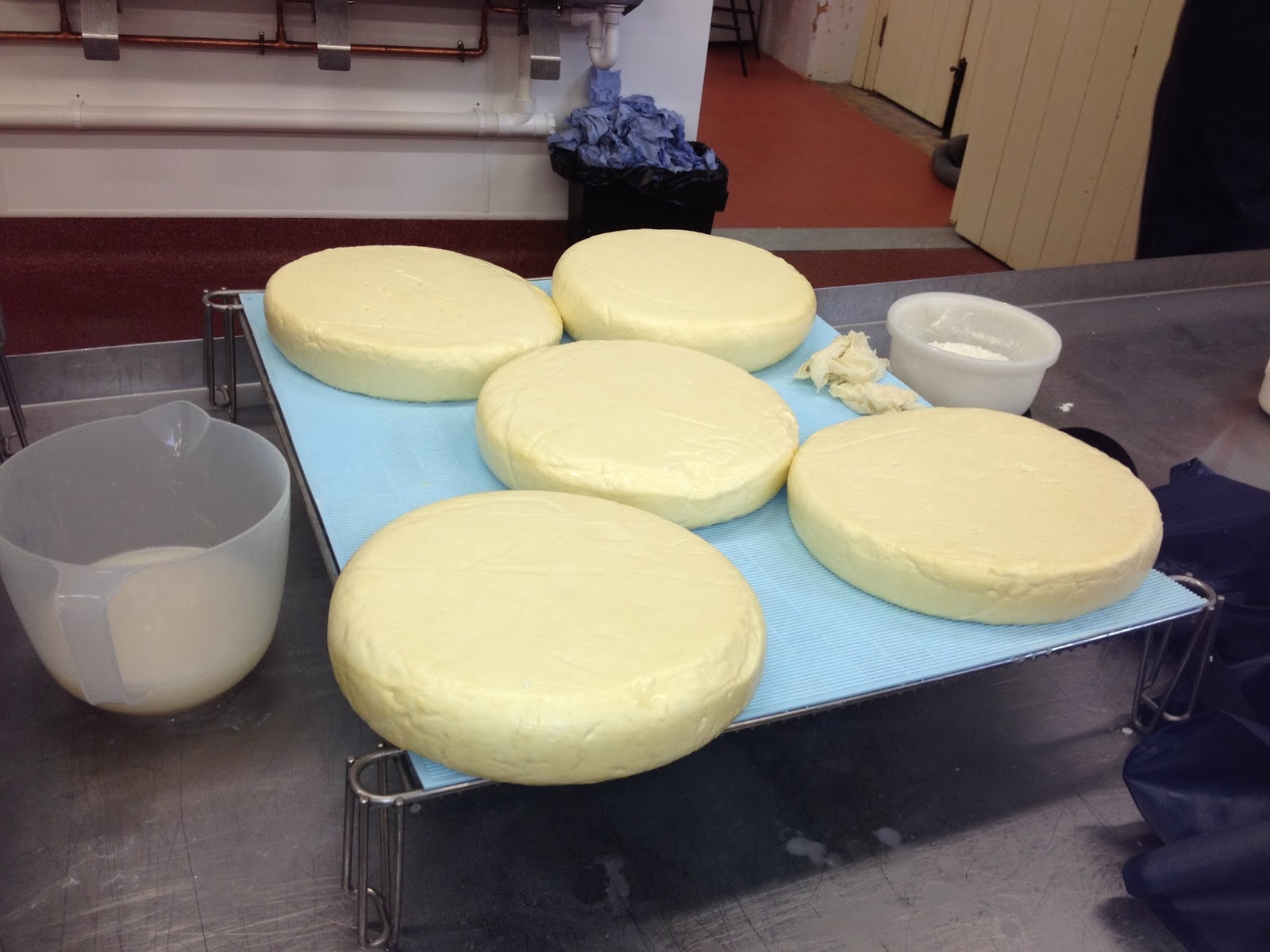
(Vacherin production at Sancey Richard)

If you’re selling British cheese, then Christmas is all about Stilton.  Even with the advent of Stichelton, Colston Bassett is still a major player on the Neal’s Yard Dairy counter and at Mons, we get several customers per day asking for Stilton and needing to be directed to the Neal’s Yard Borough Shop, which we happily do.  Many people ask if Neal’s Yard Dairy is competition, but to be honest that’s not the attitude.  Neal’s Yard Dairy will happily direct French cheese lovers in our direction so we will happily return the favour.  It goes beyond that too, we all want to promote small cheesemakers who are making artisanal, traditional cheeses.  We’re a team.  Nationality isn’t all that important.

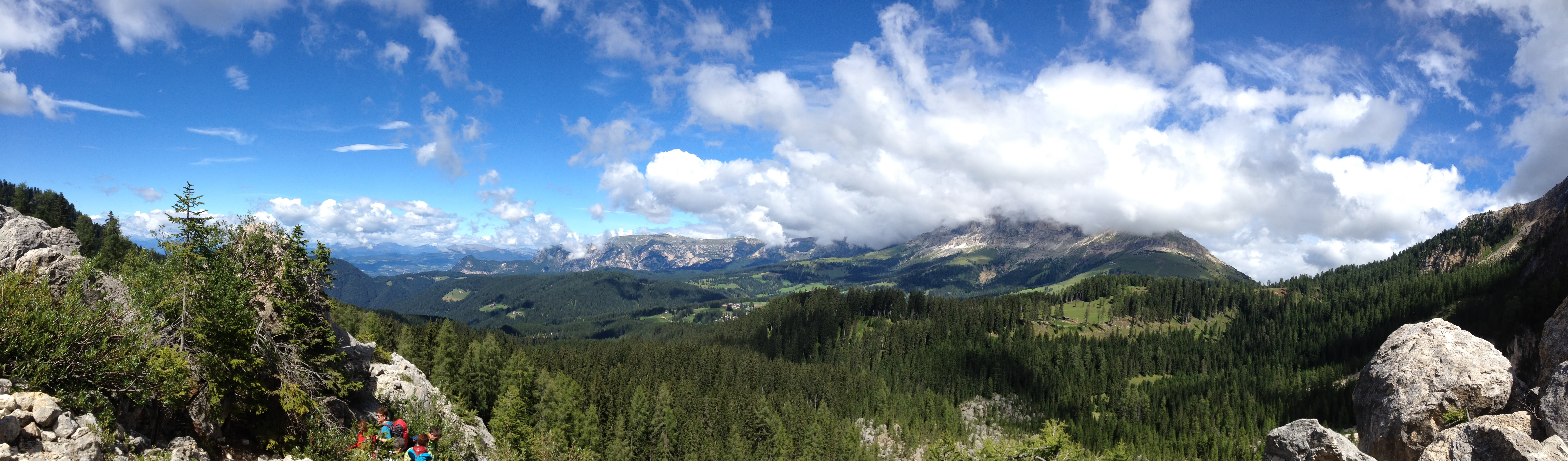
However, I digress from my main point, which is, that if you’re selling French cheese at Christmas, it’s all about the Vacherin.  Most cheeses adhere to the usual seasonal pattern of when the cows / goats / sheep go out to grass and production happens over the summer.  This is particularly evident in the mountain cheeses where the summer season is so short and the difference between grazing the amazingly varied pasture of the alpine meadows versus the hay of the winter housing is so pronounced.  Vacherin is very different in that case because its season begins as the animals go indoors.  To an English person this smacks of winter.  Cows here went in to their indoor housing fairly recently because the weather has been quite mild so far this winter.  I was at Nettlebed at the end of October and the cows were still outdoors on pasture, although it was recognised that this was due to the mild weather.  Meanwhile in the Alps, it has been snowing at pasture level since September.  This summer, I spent some time in Vigo di Fassa in the Dolomites and while there, I set the app on my phone to monitor the weather.  It’s a ski resort so it’s available.  While there, I realised it’s at the right altitude to be interesting from a cheese point of view as well and indeed I saw plenty of very happy looking cows there grazing away while I was on my walking holiday.  I kept the app monitoring Vigo di Fassa’s weather, long after the end of my walking holiday,  just for interest and I noticed that fairly early on in September it started snowing and temperatures plummeted into the minus degrees.  The cows they have there, whose milk contributes to Cuor di Fassa and Puzzone di Moena (amongst others), were most definitely indoors at this point.  I can’t really imagine that over the border in the mountain areas of France things were hugely different.

Some people romanticise the milk that goes into Vacherin production, claiming that it’s the richest milk that is produced when the cows go in to their winter housing and as such is reserved for Vacherin.  I have to be honest and say I think that is not a reflection of their housing but just a lucky coincidence.  In mountain areas, it still makes sense to have seasonal grazing and seasonal calving, meaning that the cows are calving in the late winter and getting to the end of lactation towards August through to October.  The end of lactation milk is always richer in fats and proteins.  It’s probably nature’s way of getting the last bits of nutrition into the calves.  If only we weren’t nicking it to make cheese!  A higher fat milk, however, isn’t great for making Comte which is the summer cheese in Vacherin areas.  To make a long maturing cheese, you don’t really want too much fat as it hinders drainage in the cheese and that ultimately means a moister cheese which can go a bit leftfield when maturing over many months.  It is, however, great for a quick maturing soft cheese.  So the enterprising mountain cheesemakers who, due to the early onset of winter in the mountains, have to house their cows indoors when they still have rich end of lactation milk to give, developed a recipe to showcase this milk and turn it into what we now call a marketing opportunity.

Vacherin is a high moisture cheese.  It is set very quickly and firmly which allows the rennet to trap in the maximum moisture.  The spruce cambium binding actually serves a practical purpose, to stop the cheese from overflowing its rind and spilling out as it matures.  The bonus is that it also adds to the flavour.

Sancey Richard, personified by Patrick Richard the head cheesemaker, make their Vacherin particularly well.  Interestingly they make their cheese using a vegetarian rennet.  I’m sure there are other Vacherin producers using animal rennet which would basically be the more traditional way but vegetarian rennet is often more proteolytic than animal rennet (more prone to protein breakdown) and this causes a more liquid and runny texture.  If you think of the Spanish and Portuguese sheeps milk cheeses that use a thistle rennet and need to be spooned out of their rind, you get the idea.  The choice of rennet has been due to technical reasons, however it does mean that for the vegetarian cheese buyer coming to a French cheese stand, they can buy a Christmas Vacherin!  Commercial bonus.

IMG_0811

(Vacherin on the Mons stand with Max in the background)

Patrick is also apparently a great character.  There is no shortage of these in the cheese world and particularly when you venture into the cheese world of France which while it may have strong traditional standards in its AOC certification also has its fair share of iconoclasts.  However nearly everyone I spoke to on the Mons stand when asking about the Vacherin, remembered fondly the time Patrick was convinced to do a promotion at Selfridges Food Hall.  A couple of hours in and he was autographing the cheeses for his customers and proudly pronouncing

‘Je suis le producteur!’

Vive le Vacherin de Sancey Richard.

News from Nettlebed

Image

Over the summer we received planning permission for our build based on some preliminary plans.  I received the news by text somewhere in the Labirinto in the Dolomites (see above).  It was a rather good setting in which to receive good news and felt appropriately celebratory.

Of course we hadn’t really expected to get the go ahead quite that early and I was in Italy for another 6 weeks so our progress wasn’t as quick as perhaps it could have been all things considered.  We did, by dint of long distance phone calls to Alan Hayes of Capital Refrigeration who had expressed interest in building the interiors, manage to agree a basic interior layout and after a trip to Cheese in Piedmont and a rather informal meeting with Ivan Larcher by the side of the NYD stand, got confirmation that it would be appropriate for the volumes we intend to make and the types of cheese we intend to make.

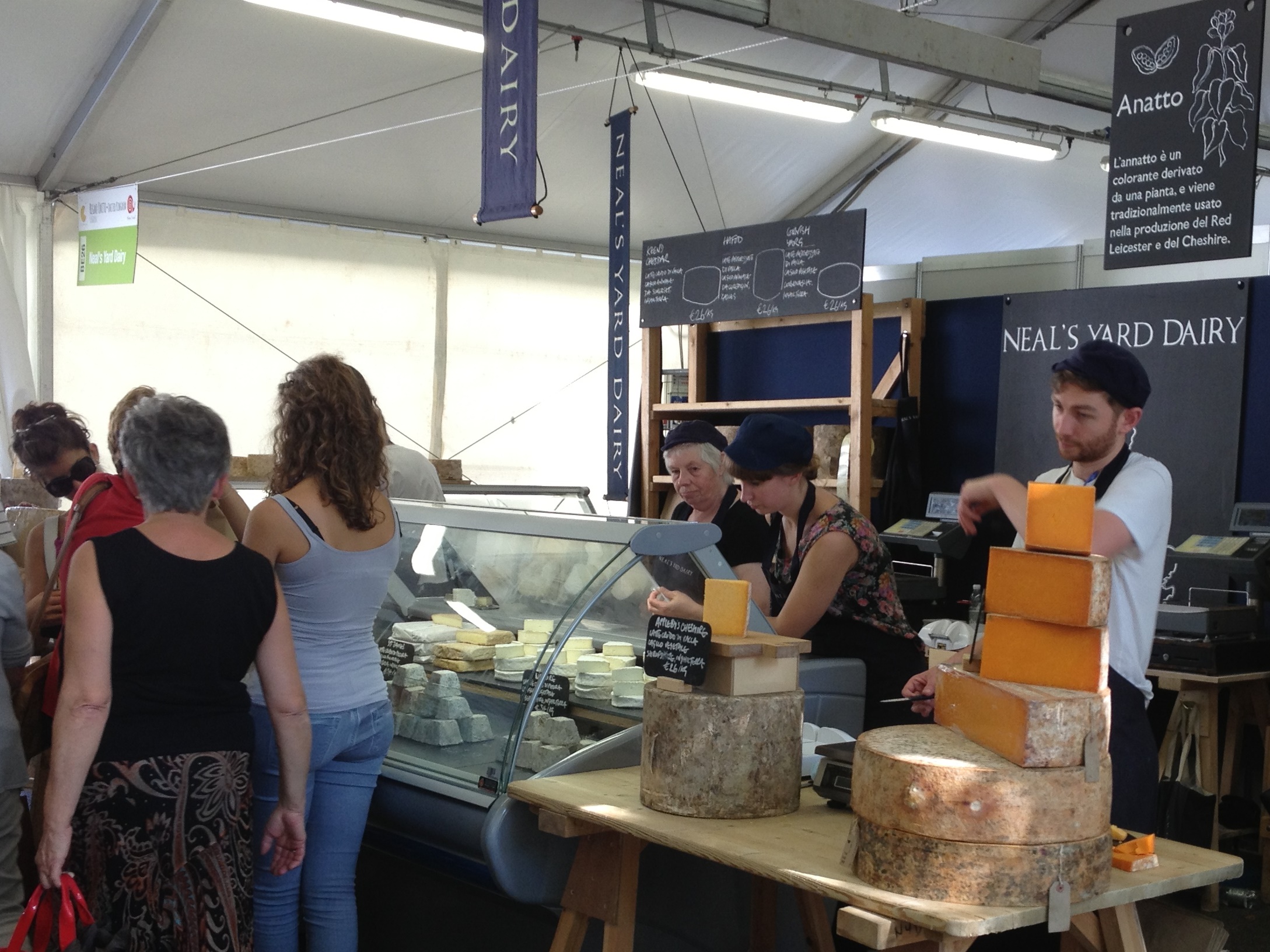
Image(Cutting edge Dairy design happened right next to this scene of cheese retail).

On my return to the UK and having managed to ascertain a date when Ivan would be in the UK, we arranged for him and Alan to meet and go through our final plans, sign off on them more or less and basically agree what we were planning to build in terms of its cost effectiveness and practicality.  We also met our future EHO who is all we could possibly wish for!  She freely admitted that she didn’t have experience of cheese but when Rose initially mentioned plans to make cheese and unpasteurised cheese at that, her employers put her on a course taught by Dr Paul Neaves so that she could learn more.  She was surprised to find that on this course, raw milk in and of itself wasn’t considered a problem and as long as we have good hygienic practices in work and hygiene is made practical and easy to achieve by the design of our building, she will be happy.  I was particularly impressed too that she had researched the Specialist Cheesemakers Association and was aware of current negotiations by the SCA’s Technical Committee to nominate a primary authority in Cornwall.  Primary authorities are a new(ish) idea, I believe, which are particularly useful for big companies with lots of different sites, like Arla or Dairycrest.  They nominate the authority at their head office or main manufacturing plant as their primary authority and this means that each site doesn’t have to deal with a different local authority as interpretations of the regulations is apparently extremely changeable from one borough to the next.  The SCA has used this as a template for themselves as an organisation so that all members of the SCA can deal direct with one authority.  The hope is that this will put an end to the issues individual members have had with one authority being unneccessarily obstructive with raw milk cheese producers due to half knowledge and perceived threats from its unpasteurised nature where one with more experience is a dream to work with and entirely co operative.  From the EHO’s point of view, as we learned when meeting ours, it’s a big relief too because it means that should there be a problem with a new business making a ‘dangerous’ raw milk cheese, the buck doesn’t stop with them.

From those meetings, things continue to move on.  Our barn is full of straw that the current tenant needs to move.  This hasn’t happened yet though I am assured that it will be doing so on either Wednesday or Thursday this week.  Once that happens a structural engineer will go in and assess what strengthening and repairs need to be done to the existing structure which has been up for a few years and may need a little bit of TLC to get it up to scratch for what we need it to do.  After that, accurate costs can be drawn up and following that, work can begin on the exteriors.  And when the walls go up outside, I will start to relax a bit.  Until then it’s weather dependent and we are of course entering winter.  Once the outside walls and roof are done, interior work can carry on regardless of the rain.  If everything runs to time (which we’ve been advised not to expect) we could start cheesemaking on April 8th.  However, as the advice from older and wiser heads is that it won’t run to time, we could hope to be up and running anywhere from May to September.  Another reason at this stage why I’ll relax a bit more when there are some walls there.  It will give a clearer idea of when I need to move house again and when I can get my hands in that curd!

Until then, however, I have Christmas Cheese Mongering to take my mind off things.  The next couple of weeks will see me, swaddled in so many layers of thermal clothing that I look like the Michelin man, behind the counter of the Mons Cheesemongers Borough Market Stall.

Can I switch my allegiance from Neal’s Yard Dairy British Cheese to the French stuff?  You bet I can. It’s in the family now!  Vacherin and Gruyere for Christmas anyone?

Washed Rinds Blowing through my Mind

Somewhere into the Blue Cheese Course at the School of Artisan Food, Rose and I experienced the Neal’s Yard Dairy Dilemma and had to think long and hard over whether we were going to make a washed rind cheese.  As the answer was ‘yes’, it seemed like a rather good idea to sign up for the Washed Rind cheese course that was to be held in July.

The blue cheese course ended.  The first Taleggio experiment was held.  As you all know, it was not an unprecedented success.  The course was going to be very handy indeed.
The blue cheese course had taught me how to measure out DVI starters and combine different types to come up with a good mixture of lactic acid bacteria, yeasts and moulds.  During my experiments however when I had wanted to create my own bulk starter, I’d run into difficulties.   How to draw a parallel between the small wrap of white powders we’d thrown into our blue cheese and a percentage volume of a liquid starter culture.  I emailed Ivan Larcher with a request to cover cheesemaking with bulk starter somewhere on this course and was happy to notice that when I turned up on the morning of the first day, a pan on the side contained several litres of a white liquid which we subsequently added to our make.  Thank you Mr Larcher!  Taleggio experiment no 2 went considerably better as a result.
My fellow students on this course were enthusiastic amateur hoping to go professional Simon Raines and experienced cheesemakers looking to branch out: Carol Peacock from Parlour Made, Jane Bowyer from Cheesemakers ofCanterbury, Callum Clark who had travelled down from Connage Highland Dairynear Inverness for the course and finally from White Lake Cheeses, Pete, fellow cheesemaker to Roger Lakeman who I had met on the blue cheese course.  We settled in for the three days and as usual packed a lot in.
The first cheeses we made on day 1 (Ivan doesn’t teach cheese without making cheese if you recall) were a contrasting pair: a fairly industrial non artisan one Mamirolle which showed us about scalding and curd washing and Brie Noir, which is about as far away in flavour terms from a Mamirolle as it’s possible to get.  Brie Noir was intriguing.  I rather liked making a Brie recipe with its greater acidification.  I am not sure I’d want to mature it on for up to a year as the real Brie Noir but it’s intriguing none the less.

Salting Brie Noir
This accompanied the day of milk chemistry and microbiology which on the third hearing was starting to sink in and actually stay lodged in my brain.  I could see the usual signs of brain fatigue going round the group though as they tried to absorb the golden nuggets of information that Ivan gave them.  Poor Simon in particular, not yet being a cheesemaker like the others or having the benefit of doing Ivan’s course before like me, was looking terrified at times.  Unlike blue cheeses where a degree of acidification is helpful to favour the blue moulds, washed rind cheeses want to control their acidity.  Here we learned about the importance of developing a good coating of yeasts on the rind in order to begin to lower the acidity of the cheese and allow the subsequent coat of Brevibacterium linens to develop.
However the following morning we arrived bright and early to make our next lot of cheeses.  We split into 2 groups for this but as the day progressed there was a lot of crossing from group to group.  I started in the group that was planning to make a Reblochon and a Vacherin style, based loosely around Jasper Hill’s Winnimere.  The other group, using goats milk again brought from White Lake cheeses were going to make a Langres and a goats milk Raclette.

Langres in moulds
Raclette and Reblochons on racks
The Reblochon / Vacherin make needed to acidify very little, hold in a lot of moisture with quite high rennet content and predominantly use thermophilic bacteria in the make as these would stop acidifying soon, allowing the pH to stabilise at the right level so that the cheese develops the creamy, liquid in the case of Vacherin, consistency that is the hallmark of both cheeses.  For me, with my Taleggio interests, this was the group to follow.  While not my exact recipe, this was the sort of cheese I was planning to make.
Raclette of course, allowed us to try a semi hard cheese with more acidification and flavour than day 1’s Mamirolle but still playing with scalding the curd and washing it.  Langres, allowed us to try what was nearly a lactic cheese.  A true lactic cheese would have a set of over 12 hours and our Langres had acidification in the milk of around 5 hours followed by a set of a couple of hours.  We were speeding it along a little because of the time constraints of the course but while Mons Cheesemongers sell a Langres that acidifies overnight, it too is set is a comparatively short time of an hour or so.
As with blue cheese, Ivan explained, washed rind cheeses can come from pretty much any cheese family.  They can be hard (Raclette, Comte), soft with acidification (Langres, Brie Noir) or soft with low acidity (Vacherin, Reblochon).  This basically meant for very interesting three days as we got to try a very varied range of recipes.
Along the way, as is Ivan’s wont, we learned how to fix problems in the make, so that when we encounter them in the real world, we’ll know what to do.  These included looking out for over acidification in the vat and how to correct it, slow vats and the unexpected error on day 1 which was that one of my fellow students who normally make vegetarian rennet cheese, unthinkingly took out the vegetarian rennet to use on our Mamirolle make.  Ivan doesn’t knowingly teach with vegetarian rennet and this had probably not been used in a while.  The curd didn’t set.  We waited and waited, testing for flocculation time after time and to no avail.  Eventually when it looked like we were going to have a vat of acidified milk only, Ivan took a decision to add more.
‘Everyone will tell you that you must never add a second dose of rennet,’ he told us, ‘but if your milk won’t set, what are you going to do?  It may not be good cheese but it’s better than throwing the milk away.’
Luckily with a double dose the cheese set and seemed to follow its recipe pretty well after that.  I’ve tried double renneting in the past and it was a scary moment and produced a very odd grainy set as stirring in the second dose had damaged the beginnings of the set from the first dose.  It wasn’t good cheese, but as the man said, it was better than throwing the milk away.  At least it made it into some form or other.
Two rather exhilarating days of cheesemaking down and we returned for the final the morning to finish up and to learn about rind washing.  Suffice it to say there is a whole lot more to washing rinds than I had encountered before both at Neal’sYard Dairy and at Holker Farm.
At Neal’s Yard Dairy, when we started rind washing as a cheese maturing activity we began by creating a brine solution in a bowl with the washing cloth and pouring on boiling water to ensure everything was sterile.  The solution was then let down with potable cold water or left to cool of its own accord.  We washed young cheeses first and then on to the older cheeses.  After a while, the cheeses seemed too salty so we stopped using a brine solution and used plain water.  After a further while, it became a bit too much of a hassle to boil the kettle due to the amount of time the solution needed to cool and plain cold potable water was used.  I was the QA manager responsible for writing up these procedures and querying them and with that hat on, I wasn’t wholly happy about using cold water from the tap but when challenged, I couldn’t justify my hunch.  It was after all potable water.  If it was ok to drink it must be clean.  Besides we swabbed and tested any cheeses that we rind washed and the results were good.
At Holker Farm we were washing very young cheeses so we took this a stage further and made up a wash solution of Brevibacterium linens in water.  The rationale was that this would establish a culture in the rooms and sooner or later it would be in the atmosphere to the extent that we only really needed to use plain water.  After we encountered a few pseudomonas problems, we started trying a more acidic wash putting a measure of vinegar into the water and by this time not using any culture.  The vinegar did go some way to putting off the pseudomonas but didn’t entirely fix the problem.  It doesn’t help if they are in your water supply to begin with and Holker was on borehole water at the time.  The problem was intermittent despite having a UV filter. Since going onto mains water (and keeping the UV filter as belt and braces), their problem has disappeared.  However they still do use a vinegar solution.  It cuts the grease that accumulates in your wash water and with a cheese made from sheeps milk, that, at the end of season, can be over 12% fat, you notice the grease.  I suspect cows milk cheese will be a little different.
Rind washing as taught by Ivan is a different matter.  He doesn’t advocate the use of plain water as this leaches salt from your cheese.  He advocates using a brine solution made up to a specific percentage.  If you have oversalted your cheese, the excess will still leach out but if you haven’t then it will remain in the cheese and you don’t risk undersalting cheese.  He also explained a formula for calculating what to add if you want to wash the cheeses in alcohol.  As far as the hygiene goes, he advocates making up a batch of the appropriate amounts of your brine / alcohol / whatever concoction with boiled water and naturally as cleanly as possible, then storing it in a sterilised and lidded container in your cold room and decanting a small amount at a time to use on the cheeses.  Naturally your equipment (brushes or cloths and bowls) will be sterilised before use too and preferably with steam or boiling water.

Winnimeres & Bries Noirs being washed
Returning however to the concept of rind washing with an alcohol solution, I had always considered washing cheeses in alcohol to be a bit of an affectation in the past.  My ideas began to change when I started selling cheese with Mons Cheesemongers and tasted some cheeses where the alcohol wash is done very well, for instance on their Tomme de l’Ariege or on their Langres (made by the Schertenleib family near Saulxures in Champagne Ardenne).  This made me think a little more about what the wash added to the flavour of the cheese.  It does also act as an extra bit of food safety due to the preservation qualities of the alcohol but of course you have to be careful that you use the right sort of alcohol and that you don’t use it too strong.  Sweet wines and spirits of course have too much sugar and you run the risk of having strange and unwelcome fermentations on the rind as these sugars provide food for other organisms rather than the nice Brevibacterium linens that you want to encourage.  Too much alcohol and you sterilise the rind and ‘burn’ it.  On the course, we used a dark beer from the Welbeck Brewery (conveniently located just over the cart track from the school) on our Vacherin / Winnimeres and a dilution of whisky on our Brie Noirs.  We were also given the calculation of how much of the given alcohol to use in order not to have the solution over strong.  Actually with something like a dry cider or a beer, we could use it neat although in the interests of salting, we mixed it with brine, but the whisky most definitely needed diluting.

Washing solution close up
 I am not yet sure that washing with alcohol is something for me to do necessarily.  Cheeses like Langres or Tomme de l’Ariege have developed that way because locally they make Marc de Champagne or other wines.  I don’t know well enough what local microbreweries there are in Oxfordshire or if there is an Orkney whisky distillery which would tie in nicely with Rose’s family connections.  Besides the cheese underneath the wash needs to measure up before I think about doing anything flirty with an alcohol wash.  But I am thinking about it; really quite seriously too.

Studying Up on Milk

This year, at Slow Food’s Cheese, I noticed a new development that for once I had time to take advantage of, workshops on milk production.

I’ve been going to Cheese every year since something frightening like 2003 as part of the Neal’s Yard Dairy contingent.  Consequently my time has been spent on retailing, resting, staying up late eating pizza at Da Ugo or in club Macabre (when it still existed) and then necking strong but delicious coffees the following morning.
This time, however, I was here with purely the aim of furthering my cheese education.  Where better to comparative taste Gorgonzolas and Taleggios?  Where better to explore the concept of what a traditional recipe or make actually tasted like in the interests of developing the recipes I’d been trialling at the School of Artisan Food? Where better to learn more about cheese?  To which end, I trawled Slow Food’s website for tastings and discovered the milk workshops.
I’d helped Randolph Hodgson prep some of his own talks at Slow Food workshops in the past which were purely cheese focussed and with an element of pairing wine / beer etc and cheese.  I’d found them interesting but not hugely technical (not a reflection, I should explain, on what Randolph talked about – he was easily the most technical person there, it’s the other speakers who were a bit more pedestrian).  The milk workshops held in the piazza XX Settembre were more technical sounding, geared towards cheesemakers and milk producers and while there were some things that I didn’t feel the need to attend (a talk on adulteration of food and labelling regulations didn’t thrill me), there were some that were most definitely relevant.
The topics I thought it was a good idea to get clued up on were: animal welfare, the importance of pasture, milk quality that goes beyond simply whether it is raw or pasteurised, sustainable agriculture and the role of fermentation.

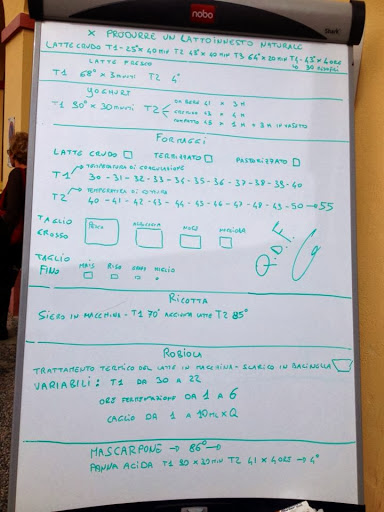
A white board displayed around town with loads of technically useful cheese facts and recipes on.  Just there for you to copy and to spread the cheesey knowledge.  This sort of generosity of information in the interests of the bigger picture is typical of Cheese.
It lead to a hugely interesting few days and a lot of food for thought and luckily for me, the happier the cows, bees and environment it would appear the happier the cheesemaker.  Let me elaborate:
The talk on animal welfare with speakers from Compassion inWorld Farming started by stating that animal health and human health are linked and animals farmed in a higher welfare manner produce better milk.  There are obvious examples of this:  animals on pasture have less instances of mastitis and cleaner udders than animals that live indoors.  To put it bluntly, in the fields, if they need to defaecate, they just walk away from it and to a nice clean bit of pasture.  In the sheds they can’t do that and although their bedding will be replaced frequently during the day, there’s more than just a chance that they will end up lying down on dirty straw at some point.   However, it goes beyond cleanliness.  The milk from animals that are grazed on pasture has been found to be more healthy with better levels of Omega 3 fatty acids and betacarotene.

The talk on pasture discussed milk composition in more detail, citing EU funded research projects that have demonstrated the effects of each different herb or grass or wild flower variety that the animals graze on the composition of the fats and the number of flavour ethanols in the milk and also its vitamin content.  One speaker, Roberto Rubino from ANFOSC (the Associazione Nazionale di FormaggiSotto Il Cielo), had particularly interesting data to demonstrate the different fatty acid composition between animals eating oats, borage, hawthorn (really), wild geranium and plenty of other plants.  His point was not that there was any one plant that was the cow / goat or sheep superfood but that the bigger variety the better.  Just like humans, a varied diet is better for the animal but we are able to reap the benefits of that through the composition of the milk.  He went on to also explain that the animals’ diet also affects the cholesterol in their milk.
Contrary to the thinking on nutrition that I remember growing up which had us ditching butter in favour of margarine and believing all cholesterol to give us heart attacks, current thinking now considers cholesterol a necessary part of the diet, provided it is not oxidised.  A diet of pasture contains 4 or 5 times as many antioxidants as the diet of animals on a zero grazing indoor farming system.  In other words, they consider that you can drink milk and eat butter and cheese without worrying about heart disease, provided it’s farmed a certain way.
A speaker also from the European Forum on NatureConservation and Pastoralism explained that the value of mountain pasture is precisely that it hasn’t been planted or farmed.  As a result, the plants are far more diverse than they would be even if planted with the most complex herbal seed mix.  They quoted that an intensively farmed and planted field would contain 2 or 3 different species whereas you’d expect to find 50 to 100 species in natural grasslands. They even explained that animals left to graze and pick and choose will even eat shrubs and leaves off trees sometimes for a bit of variety (presumably hence the hawthorn research presented by Roberto Rubino).
During the talk on raw milk, a speaker called Tom Baas a biologist from the Research Institute of Organic Agriculture in Germany (FIBL)talked about how research into raw milk in the past 10 to 12 years has shown a change in attitudes to unpasteurised dairy.  Statistical research demonstrated that raw milk could actually assist in children developing a healthy immune system and lower incidences of asthma, allergies and even hayfever.  Some of these points were rather circumstantial evidence, farmers children seem to be healthier than others, however, Basel University has done over 10 studies into the possibilities of raw milk against atopic conditions and other health benefits including that of a fatty acid called CLA (conjugated linoleic acid).  Their studies showed that CLA which is produced by herbivores will be different depending on the animals diet.  When fed to rats, the grass fed CLA did not make the animals put on weight or develop fatty liver while the CLA from animals on a different diet did.  CLA is present in raw and pasteurised milk but the heating process will affect it and at least make it less effective if not actually contributing to weight gain actively.Further to this taste studies had been carried out also assessing the smell, taste, aftertaste, viscosity and visual aspect of 4 different milks, 2 of which were organic (1 actually biodynamic) and 2 intensively farmed.  While the differences were subtle, a distinct difference was found.
The message of all of this?  Raw milk, varied pasture that is left to grow as naturally as possible, grass fed as much as possible will be the healthiest dairy food for you and will also have the best flavour potential for the cheesemaker.  Of course they were speaking in fairly black and white terms and you’ll find conscientious extensive farmers who do feed concentrates and silage who also manage to give their animals a varied diet while not using natural and unplanted grasslands.
Finally we moved to the role of fermentation.  This was an idea I’d first heard proposed at courses that Ivan Larcher teaches.  You have this amazing milk, with wonderfully farmed animals and all those aromatic flavour ethanols waiting to be liberated.  How to make the most of it? Well using a naturally fermented starter.  Just as the natural grassland is more diverse, so is the naturally cultured soured milk from your raw milk.  Most commercial starters will contain possibly 1 or 2 different organisms.  The more complex ones perhaps 4 or 5.  Your own natural culture from your raw milk will have many more and also all the ripening cultures too (yeasts and moulds).  It also renders your product truly a local and unique one.  The speakers gave a brief method for producing your own soured milk starter, something they called ‘latte inesto’ and tasted a range of 4 cheeses chosen to demonstrate that the latte inesto starter produced the more complex flavour.  Again, I’ve done enough tastings to know you choose your cheeses to demonstrate the point you want them to make so while the tasting was dramatic, it was also staged to be so.  The difficulty of naturally occurring bacteria is that you can’t be sure of what will grow, but if you have followed certain guidelines you will maximise your chances of cultivating good starter cultures rather than a big bunch of spoilage bacteria instead.
Most interesting for me, as we research our milk at Nettlebed, was the discussion on where the natural lactic acid bacteria come from.  The research in this case has not been carried out on dairy animals but on humans but it is extrapolated that other mammals will have similar processes.  The baby’s gut is populated with the appropriate bacteria by the colostrum phase but after that is finished, the milk produced is sterile.  Any lactic acid bacteria and other flora that get into the milk from that stage onwards are transferred from the skin of the udders which will be picked up from dust particles on their food and in the pasture, dust particles from the soil (this would be bad news things like E.coli and Listeria) or illness which would be mastitis (Staphylococcus aureus).
Further to that, a cheesemaker asked a question.  He had been making cheese with latte inesto for 20 years but recently in response to demands from the milk dairies he had been trying to reduce his total bacterial counts.  Ever since the counts went down, his latte inesto stopped working.  It wouldn’t sour and when cultured, the only thing that grew was coliforms (gas producing bacteria from the gut – harmless but no help to the cheesemaker).  It appeared that in pre-dipping the animals’ teats before milking, they were removing a healthy population of lactic acid bacteria and although there were very few coliforms present, in the absence of any competition, these became dominant.  By trying to clean up what had been essentially clean milk before, they had created ‘dead milk’.  The advice was to stop pre-dipping and do all they could to ensure lactic acid bacteria got back onto the teats (this can include wiping with hay before milking, making sure the animals are getting hay or natural grass as pasture) to make the milk come alive again.
In summary, what did I learn?  Well to sum it up in one sentence: diversity, diversity, diversity and leave it to nature as much as possible.  Naturally managed grasslands and animals kept as close to their natural state as possible will produce happy animals giving milk that is better both nutritionally and in flavour profile and potential.  Then allow your naturally produced milk to sour with what nature in its bounty has given you and you’ll get cracking good cheese!  In theory anyway….

The Lightbulb Moment

One of the exciting things about working with Merrimoles Farm on the Nettlebed Estate is the potential inherent in their milk.  The herd is a mixture of Friesian Holsteins with Swedish Red and Montbeliard bred into the herd for increased vigour.  Increased vigour is the immediate benefit for the farmers along with better health, less likelihood of lameness and better fertility.  However it isn’t just a benefit to the farmer.   The cheesemaker (that would be me) naturally gets better milk from healthy, happy animals but the breeding with Swedish Red and Montbeliard is exciting because the solids in the milk of both of those breeds lend themselves more to cheesemaking than that of the Friesian Holstein or Holstein itself.  In addition to that, the animals graze on organic pasture and, as a result, spend most of the year happily outside, munching grass, flowers and herbs in the fields, which in theory means that they should have a diverse diet which will lend to aromatic compounds in the milk and the potential for a diverse grouping of lactic acid bacteria derived from the bacteria present on the teats.
I had come into the discussions with Rose and with Merrimoles Farm with a mental ticklist of what I was looking for in a milk supplier, namely, interesting breeds (check), outdoor grazing (check), varied pasture (check), preferably organic or as near to as possible (check).  Part of this is ideological, I don’t want to be involved in an enterprise where there are unhappy animals and where the farming isn’t sustainable and respectful to the environment.  Part is flavour driven.  Interesting breeds, varied pasture and organic management of the herd and pasture should, in theory, translate to the most interesting milk.  In other words, if I can unlock it, there’s a lot of potential for good flavours in our cheese.
‘Our milk is really good’ Rose told me proudly when we first met.
We collected a sample from the bulk tank to drink it fresh and (naturally) unpasteurised.  It tasted lovely.  I agreed with her.  On other occasions that I have drunk it since then, it consistently tastes lovely with a milky sweetness, mineral undertones and a velvety creamy mouthfeel.
‘And we get really great test results too’ she continued, ‘Dairycrest actually say that our counts are really low.  For an organic farm it’s practically unheard of.’
When I first visited the farm, Phil, the farm manager showed me a printout of their milk results which included fats and protein content as well as their routine total bacteria counts.  Having looked over other milk results in the past when I was Quality Assurance Manager at Neal’s Yard Dairy, I too was surprised at how low some of the counts were.  I expressed my surprise to Phil also who confirmed that yes, they were often told how rare it was for an organic farm to hit those levels.  It was something they were all proud of and justifiably so.  For their current customers this is exactly what they need and want.
I was a little more cautious.  Low total counts, seemed to me a good starting point, but more important than that is what that total count breaks down into.  Ideally, of course, that total count is entirely composed of lactic acid bacteria.  Worst case scenario, it’s entirely composed of Listeria monocytogenes or another pathogen.  As we drove away from the farm, I mentioned to Rose that, before we got into cheesemaking, we needed to build up a history of testing the milk in more detail.
‘For raw milk cheese,’ I explained, careful not to cast aspersions on what was evidently, very carefully produced milk, ‘It’s not so much the total counts we’re concerned about, but what’s in there.  So we need to send off some samples for testing and cover all the pathogens: Listeria monocytogenes, Staph. aureus, E.coli O157 and Salmonellae.’
It wasn’t urgent to get started testing straight away and actually we are hardly going to go and find another milk supplier.  Our cheese business is being started to make better use of the Merrimoles milk.  Whatever the results, we were already committed to working with them, so to begin testing nearer our production time made more sense.  I took a bottle of milk away to do a lactofermentation at home.  They took 48 hours to set, tasted yoghurt-like, although a little bitter, and had about one gas bubble.  I would have been happier to find no gas bubbles and to not have tasted the slight bitterness, but I wasn’t too bothered at this stage.
When we did begin our testing in May this year, however, we had a bit of a shock.  The total counts were low, as usual, but the lactic acid bacteria counts as a proportion of that were also a lot lower than we had hoped for.  We thought, especially as we want to culture our own starters, that we would be aiming for 80% of the total count to be lactic bacteria.  We were finding considerably less than that.
This means for our cheesemaking, culturing our own starters is a project for a few years time and won’t be happening initially.  If you make your own starters, the argument goes, you will have a more diverse population of bacteria but, of course, you don’t know what you are getting and they are likely not to acidify as strongly as bought and proven starters.  Just at the moment, we need to use plenty of proven starter to get our milk to acidify.  This is fine, I can work with that and still do my best to use a varied and interesting cocktail of cultures.  What makes me a little nervous though is that not having a naturally strong population of lactic acid bacteria does mean that we don’t have a built in safety mechanism in form of the milk’s natural ability to out compete pathogens.  If something nasty gets in, it can have a little pathogen party, reproducing itself all over the shop.
‘What does this mean for your cheese?’, I hear you ask.
Well as I said, we’ll use bought in starters and in addition we will record our acidity curves with every make.  We will also prepare ourselves for higher testing costs as we will have to test each batch that doesn’t acidify quickly enough and higher wastage for the cheeses whose test results don’t make the grade.  In the longer term, we’ll begin learning a lot about the factors that encourage or discourage lactic acid bacteria, because, in theory, with organic production and grazing outdoors, we should have plenty of them and yet we don’t.  With that in mind, at Slow Food’s Cheese this year, I listened avidly to their workshops on milk production.  But that is a blog-post for another day.
More importantly, all of a sudden, all the arguments in defense of raw milk that I have trotted out obediently, on behalf of Neal’s Yard Dairy to officials and other quality assurance managers, clarified in a moment of epiphany.
If you don’t want to bottle milk and offer your customers long shelf life of what is naturally a short shelf life product, pasteurisation is irrelevant.
It doesn’t make sense for a cheesemaker to seek out milk with low counts or be encouraged to use pasteurised milk which it is perceived as being safer than raw milk.
If the raw milk has a healthy population of natural bacteria, it’s the safer choice.
A lot of what a laboratory scientist may consider to be a risk and that has been worked into HACCP and the food safety risk analysis we all do, suddenly seems misdirected and possibly dangerously so.  Pasteurising doesn’t sterilise.  It doesn’t make milk a perfectly clean slate, there are still some organisms in there or organisms can get in there even if you think you’re doing everything at the very pinnacle of hygiene.  With low counts, it’s key to your cheese quality that your starters work quickly.  If they are slow to start, then they can be out competed and potentially they don’t get the upper hand.  This doesn’t neccessarily happen – you might be lucky but it’s like driving without your seat belt.  It isn’t a given that you’ll have an accident but if you do the consequences are worse.
I now see very clearly, that it’s not a question of absolutes and black and whites.  It’s not that low counts of staph aureus or enteros are automatically good.  It really depends on what they compete against.  Cheesemaking is a question of managing populations and communities of organisms.  It’s so much more complicated, nuanced and subtle than low counts good, high counts bad and it’s not a question of limits and levels but of balances.  This is as necessary for food safety every bit as much as to get the recipe to work.
I thought I understood this when I worked at Neal’s Yard Dairy.  I was only half way there.
Now, I really get it.