Washed Rinds Blowing through my Mind

Somewhere into the Blue Cheese Course at the School of Artisan Food, Rose and I experienced the Neal’s Yard Dairy Dilemma and had to think long and hard over whether we were going to make a washed rind cheese.  As the answer was ‘yes’, it seemed like a rather good idea to sign up for the Washed Rind cheese course that was to be held in July.

The blue cheese course ended.  The first Taleggio experiment was held.  As you all know, it was not an unprecedented success.  The course was going to be very handy indeed.
The blue cheese course had taught me how to measure out DVI starters and combine different types to come up with a good mixture of lactic acid bacteria, yeasts and moulds.  During my experiments however when I had wanted to create my own bulk starter, I’d run into difficulties.   How to draw a parallel between the small wrap of white powders we’d thrown into our blue cheese and a percentage volume of a liquid starter culture.  I emailed Ivan Larcher with a request to cover cheesemaking with bulk starter somewhere on this course and was happy to notice that when I turned up on the morning of the first day, a pan on the side contained several litres of a white liquid which we subsequently added to our make.  Thank you Mr Larcher!  Taleggio experiment no 2 went considerably better as a result.
My fellow students on this course were enthusiastic amateur hoping to go professional Simon Raines and experienced cheesemakers looking to branch out: Carol Peacock from Parlour Made, Jane Bowyer from Cheesemakers ofCanterbury, Callum Clark who had travelled down from Connage Highland Dairynear Inverness for the course and finally from White Lake Cheeses, Pete, fellow cheesemaker to Roger Lakeman who I had met on the blue cheese course.  We settled in for the three days and as usual packed a lot in.
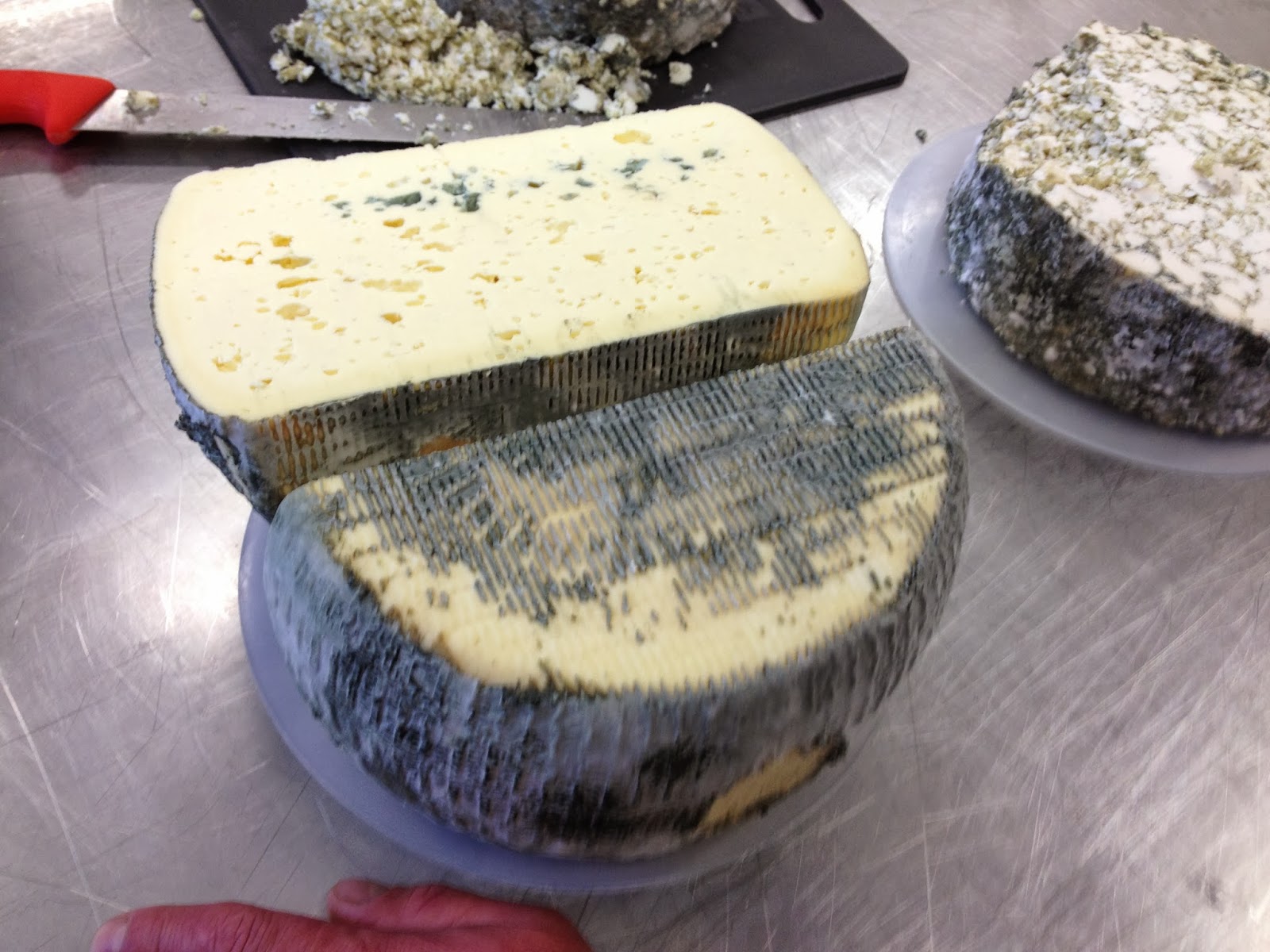
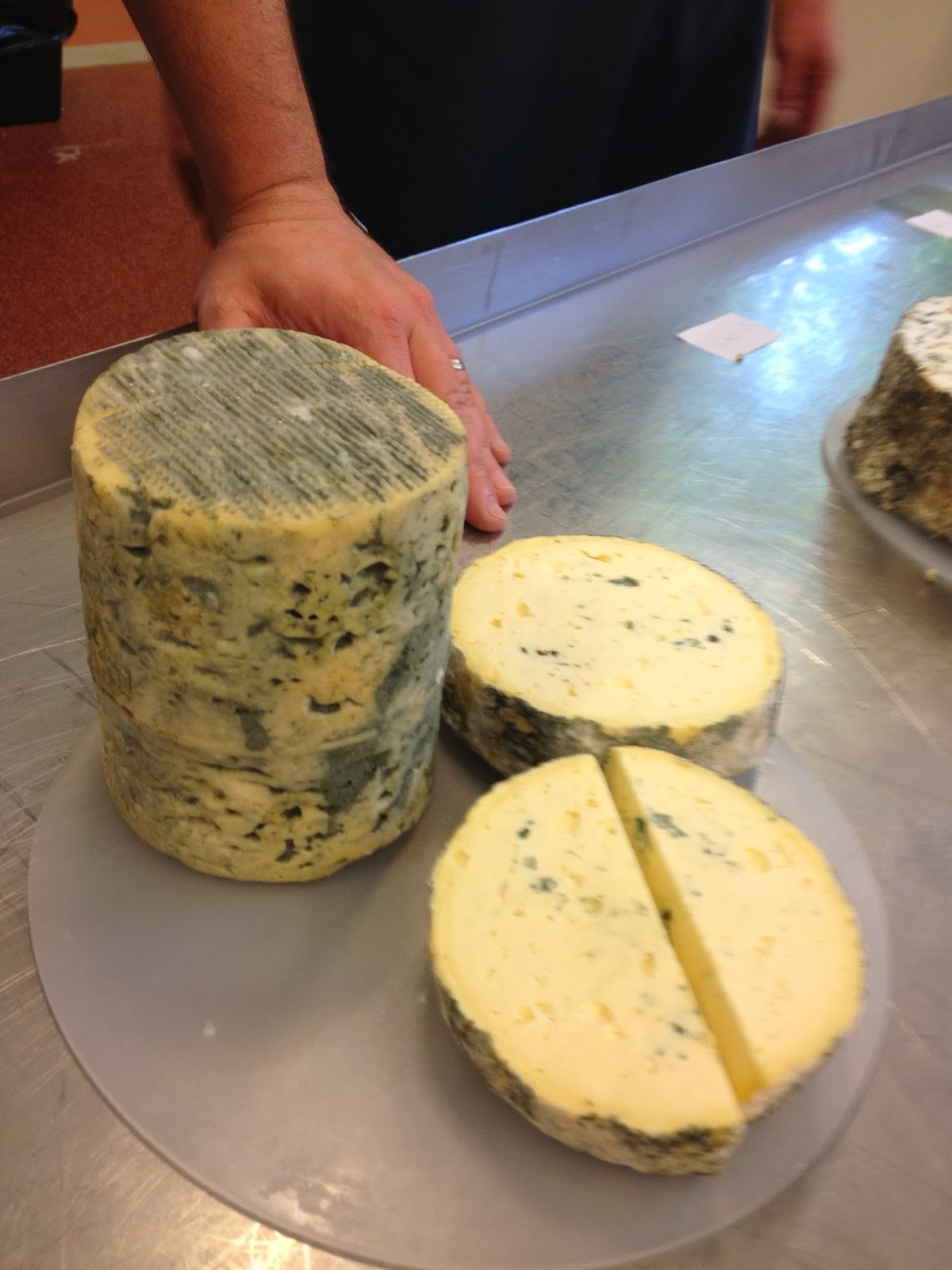
The first cheeses we made on day 1 (Ivan doesn’t teach cheese without making cheese if you recall) were a contrasting pair: a fairly industrial non artisan one Mamirolle which showed us about scalding and curd washing and Brie Noir, which is about as far away in flavour terms from a Mamirolle as it’s possible to get.  Brie Noir was intriguing.  I rather liked making a Brie recipe with its greater acidification.  I am not sure I’d want to mature it on for up to a year as the real Brie Noir but it’s intriguing none the less.
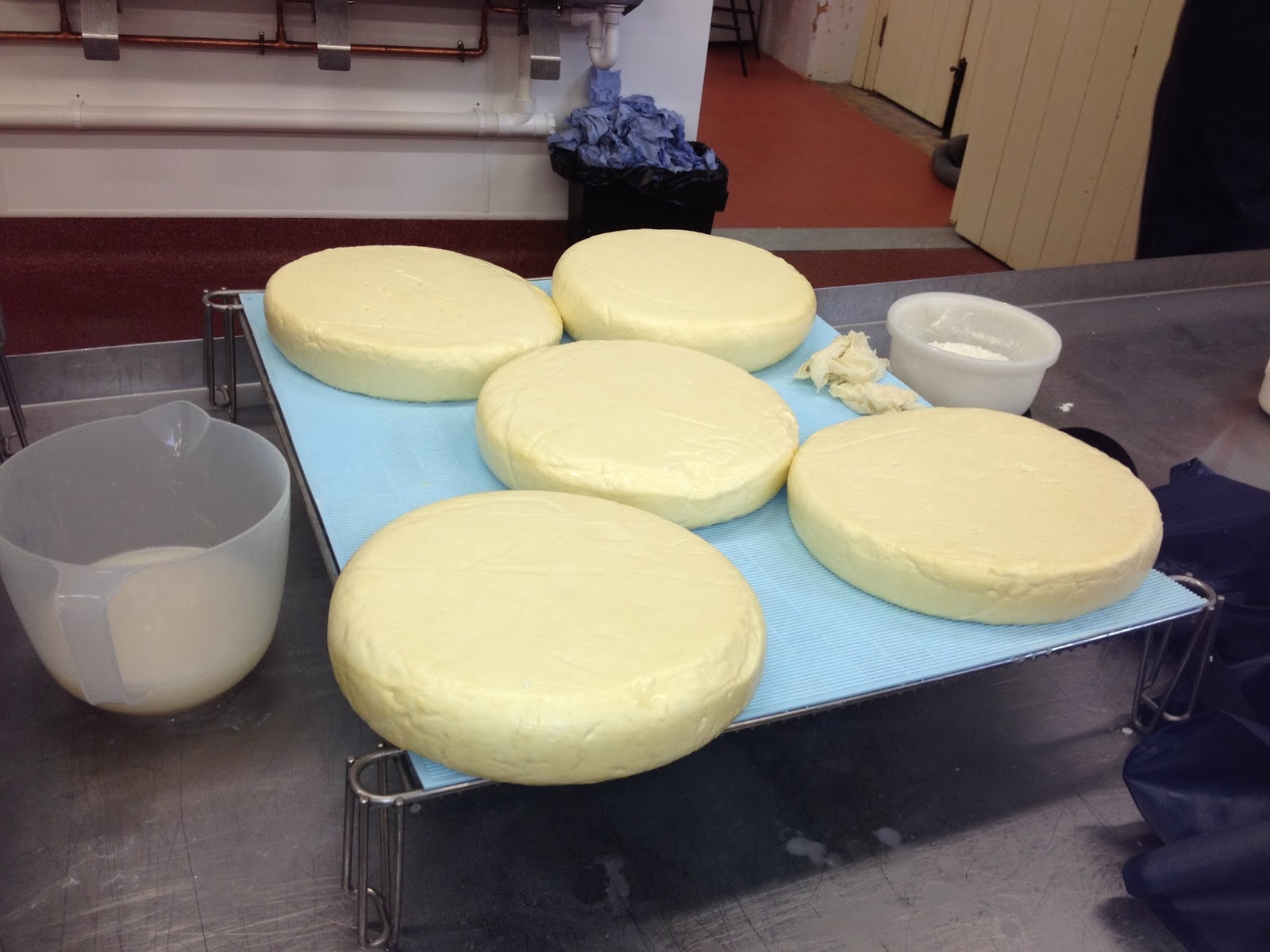
Salting Brie Noir
This accompanied the day of milk chemistry and microbiology which on the third hearing was starting to sink in and actually stay lodged in my brain.  I could see the usual signs of brain fatigue going round the group though as they tried to absorb the golden nuggets of information that Ivan gave them.  Poor Simon in particular, not yet being a cheesemaker like the others or having the benefit of doing Ivan’s course before like me, was looking terrified at times.  Unlike blue cheeses where a degree of acidification is helpful to favour the blue moulds, washed rind cheeses want to control their acidity.  Here we learned about the importance of developing a good coating of yeasts on the rind in order to begin to lower the acidity of the cheese and allow the subsequent coat of Brevibacterium linens to develop.
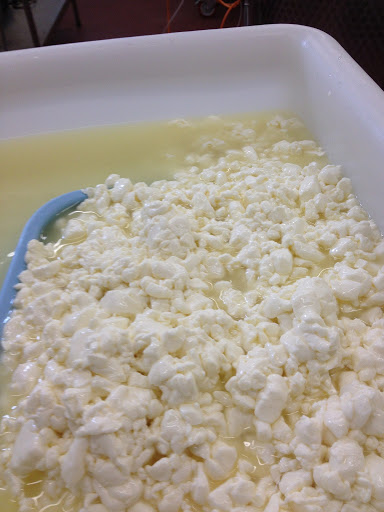
However the following morning we arrived bright and early to make our next lot of cheeses.  We split into 2 groups for this but as the day progressed there was a lot of crossing from group to group.  I started in the group that was planning to make a Reblochon and a Vacherin style, based loosely around Jasper Hill’s Winnimere.  The other group, using goats milk again brought from White Lake cheeses were going to make a Langres and a goats milk Raclette.
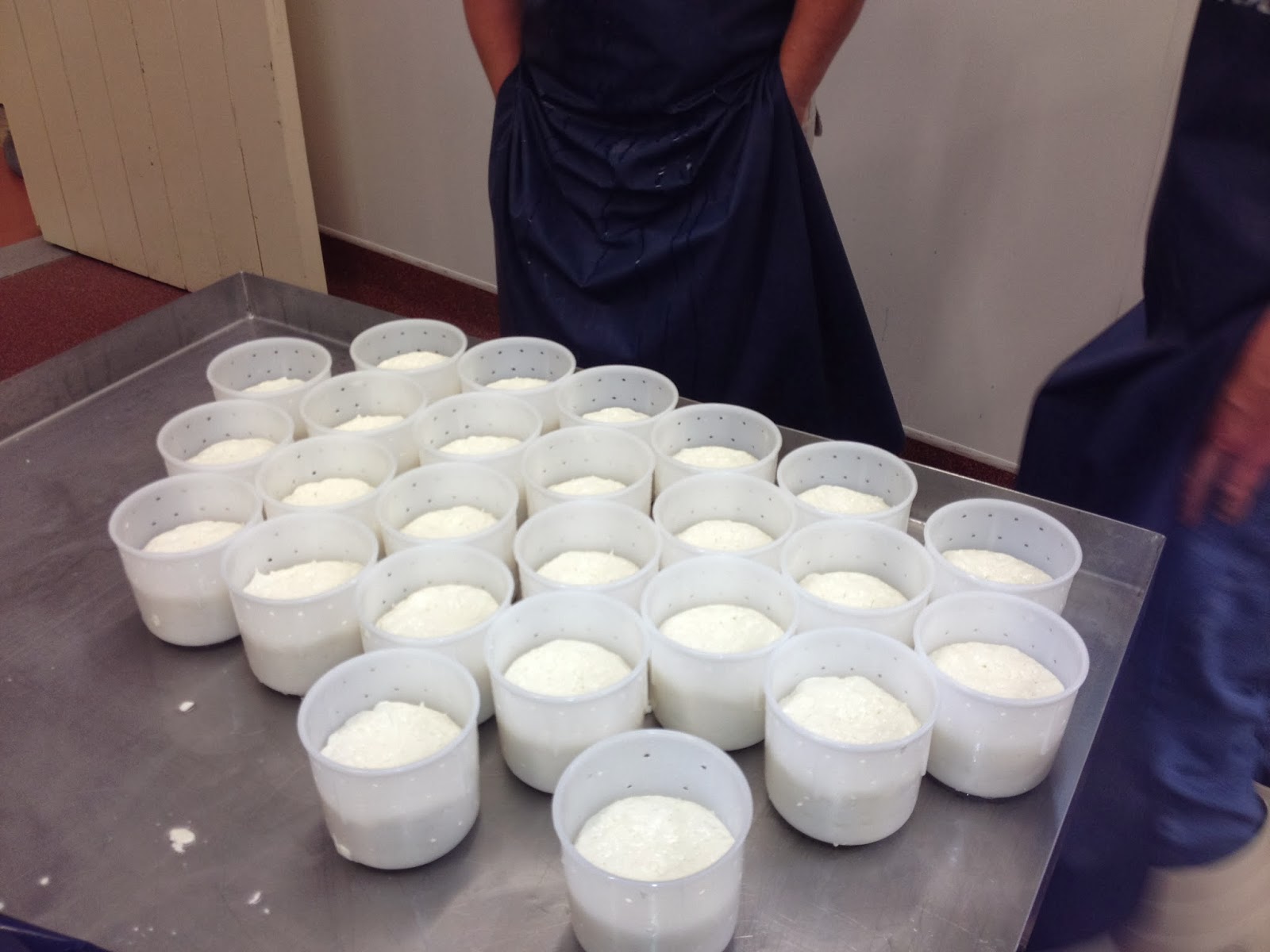
Langres in moulds
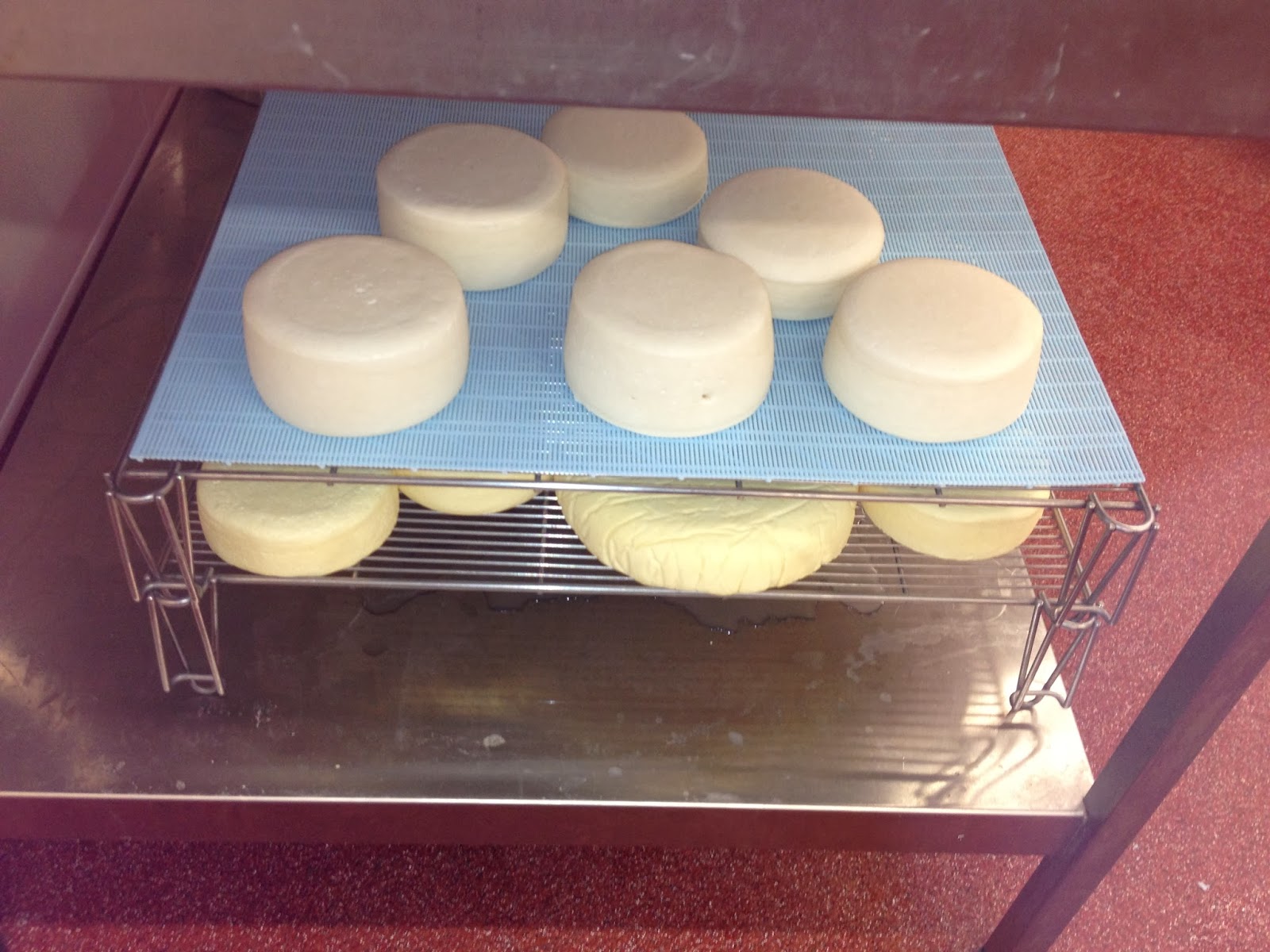
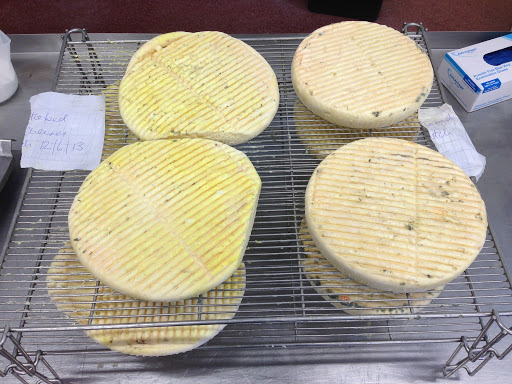
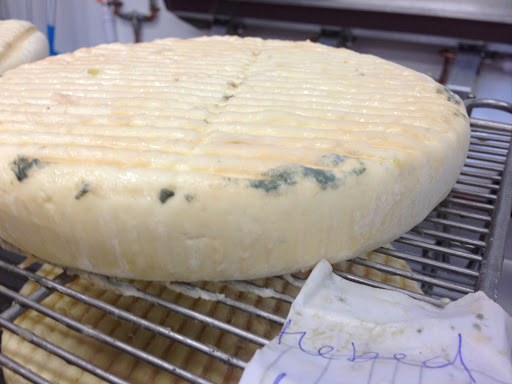
Raclette and Reblochons on racks
The Reblochon / Vacherin make needed to acidify very little, hold in a lot of moisture with quite high rennet content and predominantly use thermophilic bacteria in the make as these would stop acidifying soon, allowing the pH to stabilise at the right level so that the cheese develops the creamy, liquid in the case of Vacherin, consistency that is the hallmark of both cheeses.  For me, with my Taleggio interests, this was the group to follow.  While not my exact recipe, this was the sort of cheese I was planning to make.
Raclette of course, allowed us to try a semi hard cheese with more acidification and flavour than day 1’s Mamirolle but still playing with scalding the curd and washing it.  Langres, allowed us to try what was nearly a lactic cheese.  A true lactic cheese would have a set of over 12 hours and our Langres had acidification in the milk of around 5 hours followed by a set of a couple of hours.  We were speeding it along a little because of the time constraints of the course but while Mons Cheesemongers sell a Langres that acidifies overnight, it too is set is a comparatively short time of an hour or so.
As with blue cheese, Ivan explained, washed rind cheeses can come from pretty much any cheese family.  They can be hard (Raclette, Comte), soft with acidification (Langres, Brie Noir) or soft with low acidity (Vacherin, Reblochon).  This basically meant for very interesting three days as we got to try a very varied range of recipes.
Along the way, as is Ivan’s wont, we learned how to fix problems in the make, so that when we encounter them in the real world, we’ll know what to do.  These included looking out for over acidification in the vat and how to correct it, slow vats and the unexpected error on day 1 which was that one of my fellow students who normally make vegetarian rennet cheese, unthinkingly took out the vegetarian rennet to use on our Mamirolle make.  Ivan doesn’t knowingly teach with vegetarian rennet and this had probably not been used in a while.  The curd didn’t set.  We waited and waited, testing for flocculation time after time and to no avail.  Eventually when it looked like we were going to have a vat of acidified milk only, Ivan took a decision to add more.
‘Everyone will tell you that you must never add a second dose of rennet,’ he told us, ‘but if your milk won’t set, what are you going to do?  It may not be good cheese but it’s better than throwing the milk away.’
Luckily with a double dose the cheese set and seemed to follow its recipe pretty well after that.  I’ve tried double renneting in the past and it was a scary moment and produced a very odd grainy set as stirring in the second dose had damaged the beginnings of the set from the first dose.  It wasn’t good cheese, but as the man said, it was better than throwing the milk away.  At least it made it into some form or other.
Two rather exhilarating days of cheesemaking down and we returned for the final the morning to finish up and to learn about rind washing.  Suffice it to say there is a whole lot more to washing rinds than I had encountered before both at Neal’sYard Dairy and at Holker Farm.
At Neal’s Yard Dairy, when we started rind washing as a cheese maturing activity we began by creating a brine solution in a bowl with the washing cloth and pouring on boiling water to ensure everything was sterile.  The solution was then let down with potable cold water or left to cool of its own accord.  We washed young cheeses first and then on to the older cheeses.  After a while, the cheeses seemed too salty so we stopped using a brine solution and used plain water.  After a further while, it became a bit too much of a hassle to boil the kettle due to the amount of time the solution needed to cool and plain cold potable water was used.  I was the QA manager responsible for writing up these procedures and querying them and with that hat on, I wasn’t wholly happy about using cold water from the tap but when challenged, I couldn’t justify my hunch.  It was after all potable water.  If it was ok to drink it must be clean.  Besides we swabbed and tested any cheeses that we rind washed and the results were good.
At Holker Farm we were washing very young cheeses so we took this a stage further and made up a wash solution of Brevibacterium linens in water.  The rationale was that this would establish a culture in the rooms and sooner or later it would be in the atmosphere to the extent that we only really needed to use plain water.  After we encountered a few pseudomonas problems, we started trying a more acidic wash putting a measure of vinegar into the water and by this time not using any culture.  The vinegar did go some way to putting off the pseudomonas but didn’t entirely fix the problem.  It doesn’t help if they are in your water supply to begin with and Holker was on borehole water at the time.  The problem was intermittent despite having a UV filter. Since going onto mains water (and keeping the UV filter as belt and braces), their problem has disappeared.  However they still do use a vinegar solution.  It cuts the grease that accumulates in your wash water and with a cheese made from sheeps milk, that, at the end of season, can be over 12% fat, you notice the grease.  I suspect cows milk cheese will be a little different.
Rind washing as taught by Ivan is a different matter.  He doesn’t advocate the use of plain water as this leaches salt from your cheese.  He advocates using a brine solution made up to a specific percentage.  If you have oversalted your cheese, the excess will still leach out but if you haven’t then it will remain in the cheese and you don’t risk undersalting cheese.  He also explained a formula for calculating what to add if you want to wash the cheeses in alcohol.  As far as the hygiene goes, he advocates making up a batch of the appropriate amounts of your brine / alcohol / whatever concoction with boiled water and naturally as cleanly as possible, then storing it in a sterilised and lidded container in your cold room and decanting a small amount at a time to use on the cheeses.  Naturally your equipment (brushes or cloths and bowls) will be sterilised before use too and preferably with steam or boiling water.
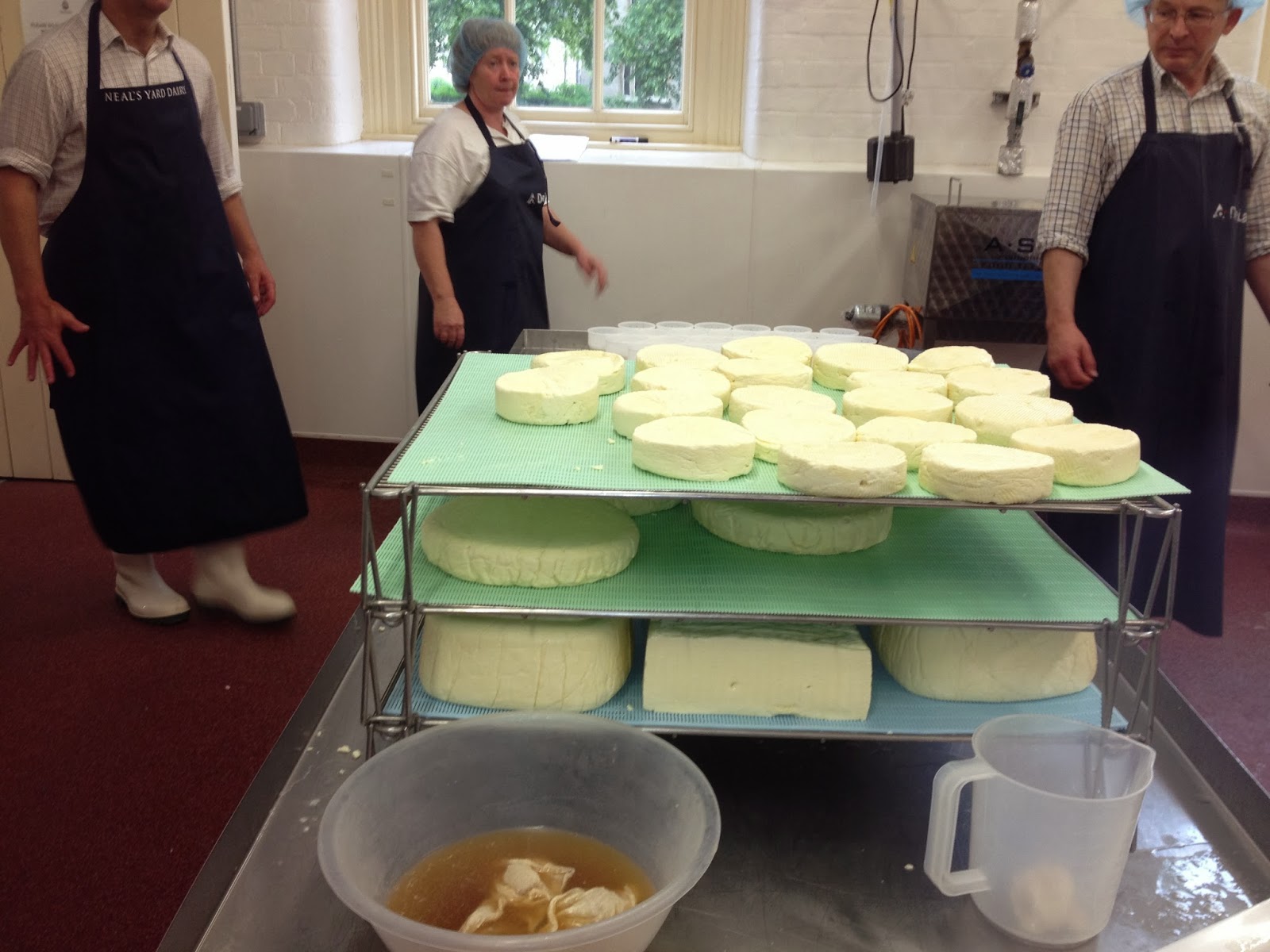
Winnimeres & Bries Noirs being washed
Returning however to the concept of rind washing with an alcohol solution, I had always considered washing cheeses in alcohol to be a bit of an affectation in the past.  My ideas began to change when I started selling cheese with Mons Cheesemongers and tasted some cheeses where the alcohol wash is done very well, for instance on their Tomme de l’Ariege or on their Langres (made by the Schertenleib family near Saulxures in Champagne Ardenne).  This made me think a little more about what the wash added to the flavour of the cheese.  It does also act as an extra bit of food safety due to the preservation qualities of the alcohol but of course you have to be careful that you use the right sort of alcohol and that you don’t use it too strong.  Sweet wines and spirits of course have too much sugar and you run the risk of having strange and unwelcome fermentations on the rind as these sugars provide food for other organisms rather than the nice Brevibacterium linens that you want to encourage.  Too much alcohol and you sterilise the rind and ‘burn’ it.  On the course, we used a dark beer from the Welbeck Brewery (conveniently located just over the cart track from the school) on our Vacherin / Winnimeres and a dilution of whisky on our Brie Noirs.  We were also given the calculation of how much of the given alcohol to use in order not to have the solution over strong.  Actually with something like a dry cider or a beer, we could use it neat although in the interests of salting, we mixed it with brine, but the whisky most definitely needed diluting.
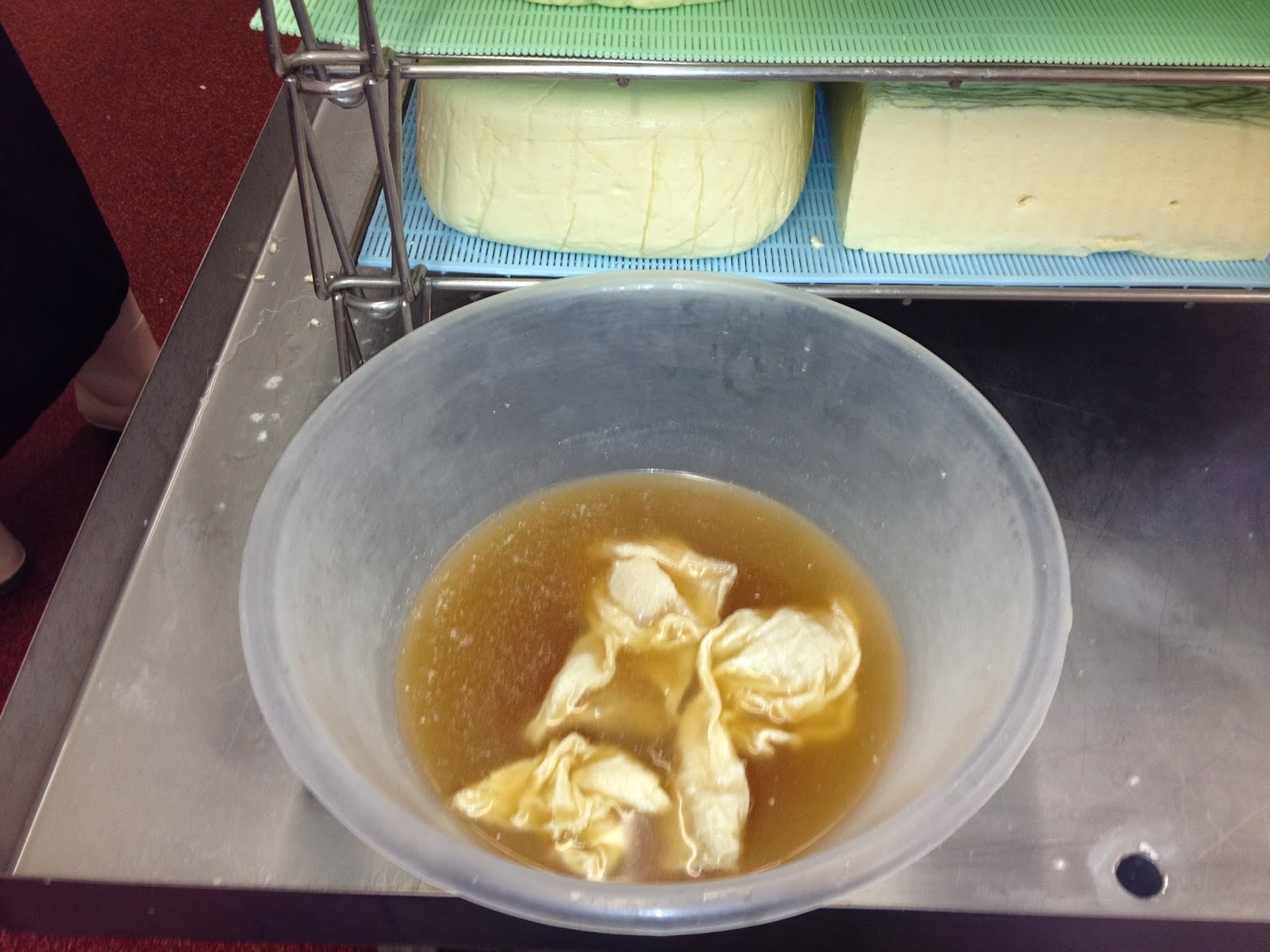
Washing solution close up
 I am not yet sure that washing with alcohol is something for me to do necessarily.  Cheeses like Langres or Tomme de l’Ariege have developed that way because locally they make Marc de Champagne or other wines.  I don’t know well enough what local microbreweries there are in Oxfordshire or if there is an Orkney whisky distillery which would tie in nicely with Rose’s family connections.  Besides the cheese underneath the wash needs to measure up before I think about doing anything flirty with an alcohol wash.  But I am thinking about it; really quite seriously too.

Glaucum? Expansum? Penicillium? Gliocladium? Let’s call the whole thing off!

I last wrote about the blue cheese course I attended at the School of Artisan Food.  It was hugely informative and I learned a lot.  One of the things that impressed me was that not all types of Penicillium roqueforti in blue cheeses are the same and not all blue cheeses even contain Penicillium roqueforti.  Some use a mould I’d never heard of – Penicillium glaucum.

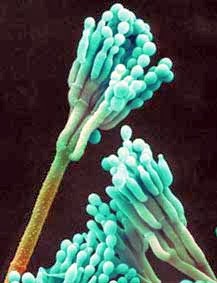
If google images is to be believed this is P roqueforti under a microscope
And this is Penicillium glaucum / expansum (read on for nomenclature explanation)
As I always do, I posted the link on Facebook and then sat back a little surprised as the Facebook comment thread lengthened.  Penicillium glaucum is best known as the Gorgonzola mould but also, according to Ivan Larcher, very suitable for use in goats cheese and naturally occurring on rinds of Loire cheeses like Valancay.  Was this the same as was sourced from Coquardand used at Sleight Farm?  No, that’s Penicillium album, but it looks similar.  Is Penicillium glaucum also in Stilton (it’s sometimes referred to in textbooks as Roqueforti (Glaucum)).  Are Penicillium album and glaucum the same?
This was above my knowledge level, but when something’s a bit out of my league, I like to catch up and understand.  Luckily for me, Paul Thomas of ThimbleCheesemakers and a biochemist to boot, is very generous with his explanations and very good at explaining things so that the idiot (that would be me) can follow.
I will basically copy and paste what he emailed me because he says it better than I can.
 ‘As a quick background to microbiological classification, historically scientists would have peered down the microscope to attempt to assemble a vast number of species into some kind of order.
This creates some problems.  Some microbes have stages in their life cycle during which they may behave in different ways (which may lead to the identification of two species that are actually one).  There may be an element of variation within a species (that may or may not deserve subsequent separation into two species).  And, given the vast diversity of species it is possible to incorrectly identify a species of assign it to the wrong group.  If incorrectly assigned would it then perhaps lead to incorrect assumptions about the characteristics specific to the group and increase the likelihood of further errors in classification of other species?
The introduction of molecular biology techniques such as DNA sequencing makes it easier to classify species now according to genomic similarity.
So, Penicillium is a Genus (Kingdom, Phylum, Class, Order, Family, Genus, Species) and roqueforti, camemberti, album or glaucum are all species names.
P. glaucum is more commonly called P. expansum outside of cheese circles and is sometimes used to describe the light green mould found in Gorgonzola. I believe that David Jowett* was referencing Walker-Tisdale & Woodnut when he said that stilton had been described as being veined with “P. roqueforti (P.glaucum)”.  I’ve never seen it available as a culture – or at least not described as such.  I suppose it is possible that some of the milder P. roqueforti cultures may turn out to be glaucum – or it may turn out that what is often attributed to P. glaucum in Gorgonzola production is actually a low-pigment, low-methyl ketone (the group of compounds which cause the distinctive ‘blue cheese’ taste) form of P. roqueforti.  The cultures almost certainly predate any interest in sequencing them.
P. expansum/ glaucum is associated principally with decay in apples. Citrus Green Mould (P. digitatum) is very closely related to P.expansum.
P. album is now called Gliocladium album (it has been reclassified into another genus). This is the one we would commonly associate with the greyish appearance of the rind of a Loire goats cheese. Coquard sell a product described as P.album that produces a rind with an appearance compatible with that of a Loire goats cheese but, of course, it may be possible that natural mould growth in either the surface ripened goats cheese or a farmhouse gorgonzola may actually consist of several Penicillium (and Gliocladium) species.
While use of pasteurisation dramatically reduces the bacterial diversity of the finished cheese, it has less of an impact upon moulds.  Moulds present in very low numbers in the raw milk and are simply a representation of the moulds present environmentally and therefore continuously inoculated into the milk/curd/cheese. With Lyburn’s Stoney Cross, I saw considerable rind diversity (including some Sporendonema) despite the pasteurisation of the milk.
On a related subject, as I know you are keen to express the natural microflora of the milk, it may prove to be impossible to influence one Penicillium over another as the species present similar requirements with regard to temperature, pH and moisture.  Darker, more methyl ketone-producing strains seem to tend to dominate in natural blueing – either because they are more dominant and outcompete the milder strains or because they are simply more noticeable.  Termignon is a case worth studying in this instance and, I imagine, similar to the pre-industrial two-curd Gorgonzola.’
Back to my take on the situation.
At the end of the day, to my mind, there are a couple of key areas that confuse the cheesey mouldy world that Paul addressed.  Re-classification and new technologies that post date the accumulated knowledge of even pretty technical cheesemakers confuse us with new names that may or may not correlate with what has been written in the past and our sources for information may or may not be up to date with the latest nomenclature.  However also there is the environmental factor.  What we believe to be in the cheese be it Gorgonzola, Persille de Beaujolais, Fourme d’Ambert may be a glorious mixture of what you put into the milk and what the environment favours.  What you buy from Coquard in terms of a rind culture to allow it to resemble a Loire cheese, may actually not be present when your cheese is finally mature as your own environment’s influences take effect.
Back to that eternal balancing act that the cheesemaker somehow has to manage.  Cheese is an expression of your milk, your environment and your skills.  And thank God for that!
*David Jowett had started the Facebook comment thread and contributed a lot of the conversation that followed.  Thank you for keeping me on my toes.
 
PS.  A side issue.  
 
Penicillium expansum (you know, the one I used to call glaucum) when found in apples can cause an unpleasant mycotoxin: Patulin which causes gene mutation and therefore is considered to be a potential carcinogen (although that is not yet proven).  Before you panic and decide never to eat blue cheese again, read on.
 
About 10 years ago, I needed to write something for Neal’s Yard Dairy to help their shop staff explain  to worried customers that mould wasn’t poisonous (it isn’t).  At the time the leading authority on the subject was the late Tony Williams of Williams & Neaves Microbiologists.  
 
Tony explained to me that the moulds that you find in cheese, while they might produce toxins in other media, tend not to produce it in cheese.  Although there isn’t much research done, he had heard a theory that suggested the lactic acid bacteria in cheese might even consume the toxin themselves as the cheeses matured. While this is a pleasing idea, it wasn’t one he could prove, nor did he.  However he did state that to date it had been found that for reasons of pH and Water activity (Aw) that are found in cheese, it did not provide the right conditions for its moulds to produce mycotoxins.  
 
In other words, the blue mould in your Gorgonzola and Stilton and any other cheese where P expansum grows, are fine.  But give the mouldy apples a miss.

All you ever wanted to know about Blue Cheese but were afraid to ask?

Or perhaps more than you realised there was to know about Blue Cheese and had no idea of how much to ask.

Back in April this year, I got a call from Lee Anna Rennie at the School of Artisan Food.
‘Hello!’ came the cheery greeting over the phone, ‘I think I have something that might interest you…’
She proceded to explain that the School and Ivan Larcherwere extending his Professional Lactic and Blue Cheese courses and that he had suggested that she give me a call since we were planning to make a blue cheese.  The course was going to be epic, she enthused, basic cheesemaking knowhow, lots of practical and a month’s maturation time so we could finish off by troubleshooting and looking at how to mature blue cheeses.
This happened to fall into my lap at a very opportune moment.  Before Christmas I had been in touch with Jasper Hill Farms in Vermont in the hopes of going on one of their internship programmesConstant Bliss is my very favourite Chaource style cheese (better than the original – sorry the French nation) and I also wanted to practice making blues as well in the form of their Bayley Hazen Blue.  I emailed Mateo who I had known from the NYD days and who I’d visited many years ago with Randolph Hodgson way back before their ambitious cellars had been built or indeed their current micro lab.  Mateo put me in touch with Emily in their HR department and we exchanged emails and talked about what sort of internship would suit.  It looked good for the prospect of a couple of months making cheese, maturing cheese and a little bit on quality systems and the farm for good measure.  Unfortunately then their audit from the government intervened.  According to Andy Kehler who I had a brief chance to chat to in Italy during Cheese, their whole system had to be turned upside down at huge expense and significant amounts of work had to be done and backdated which must have been hugely frustrating for them as it seemed like it was an amazing system in the first place.  An email from Emily let me know that they had managed to sort out a system for interns who wanted to apply from within the US but were stuck for people coming in from another country and she couldn’t really guarantee when they might be able to come up with something.  This had been a concern for me because although I had already made lactic cheese and felt reasonably confident going into lactic cheesemaking, I hadn’t made a blue cheese before and wanted to be better prepared.  Jasper Hill had been going to be my opportunity to get some practice in and since it fell through, I’d been racking my brains trying to think of another alternative.  Here it was.
The course fell into three parts: introduction in April, practical in May, troubleshooting in early June.
We all showed up in April, met in the kitchen at the School of Artisan food, poured ourselves a coffee and introduced ourselves.  My fellow students included: Rich Hodgsonfrom the Isle of Wight Cheese Company, Roger Longman from White Lake Cheeses, Afke Baukje Haanstra who was over on an almost last minute impulse from Holland, Fergus Ledingham from Thornby Moor Dairy and finally Gareth Derrick, retiring from the armed forces and about to begin a life of cheese (he has since started up Erme River Dairy).
Our first, three day, section covered the basics, but when I say basics, that gives the idea that it’s quite simple.  There was so much more information than that.  I’d heard Ivan teach about milk before when I did a cheesemaking workshop at Will and Caroline Atkinson’s farm and so all the topics weren’t entirely new to me, but I still left at the end of the theory day with a slight headache.  We covered the production of milk including how the udder is structured, how a milkline works and what happens in the udder during lactation;  a basic milk chemistry including a really useful conclusions that you can draw by taking pH and titratable acidity readings on your milk over time that I’ve described on a previous post , milk’s chemical composition breaking down its fats and protein components including handy tips for milk storage so as to preserve the fats and the structure of the casein micelle, lactose, milk’s mineral content (including calcium) and enzymes.
We spent quite some time on different starter cultures both those that develop lactic acidity and the yeasts and ripening cultures that are also added to the milk, or naturally present in raw milk.  Then covered various different ways of coagulating milk from the lactic set, animal rennet, vegetable rennets, thistle extract.
However, to say this makes it sound like it’s a very dry and theoretical course.  It isn’t.
‘I can only teach cheese,’ Ivan said when we entered the School of Artisan Food teaching dairy, ‘By making cheese.  So we’re going to make cheese.’
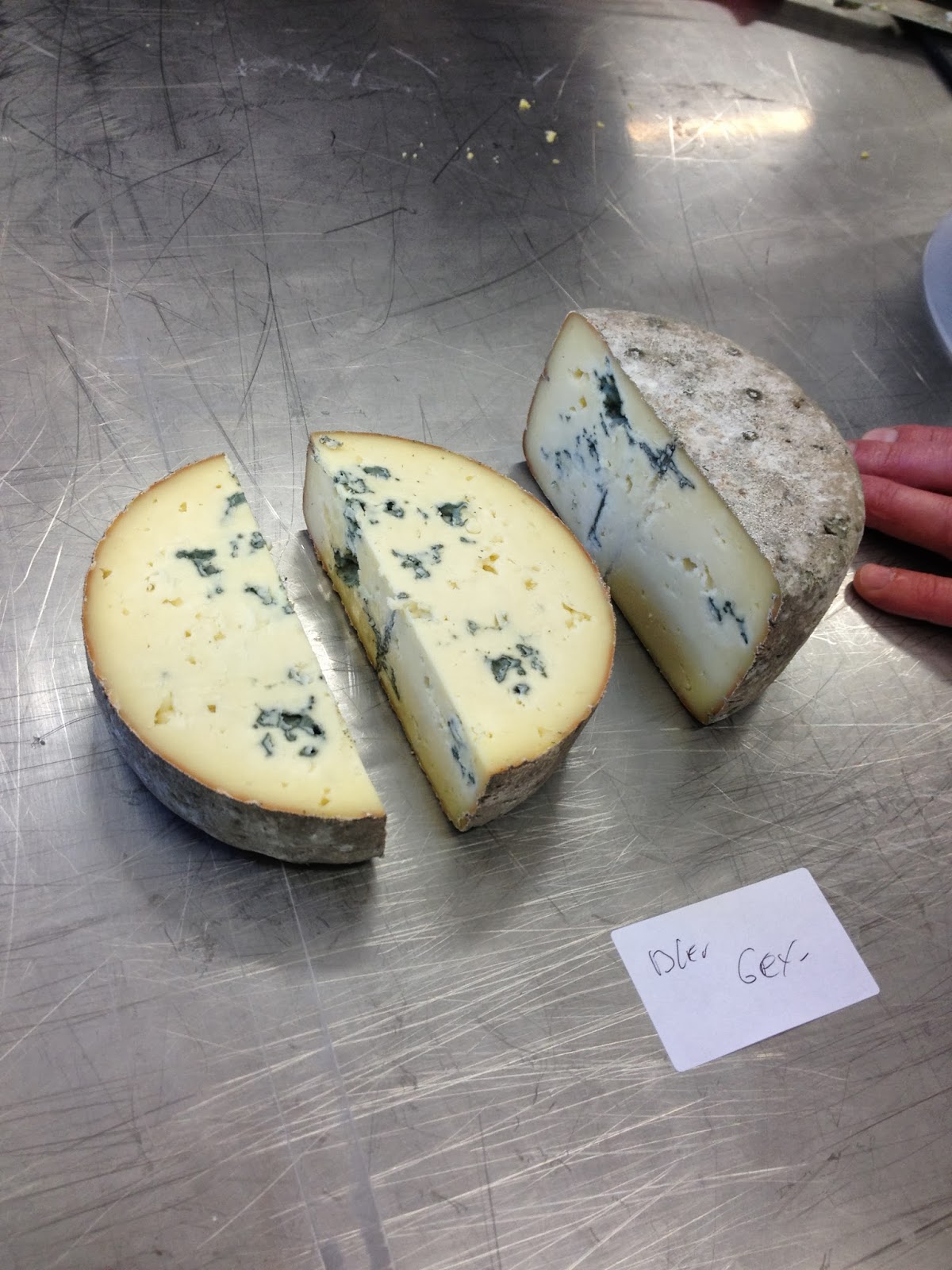
As a demonstration we made a fairly industrial recipe Camberzola / Blue Brie style to show the industrial modern soft cheese techniques and a hard cheese technique blue cheese like Bleu de Gex.  I have to be honest, the Blue Brie technique didn’t engage me that much because even though I would like to make a Gorgonzola, my plan has always been to make something a little more flavourful.  The trick with a cheese like that however is how to maintain the white rind with the blue interior.  It’s a skill, although to be honest not one that I’m interested in perfecting because I want a nice washed rind style outer on my cheese.  The Bleu de Gex was interesting however and both recipes taught us a few fundamentals to prepare us for next time.  Firstly, adding yeasts in our starter cultures to create gas holes in the paste so the cheese has an open texture through which the blue can travel.  Secondly the level of acidity that you want to reach for a blue cheese.  This obviously alters from recipe to recipe, however Penicillium roqueforti can tolerate acidity.  It’s one of the few moulds that can grow in very acid conditions.  If you think about it, the only mould you get growing on a lemon is blue mould.  So to advantage this mould rather than something else, you cultivate a certain amount of acidity.
Cheeses made and salted, lessons learned, we departed and returned again a month later for the practical.
This time, although we did more theory of course,  we made 4 different contrasting types of cheese: a Fourme d’Ambert (with Guernsey milk, thanks to Roger), a Gorgonzola Cremoso style (with added cream which allowed us to learn to use the Pearson square technique which can be used for calculating how much cream to add or how much skimmed milk to add if you want to standardise to a certain fat percentage), a goats milk Stilton style (or basically a slow acid development milled blue cheese based around lactic technology which by the way is what Stilton is – but also so is Bleu de Termignon, Blu del Moncenisio (in its really traditional form) and to some extent also Castelmagno) that last one was also thanks to Roger for supplying the goats milk.
Cheeses made, we had to decide on the recipe we would use for our next cheese.  To this end we learned how to re-create a recipe from the end point or ‘reverse engineering’ as it was not entirely romantically called.  Basically you start with the sort of cheese you want – soft or hard and you move back.  If it’s a hard cheese, you need a quite soft set that therefore has a long flocculation time and a relatively short hardening time.  If it’s a soft cheese, you need quite a firm set that has a short flocculation time with a long hardening time.  This is a bit counter intuitive I realise but the set locks the moisture in and a hard cheese wants to lose its moisture while retaining its milk solids in the form of protein and fats.  For blue cheeses, you need to consider how your blueing will present in the final cheese.  If you want marbling then the cheese needs to be milled.  If you want pockets of blue then you add yeasts to the milk with the lactic starters and create an open texture but don’t mill it.
We made a soft blue cheese (well we only had a month to assess it in and for it to have any semblance of how it might develop we couldn’t really choose a hard cheese – in a way more’s the pity) and called it Blue Wednesday.  Ivan has worked with Ruaridh Stone on his recipe for Blue Monday (when he worked with Alex James) and Blue Murder (when they parted ways – hmmm amicable break up do you think??).
Our final cheese finished, we set off again for our final break and then returned a month later for a final couple of days to taste, assess and finish off.  Along our way, despite making lots of cheese, we had also covered the business of what moulds to choose.  Did you know there are hundreds of varieties of Penicillium roqueforti a cheesemaker can choose?  The best varieties are sold in France which is unfortunate for the English cheesemaker because, for starters if you don’t speak French you’re in a bit of trouble, but also you have to get it delivered over from France which is a bit less reliable as far as courier companies go.  I’ve worked on the other side of couriering, trying to send things from England to France, and I know it’s fraught with difficulties and delays and lost parcels.  However a lot of the problems I’ve encountered were sending things to addresses in Europe which may or may not have been correct (you never realise how little the average person knows about their own postal address until you have to run it through a courier’s consignment system – myself included).  If you double check your English address (and you can do this on Royal Mail’s website) then there’s no reason that your parcel should get lost.  So just the general logistics difficulties then!  Ivan, as you would expect, gave us some good leads for interesting moulds, cultures and starters.  The key, however, should you be interested is that liquid mould cultures work best.  Also that Pencillium roqueforti may not necessarily be your best bet in blue cheese making.  Some Gorgonzola makers, rather than using roqueforti which can be too strong and break down the proteins and fats too quickly, use Penicillium glaucum which is a blue mould that is also used in goats cheeses, particularly cheeses like Valencay.  In fact, Mons Cheesemongerssell a cheese called Persille de Beaujolais which is a Fourme d’Ambert recipe but made using Penicillium glaucum they have procured from some friends in Italy who make Gorgonzola.  The technology is spreading.  It gives lighter, less alcoholic and more mushroomy flavours and, having sold the odd piece or two, I can tell you, it goes down well with the nervous blue cheese buyer as well as actually being rather damn lovely too.
So June beckoned and we tasted the cheeses we’d made last month.  We cut the cheeses open and tasted them.  The Bleu de Gex from our first visit was generally considered really rather good.  I took some home and we ate them at home for quite some time.  I can concur, it was really good.  The Blue Bries had unfortunately suffered in maturation and dried out.  They became bullets.  The Gorgonzola had too much cream added (we used 7% but you would usually use 6% or less) and this inhibited the blue.  It was also undersalted and had the danger of going soapy.  The Fourme d’Ambert with Guernsey milk seemed good so far.  The goats milk Stilton or rather Stichelton as we never pasteurised it (Ivan doesn’t teach courses with pasteurised milk) were over-acidified (which we had known at the time) and the wrong blue had been used (we also knew this at the time too – it was a spot the mistake test).  For goats milk a less lipolytic blue should have been used.  The School of Artisan Food only had Penicillium roqueforti and at that a fairly standard strain.  Ideally we would perhaps have used Penicillium glaucum or at least a less lipolytic strain of roqueforti.
The Guernsey Fourme
Our Bleu de Gex – not even blueing I think you could say but it tasted good.
Gorgonzola with added cream – enough to inhibit the blueing perhaps??
Blue Wednesday!
The goats milk Stichelton.  Well marbled as you can see.  Bit too marbled if truth be told.
Assessing all those cheeses did give valuable information.  Could we have pierced the cheeses more to allow better blueing (we pierced by hand of course because we hadn’t made very many cheeses), what was the effect of the fat content of the milk, the effect of salting and how much you really do need when you add blue mould into the mix.
And should I forget, we also got to visit Sticheltonproduction where Joe Schneider and his team,, particularly Ross were really helpful with their information and even allowed us to try ladling some curd.  It is tough work believe you me.  I am no stranger to lifting heavy things or working hard but the strain of lifting a full ladle of curd gives you arm-ache that lasts for weeks.  I know, I had it.
Another peculiarity is that, of course, you have to use a particular side of the body to ladle.  This could lead to an overdeveloped arm.
‘So how do you keep both arms equal.’ Someone asked Ross as we observed them ladling.
‘I try to vary it,’ he replied, ‘but I can’t vouch for what Joe does to keep his left arm in training…’
And on that note, I will leave you to ruminate on blue cheese.

Studying Up on Milk

This year, at Slow Food’s Cheese, I noticed a new development that for once I had time to take advantage of, workshops on milk production.

I’ve been going to Cheese every year since something frightening like 2003 as part of the Neal’s Yard Dairy contingent.  Consequently my time has been spent on retailing, resting, staying up late eating pizza at Da Ugo or in club Macabre (when it still existed) and then necking strong but delicious coffees the following morning.
This time, however, I was here with purely the aim of furthering my cheese education.  Where better to comparative taste Gorgonzolas and Taleggios?  Where better to explore the concept of what a traditional recipe or make actually tasted like in the interests of developing the recipes I’d been trialling at the School of Artisan Food? Where better to learn more about cheese?  To which end, I trawled Slow Food’s website for tastings and discovered the milk workshops.
I’d helped Randolph Hodgson prep some of his own talks at Slow Food workshops in the past which were purely cheese focussed and with an element of pairing wine / beer etc and cheese.  I’d found them interesting but not hugely technical (not a reflection, I should explain, on what Randolph talked about – he was easily the most technical person there, it’s the other speakers who were a bit more pedestrian).  The milk workshops held in the piazza XX Settembre were more technical sounding, geared towards cheesemakers and milk producers and while there were some things that I didn’t feel the need to attend (a talk on adulteration of food and labelling regulations didn’t thrill me), there were some that were most definitely relevant.
The topics I thought it was a good idea to get clued up on were: animal welfare, the importance of pasture, milk quality that goes beyond simply whether it is raw or pasteurised, sustainable agriculture and the role of fermentation.

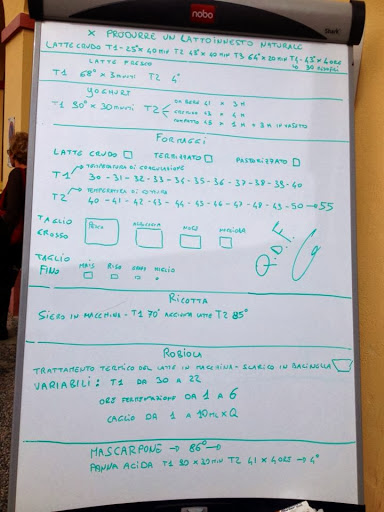
A white board displayed around town with loads of technically useful cheese facts and recipes on.  Just there for you to copy and to spread the cheesey knowledge.  This sort of generosity of information in the interests of the bigger picture is typical of Cheese.
It lead to a hugely interesting few days and a lot of food for thought and luckily for me, the happier the cows, bees and environment it would appear the happier the cheesemaker.  Let me elaborate:
The talk on animal welfare with speakers from Compassion inWorld Farming started by stating that animal health and human health are linked and animals farmed in a higher welfare manner produce better milk.  There are obvious examples of this:  animals on pasture have less instances of mastitis and cleaner udders than animals that live indoors.  To put it bluntly, in the fields, if they need to defaecate, they just walk away from it and to a nice clean bit of pasture.  In the sheds they can’t do that and although their bedding will be replaced frequently during the day, there’s more than just a chance that they will end up lying down on dirty straw at some point.   However, it goes beyond cleanliness.  The milk from animals that are grazed on pasture has been found to be more healthy with better levels of Omega 3 fatty acids and betacarotene.

The talk on pasture discussed milk composition in more detail, citing EU funded research projects that have demonstrated the effects of each different herb or grass or wild flower variety that the animals graze on the composition of the fats and the number of flavour ethanols in the milk and also its vitamin content.  One speaker, Roberto Rubino from ANFOSC (the Associazione Nazionale di FormaggiSotto Il Cielo), had particularly interesting data to demonstrate the different fatty acid composition between animals eating oats, borage, hawthorn (really), wild geranium and plenty of other plants.  His point was not that there was any one plant that was the cow / goat or sheep superfood but that the bigger variety the better.  Just like humans, a varied diet is better for the animal but we are able to reap the benefits of that through the composition of the milk.  He went on to also explain that the animals’ diet also affects the cholesterol in their milk.
Contrary to the thinking on nutrition that I remember growing up which had us ditching butter in favour of margarine and believing all cholesterol to give us heart attacks, current thinking now considers cholesterol a necessary part of the diet, provided it is not oxidised.  A diet of pasture contains 4 or 5 times as many antioxidants as the diet of animals on a zero grazing indoor farming system.  In other words, they consider that you can drink milk and eat butter and cheese without worrying about heart disease, provided it’s farmed a certain way.
A speaker also from the European Forum on NatureConservation and Pastoralism explained that the value of mountain pasture is precisely that it hasn’t been planted or farmed.  As a result, the plants are far more diverse than they would be even if planted with the most complex herbal seed mix.  They quoted that an intensively farmed and planted field would contain 2 or 3 different species whereas you’d expect to find 50 to 100 species in natural grasslands. They even explained that animals left to graze and pick and choose will even eat shrubs and leaves off trees sometimes for a bit of variety (presumably hence the hawthorn research presented by Roberto Rubino).
During the talk on raw milk, a speaker called Tom Baas a biologist from the Research Institute of Organic Agriculture in Germany (FIBL)talked about how research into raw milk in the past 10 to 12 years has shown a change in attitudes to unpasteurised dairy.  Statistical research demonstrated that raw milk could actually assist in children developing a healthy immune system and lower incidences of asthma, allergies and even hayfever.  Some of these points were rather circumstantial evidence, farmers children seem to be healthier than others, however, Basel University has done over 10 studies into the possibilities of raw milk against atopic conditions and other health benefits including that of a fatty acid called CLA (conjugated linoleic acid).  Their studies showed that CLA which is produced by herbivores will be different depending on the animals diet.  When fed to rats, the grass fed CLA did not make the animals put on weight or develop fatty liver while the CLA from animals on a different diet did.  CLA is present in raw and pasteurised milk but the heating process will affect it and at least make it less effective if not actually contributing to weight gain actively.Further to this taste studies had been carried out also assessing the smell, taste, aftertaste, viscosity and visual aspect of 4 different milks, 2 of which were organic (1 actually biodynamic) and 2 intensively farmed.  While the differences were subtle, a distinct difference was found.
The message of all of this?  Raw milk, varied pasture that is left to grow as naturally as possible, grass fed as much as possible will be the healthiest dairy food for you and will also have the best flavour potential for the cheesemaker.  Of course they were speaking in fairly black and white terms and you’ll find conscientious extensive farmers who do feed concentrates and silage who also manage to give their animals a varied diet while not using natural and unplanted grasslands.
Finally we moved to the role of fermentation.  This was an idea I’d first heard proposed at courses that Ivan Larcher teaches.  You have this amazing milk, with wonderfully farmed animals and all those aromatic flavour ethanols waiting to be liberated.  How to make the most of it? Well using a naturally fermented starter.  Just as the natural grassland is more diverse, so is the naturally cultured soured milk from your raw milk.  Most commercial starters will contain possibly 1 or 2 different organisms.  The more complex ones perhaps 4 or 5.  Your own natural culture from your raw milk will have many more and also all the ripening cultures too (yeasts and moulds).  It also renders your product truly a local and unique one.  The speakers gave a brief method for producing your own soured milk starter, something they called ‘latte inesto’ and tasted a range of 4 cheeses chosen to demonstrate that the latte inesto starter produced the more complex flavour.  Again, I’ve done enough tastings to know you choose your cheeses to demonstrate the point you want them to make so while the tasting was dramatic, it was also staged to be so.  The difficulty of naturally occurring bacteria is that you can’t be sure of what will grow, but if you have followed certain guidelines you will maximise your chances of cultivating good starter cultures rather than a big bunch of spoilage bacteria instead.
Most interesting for me, as we research our milk at Nettlebed, was the discussion on where the natural lactic acid bacteria come from.  The research in this case has not been carried out on dairy animals but on humans but it is extrapolated that other mammals will have similar processes.  The baby’s gut is populated with the appropriate bacteria by the colostrum phase but after that is finished, the milk produced is sterile.  Any lactic acid bacteria and other flora that get into the milk from that stage onwards are transferred from the skin of the udders which will be picked up from dust particles on their food and in the pasture, dust particles from the soil (this would be bad news things like E.coli and Listeria) or illness which would be mastitis (Staphylococcus aureus).
Further to that, a cheesemaker asked a question.  He had been making cheese with latte inesto for 20 years but recently in response to demands from the milk dairies he had been trying to reduce his total bacterial counts.  Ever since the counts went down, his latte inesto stopped working.  It wouldn’t sour and when cultured, the only thing that grew was coliforms (gas producing bacteria from the gut – harmless but no help to the cheesemaker).  It appeared that in pre-dipping the animals’ teats before milking, they were removing a healthy population of lactic acid bacteria and although there were very few coliforms present, in the absence of any competition, these became dominant.  By trying to clean up what had been essentially clean milk before, they had created ‘dead milk’.  The advice was to stop pre-dipping and do all they could to ensure lactic acid bacteria got back onto the teats (this can include wiping with hay before milking, making sure the animals are getting hay or natural grass as pasture) to make the milk come alive again.
In summary, what did I learn?  Well to sum it up in one sentence: diversity, diversity, diversity and leave it to nature as much as possible.  Naturally managed grasslands and animals kept as close to their natural state as possible will produce happy animals giving milk that is better both nutritionally and in flavour profile and potential.  Then allow your naturally produced milk to sour with what nature in its bounty has given you and you’ll get cracking good cheese!  In theory anyway….

The Lightbulb Moment

One of the exciting things about working with Merrimoles Farm on the Nettlebed Estate is the potential inherent in their milk.  The herd is a mixture of Friesian Holsteins with Swedish Red and Montbeliard bred into the herd for increased vigour.  Increased vigour is the immediate benefit for the farmers along with better health, less likelihood of lameness and better fertility.  However it isn’t just a benefit to the farmer.   The cheesemaker (that would be me) naturally gets better milk from healthy, happy animals but the breeding with Swedish Red and Montbeliard is exciting because the solids in the milk of both of those breeds lend themselves more to cheesemaking than that of the Friesian Holstein or Holstein itself.  In addition to that, the animals graze on organic pasture and, as a result, spend most of the year happily outside, munching grass, flowers and herbs in the fields, which in theory means that they should have a diverse diet which will lend to aromatic compounds in the milk and the potential for a diverse grouping of lactic acid bacteria derived from the bacteria present on the teats.
I had come into the discussions with Rose and with Merrimoles Farm with a mental ticklist of what I was looking for in a milk supplier, namely, interesting breeds (check), outdoor grazing (check), varied pasture (check), preferably organic or as near to as possible (check).  Part of this is ideological, I don’t want to be involved in an enterprise where there are unhappy animals and where the farming isn’t sustainable and respectful to the environment.  Part is flavour driven.  Interesting breeds, varied pasture and organic management of the herd and pasture should, in theory, translate to the most interesting milk.  In other words, if I can unlock it, there’s a lot of potential for good flavours in our cheese.
‘Our milk is really good’ Rose told me proudly when we first met.
We collected a sample from the bulk tank to drink it fresh and (naturally) unpasteurised.  It tasted lovely.  I agreed with her.  On other occasions that I have drunk it since then, it consistently tastes lovely with a milky sweetness, mineral undertones and a velvety creamy mouthfeel.
‘And we get really great test results too’ she continued, ‘Dairycrest actually say that our counts are really low.  For an organic farm it’s practically unheard of.’
When I first visited the farm, Phil, the farm manager showed me a printout of their milk results which included fats and protein content as well as their routine total bacteria counts.  Having looked over other milk results in the past when I was Quality Assurance Manager at Neal’s Yard Dairy, I too was surprised at how low some of the counts were.  I expressed my surprise to Phil also who confirmed that yes, they were often told how rare it was for an organic farm to hit those levels.  It was something they were all proud of and justifiably so.  For their current customers this is exactly what they need and want.
I was a little more cautious.  Low total counts, seemed to me a good starting point, but more important than that is what that total count breaks down into.  Ideally, of course, that total count is entirely composed of lactic acid bacteria.  Worst case scenario, it’s entirely composed of Listeria monocytogenes or another pathogen.  As we drove away from the farm, I mentioned to Rose that, before we got into cheesemaking, we needed to build up a history of testing the milk in more detail.
‘For raw milk cheese,’ I explained, careful not to cast aspersions on what was evidently, very carefully produced milk, ‘It’s not so much the total counts we’re concerned about, but what’s in there.  So we need to send off some samples for testing and cover all the pathogens: Listeria monocytogenes, Staph. aureus, E.coli O157 and Salmonellae.’
It wasn’t urgent to get started testing straight away and actually we are hardly going to go and find another milk supplier.  Our cheese business is being started to make better use of the Merrimoles milk.  Whatever the results, we were already committed to working with them, so to begin testing nearer our production time made more sense.  I took a bottle of milk away to do a lactofermentation at home.  They took 48 hours to set, tasted yoghurt-like, although a little bitter, and had about one gas bubble.  I would have been happier to find no gas bubbles and to not have tasted the slight bitterness, but I wasn’t too bothered at this stage.
When we did begin our testing in May this year, however, we had a bit of a shock.  The total counts were low, as usual, but the lactic acid bacteria counts as a proportion of that were also a lot lower than we had hoped for.  We thought, especially as we want to culture our own starters, that we would be aiming for 80% of the total count to be lactic bacteria.  We were finding considerably less than that.
This means for our cheesemaking, culturing our own starters is a project for a few years time and won’t be happening initially.  If you make your own starters, the argument goes, you will have a more diverse population of bacteria but, of course, you don’t know what you are getting and they are likely not to acidify as strongly as bought and proven starters.  Just at the moment, we need to use plenty of proven starter to get our milk to acidify.  This is fine, I can work with that and still do my best to use a varied and interesting cocktail of cultures.  What makes me a little nervous though is that not having a naturally strong population of lactic acid bacteria does mean that we don’t have a built in safety mechanism in form of the milk’s natural ability to out compete pathogens.  If something nasty gets in, it can have a little pathogen party, reproducing itself all over the shop.
‘What does this mean for your cheese?’, I hear you ask.
Well as I said, we’ll use bought in starters and in addition we will record our acidity curves with every make.  We will also prepare ourselves for higher testing costs as we will have to test each batch that doesn’t acidify quickly enough and higher wastage for the cheeses whose test results don’t make the grade.  In the longer term, we’ll begin learning a lot about the factors that encourage or discourage lactic acid bacteria, because, in theory, with organic production and grazing outdoors, we should have plenty of them and yet we don’t.  With that in mind, at Slow Food’s Cheese this year, I listened avidly to their workshops on milk production.  But that is a blog-post for another day.
More importantly, all of a sudden, all the arguments in defense of raw milk that I have trotted out obediently, on behalf of Neal’s Yard Dairy to officials and other quality assurance managers, clarified in a moment of epiphany.
If you don’t want to bottle milk and offer your customers long shelf life of what is naturally a short shelf life product, pasteurisation is irrelevant.
It doesn’t make sense for a cheesemaker to seek out milk with low counts or be encouraged to use pasteurised milk which it is perceived as being safer than raw milk.
If the raw milk has a healthy population of natural bacteria, it’s the safer choice.
A lot of what a laboratory scientist may consider to be a risk and that has been worked into HACCP and the food safety risk analysis we all do, suddenly seems misdirected and possibly dangerously so.  Pasteurising doesn’t sterilise.  It doesn’t make milk a perfectly clean slate, there are still some organisms in there or organisms can get in there even if you think you’re doing everything at the very pinnacle of hygiene.  With low counts, it’s key to your cheese quality that your starters work quickly.  If they are slow to start, then they can be out competed and potentially they don’t get the upper hand.  This doesn’t neccessarily happen – you might be lucky but it’s like driving without your seat belt.  It isn’t a given that you’ll have an accident but if you do the consequences are worse.
I now see very clearly, that it’s not a question of absolutes and black and whites.  It’s not that low counts of staph aureus or enteros are automatically good.  It really depends on what they compete against.  Cheesemaking is a question of managing populations and communities of organisms.  It’s so much more complicated, nuanced and subtle than low counts good, high counts bad and it’s not a question of limits and levels but of balances.  This is as necessary for food safety every bit as much as to get the recipe to work.
I thought I understood this when I worked at Neal’s Yard Dairy.  I was only half way there.
Now, I really get it.

The Taleggio Experiment

The decision to rent the School of Artisan Food was made, a recipe was researched, whilst attending a course there, I was able to work out what equipment we’d need and finally our dates rolled around.  Rose purchased containers, filled them with milk and sent them off with a refrigerated courier.  I drove myself off to the School of Artisan Food and got ready to receive milk.
I spent a day sanitising equipment and writing up a HACCP plan for our trial production and the following day was in bright and early for the milk to arrive.
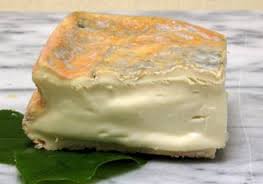
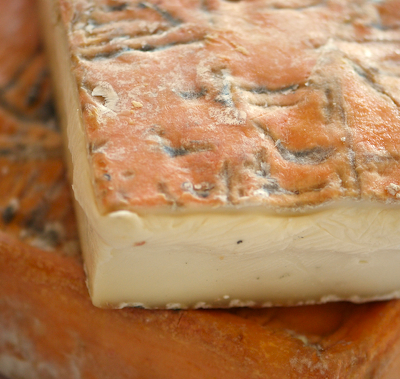
Taleggio is an interesting make from my point of view, in that it uses thermophilic bacteria as a starter culture and yet doesn’t use the temperatures at which thermophilic bacteria tend to work best.  Like all washed rinds, the curd doesn’t want to acidify very much and it wants to retain a calcium rich, pliant structure.  The thermophilic bacteria therefore are used precisely because they will start working but as the temperature of the make cools off when the cheeses are in their moulds, they will stop going, the acidity will level out and won’t develop further.  This in theory and coupled with curd washing, should mean that the cheeses remain pliant with their moisture locked within the curd structure and soften when ripe to a gloriously oozing texture.  That is the theory anyway.
Taleggio photo courtesy of the thefiftybest.com
Within this, of course, there are many parameters to play with.  So many, in fact, that I wish we were in full production right now in some ways so I could be happily making cheese day after day, tinkering with a whole multitude of variables.  Would a degree or 2 more or less in terms of temperature affect the rennet set and the texture as the cheese matures?  How would the flavour and acidity be affected if I remove a bit less whey at curd washing?  What if I add in more starter cultures at stirring?  What if I stir for longer?  That’s not even getting started on how much starter we need to use to work with our milk and how much rennet will get me a 15 minute flocculation and 45 minute hardening time (which, I believe, is what I’m aiming for).
First challenge and challenge not yet overcome at that, is the quantity of starter.  There are no hard and fast rules for this of course because the amount of starter you use is entirely related to the numbers of lactic acid bacteria in your milk.  Thinking back to my Holker Farm days and remembering the drainage battles we had balancing acidity and calcium, I figured that if I wanted to have a slow acid development, even though I was using thermophilic bacteria this time rather than mesophilic ones, I should be using pretty small quantities of starter.  In retrospect, I’m not sure that was the case, but you live and learn.  I remembered that when I left Holker, we were using tiny quantities of bulk starter, having been advised to drop to around 0.025% and before that had been using still pretty tiny quantities at 0.05%.  I decided to start at the higher of these values, having made up a yoghurt culture in skimmed milk the night before and incubated it overnight.  Yoghurt cultures, for those who didn’t realise, are thermophilic bacteria.
Now, at this stage, the benefit of recording values of acidity began to hit home.  In all my time at Holker, we never recorded a pH.  The pH meter had broken before I arrived and they are very expensive bits of kit to replace.  We took titratable acidity of course but the TA of our starter cultures which I took every so often, are hard to correlate with that of this yoghurt because of the buffering factor.  Our starters at Holker were made up in sheeps milk, which is high in protein – it can be up to 3 times that of cows milk.  My yoghurt cultures were made up in UHT skimmed cows milk.  As you all no doubt remember from the pH and Titratable acidity post last autumn, protein captures Hydroxl ions (OH-) when you add the alkaline solution looking for a pink colour produced by its reaction with the indicator, phenolphthalein.  This distorts the correlation between acid and pH because it is non-uniform.  The more protein the milk has, the more Hydroxyl ions it can capture and the more Sodium Hydroxide needs to be added before a reaction with the indicator will register.  In other words the TA value will be higher in sheeps milk than in cows milk just down to the protein.  In fact, at Holker when we began making cows milk and sheeps milk cheese side by side, we noticed a huge difference when recording the TA at 24hours (or thereabouts) between the two.  Our sheeps milk St James regularly recorded 80-90 ’D while the cows milk Brother Davids struggled to reach 40’D.  You would think that the majority of the protein in the sheeps milk had been locked up in the curd by then but just as the milk is higher in protein, so is the whey and so the titratable acidities ended up being quite dramatically different.
Anyway, returning to the matter in hand and hope I didn’t lose too many non techno cheese geeks along the way.  There was no point, to my mind, trying to correlate vaguely remembered TA values of starter culture with a yoghurt I had just made as I didn’t have any of those values recorded for reference.  So I took a pH reading of the starter and was conscious it was more acidic than my notes from Ivan Larcher’s course suggested was ideal (pH 5 – to make sure you catch the bacteria while they are multiplying happily and before the lactic acid they have produced can denature them and kill them off), but otherwise didn’t have much to relate it to.
On the first trial, 0.05% in quantity was added to 50 litres milk, the milk was heated to 34’C, rennet added at the appropriate pH change and I filled my pot of water to look out for flocculation times.  The flocculation happened right on time, the hardening more or less followed the pattern it was supposed to.  I pre-cut, then cut to hazelnut size (more or less – it’s a bit hard to use a cutting harp designed for a big vat in a 50 litre tub), let if settle, took off the 25% whey, added back the appropriate quantity of water at 32C, added some starter back in for flavour and stirred.  The recipe was one I’d found online and frankly has already been adapted.  At the time, I queried curd washing with Ivan Larcher and he replied
‘Good luck settling the pH at 5.2 without it.’
Later on, I asked for clarification on quantities and adjusting those parameters only to be told that it’s an industrial technique and he didn’t recommend me doing it.  I have therefore stopped.
However I was doing so on this trial make, and at every stage, I was recording pH on the spreadsheet Ivan had emailed me after our Blue Cheese course so that it would track the pH curve.  Unfortunately my pH curve didn’t curve.  It was more of a wobbly straight line.   Short of leaving the whole thing for 24 hours to acidify on its own, there wasn’t much I could do but proceed, pre-draining the curd on a mat and then filling the moulds with the drained curd pieces and turning, turning, turning throughout the afternoon.
All looking quite convincing so far – unfortunately it’s all in the maturation.
They looked pretty convincingly like cheeses.  They were draining.  But who knows what was going on below the surface without much acidification.  The problem is, all sorts of other bacteria could be enjoying the quantities of lactose and developing to undesirable results.  Unfortunately despite doubling the starter cultures the following day, the same acidification pattern followed.  Evidently at Holker Farm the starter culture had very minimal effect and acidification was largely governed by the lactic acid bacteria naturally present in the sheep and cows milk.  Further unfortunately, I already knew from a lactofermentation we had done a week or so earlier when Rose drove up (bringing a bottle of milk with her) to SAF to meet Ivan and me after one of the days of the course had finished, that we didn’t have a lot of strong lactic acid bacteria in our milk at the moment and that other things tended to become dominant.  To say I was nervous of the test results we would get from milk and curd samples would be an understatement.
I left SAF; the samples headed to the lab; we waited for the results.  As I had feared, without enough lactic acid bacteria from the starter or naturally present in the milk itself, enteros and pseudomonas had had a field day.  Staph. aureus hadn’t done so badly either.
Not quite what I was hoping for but still looking relatively like cheeses
After a couple of weeks, I drove to SAF to collect the unfortunate cheeses.  I did not have high hopes to be honest, particularly as one of them had pancaked overnight and collapsed – a bit of a surprise for me and also for Lee Anna.
However, I had known, that I had more cheese than I was expecting, which I suspected meant they were too moist.  This raises the likelihood of crazy things happening during maturation.  What I didn’t know however until I began to think and mull it over was that those rather too healthy pseudomonas might also have played a part in this too.  Pseudomonas, as I had discovered thanks to the very knowledgeable Paul Thomas, are caseolytic (they eat casein).  Could that mean that they might increase the speed and amount of protein breakdown in our cheeses?  One quick email and a reply later and yes, by no means the only factor but, if there were large numbers of pseudomonas, then there was much more chance of pancaked gooey cheeses that fall apart.
All in all, I wasn’t sure what I would find at SAF but although one batch had fallen to pieces, the other did seem to be holding some shape and smelled convincingly washed rind.  Not the best behaved of washed rind, I’ll admit, but I’ve smelled worse in my time.  We tasted one of them and to my surprise there wasn’t a strongly bitter flavour that I was expecting due to the pseudomonas, in fact the predominant flavours were beery, yeasty and fruity with a hint of meaty and savoury in the background and perhaps just a touch of the bitterness on the rind but certainly not overpowering.
Now let’s be clear, it’s not the flavour profile I want but then again, the recipe didn’t work, so for it to have turned out to be not only edible but while a bit raucous, actually not too bad, was a definite bonus.  That said, a valuable lesson was learned for Cheese Trial no 2: use a hell of a lot more starter!

Cheesery on Wheels

Somewhere around February as we were delayed in our site planning permission by the Highways Agency and considering renting an industrial unit, Rose’s mother asked
‘Why don’t you just try and make a few cheeses?’
Although we had no site in which to make cheese, we both loved the idea and began to test out various options.
Option 1:  Use a catering kitchen on the estate
Option 2:   See if a friendly cheesemaker would like to rent us their space
And Option 3, which presented itself while booking in on a course for learning about Blue Cheese:
Rent the training dairy at the School of Artisan Food.
Option 1 was abondoned quite quickly as not only was the kitchen not available but we also had no maturing space for anything we made (although we did consider purchasing a few wine fridges for the purpose).
Option 2 was investigated but bringing non EHO approved milk into someone’s work space to make a completely different type of cheese which the cheesemaker had no HACCP for was a can of worms that the people we approached would rather wasn’t opened and, to be honest, that’s understandable.  Option 3 however had legs.
Enter Lee Anna Rennie Dairy co-cordinator for the School of Artisan Food, who loved the idea and researched us a price and set about working out what the School would need from us in order to make this idea reality.
At the same time, we also looked into the possibility of hiring the Little Cheesery, a mobile cheesemaking unit which has been developed by a company in Derby.  They actually specialise in stainless steel work and custom making as well as assembling food standard production lines.  The Little Cheesery is something they knocked together to show what they can do in terms of cheese equipment and it has proved really quite popular for demonstrations and fairs as well as for people like us who want a home for some trial batches.
A visit to both was necessary so off I drove to the School of Artisan Food for a look around and then a few days later off I drove again to Derby to look over the Little Cheesery.
It was a tough choice to make, actually, in the end.  The Little Cheesery is remarkably well equipped and fits a lot of stuff into a small space, actually rather more than we needed.  The dairy at the School of Artisan Food also has a lot of equipment, far more than we need, but of course they run professional cheesemaking courses covering every type of cheese from hard, mountain-style cheese to soft lactic cheese so diverse equipment is required.  It has many other attractions too, the possibility of a milk supply if we had wanted, their extensive research library, the waterbath for controlled lactofermentation tests and the cheese care services of Lee Anna as well.
The thing that really made the decision crystal clear in my mind, though, was just the fact it is a permanent building with its own functioning infrastructure.  The basic things like not having to plug a trailer into three phase electricity or connect up to a water supply etc are taken care of meaning that when it comes to the problems you have to troubleshoot (because let’s not be so naïve as to think there won’t be any) they are related to the milk, the make and the cheese and not fixing the electrics.
With any decision, you choose what problems you’d rather be dealing with.  We chose to focus on understanding the milk and the cheese.  I’m glad we did.

Choosing a Cheese: The Neal’s Yard Dairy Dilemma

When I left Neal’s Yard Dairy, I had a vague idea of learning how to make a traditional dales type of cheese like Cheshire (the house cheese where I grew up) or Lancashire (the fabled house cheese of my dad’s childhood).  I also had a pipe dream of my own orchard and market garden and a yoghurt making facility where I made yoghurts and fruit coulis to be sold together using  rare and interesting varieties of cherries, pears, apricots, strawberries, rhubarb or whatever other fruit took my fancy.  A visit to Caroline Atkinson at Hill FarmDairy to make Stawley, reminded me how much I enjoy the pace of a lactic cheese make.  Nine months at Holker Farm Dairy getting my head around drainage of a washed rind cheese made me wonder if I really did want to put that all to one side and make something entirely different in future.  Equally, memories of the sticky, greasy, gloopy and slimey business that is rind washing cheeses did put me off the idea of making a washed rind of my own.

When I first got in touch with Rose, they had made a Chaource on a very much ‘in the kitchen’ basis which tasted really pretty darn good.   I was very keen to make a lactic cows milk cheese and to be honest this did encourage me to keep the email correspondence going in those early stages.  The fact that she also was interested in making yoghurt (albeit for a frozen yoghurt range primarily) was an added bonus.  Should it ever be even a remote possibility, Oxfordshire is a considerably better place climate-wise to try and plant the odd fruit tree than Cumbria.
I did my market research too – by which I mean I got in touch with Jason Hinds and Bronwen Percival at Neal’s Yard and asked them what they suggested would be a good choice for a dairy that was just setting out.
‘Bloomy rind soft cheese and continental style blue’ came the reply.
‘Does a lactic cheese qualify as bloomy rind?’
‘Yup’
Emboldened, Rose and I set about our sales projections and planning with a soft lactic cheese in mind and to then bring on a gorgonzola style blue a year or so later into production.
‘What about doing a washed rind though?’ she asked.
‘Well I have made one before,’ I said, reluctant to abandon all that I’d learnt in Cumbria for projects new, ‘I could probably be up for doing one again if we could have a bit of help on the rind washing.’
We tentatively pencilled it in for year 5.
‘I’d quite like to do a hard cheese too’ Rose ventured.
‘I think we’d need to think about that further down the line when we’ve got more money.  It will probably need more equipment than our soft cheeses…. but we could definitely have a go.’
So we were decided.  Year 1 would be a delicate little lactic cheese, year 2 would see the launch of our blue and we would then let those establish themselves for a few years before embarking on anything new but a washed rind and a hard cheese were a possibility.  The Cheshire / Lancashire or Cotherstone type of cheese was still in with a chance.
Why so many cheeses?  Wouldn’t it be better to just do one cheese and do it right?
It’s a very valid and good point, but I think if we don’t take the possibility of maintaining the quality of all of our cheeses lightly and are always trying to improve, then we can manage it.  It also appeals to my nature to have a variety of work to do and have the challenge of doing it all well.  It’s not the easy path.  There are risks that we’ll take our eyes off one of the cheeses and mess it up.  There are plenty of examples of cheesemakers who make a large variety of cheeses and make a range of decent but not amazing cheeses.  There are also compelling examples of people who sensibly limit their product range to only one cheese and just make it good: Kirkham’s Lancashire, Stichelton to name but two.  However being nothing if not fussy about what I make and obstinate to boot, I believe I have the tenacity, doggedness and pig-headedness to make it work.  Although not commonly seen as such, I think, in this instance, these will be positive character attributes.
So, all set, we begin finding our site, getting our plans together and preparing for our planning application and build.  We call in Ivan Larcher and he designs us a beautiful layout in which we can make a lactic cheese and a blue cheese with a little yoghurt room off the side for playing around with yoghurt making and lactofermentations.  It’s all good.
But time moves on and while we are battling the planning process and pursuing the all important question of where our dairy should be (it’s going to be a permanent structure so we’d better get this vital point right), the industry waits for no man or woman. Julie Cheyney is making a lovely lactic cows cheese, St JudeDavid Jowett is alternating his mountain cheese makes with Alscot, his lactic cheese.  Jason also knows of a couple in Suffolk experimenting with a Brie.
So, one day, after heading in to meet Bronwen and ask if they might be prepared to mature on some of our lactic cheese trials that we hope to make later this year before the dairy is built, I get home to discover 2 missed calls from one Mr Jason Hinds.  I call back.
‘Anne,’ he says without preamble, ‘ I’m about to throw you a curveball, but you know me and curveballs, so I’ll carry on…’
‘Go on, I’m listening.’
‘What we really need right now isn’t a white rinded cheese.  We could really do with a washed rind.’
Gulp.
He carried on, explaining what they felt they needed on their counter and I mentally reversed our white rind lactic cheese to year 5 and brought forward the washed rind to year 1 to see how I felt about that.  Although I’d been entirely decided about the lactic cheese, I found that I actually didn’t feel particularly upset about switching things around and we ended the conversation by agreeing that I’d talk to Rose and we’d both consider the matter further.
Meanwhile I had a Blue Cheese course to go on at the School of Artisan Food where I’d have chance to talk to Ivan Larcher about the idea so I emailed him to ask how it might affect our dairy plan and to warn him I’d be asking him about it when I saw him.
‘What do you want to do?’ Ivan asked, getting to the point with clear sighted accuracy and without beating about the bush, ‘Make a cheese you want to make or sell to Neal’s Yard?’
A good question.
I examined my motives and in doing so, I realised that, having spent 16 years at Neal’s Yard, I did want them to sell my cheese.  In part, I wanted the friends I have there to be excited about what I’m making, but also I know from working at Holker with Martin that if anyone can be relied upon to push you, always ask for the cheese to be better and make sure you aren’t resting on your laurels, it’s Neal’s Yard Dairy.  I want someone to be a pain in the arse and insist that I make them better cheese.
That said, I want to make what I want to make.  So in answer to Ivan’s question, I want to do both.  I want to make what I want to make and I want to sell to them.
In terms of a washed rind cheese, I want to look to Italy for inspiration, just as I did with our blue cheese.  Italy is my second home.  I’ve spent about a tenth of my life there over the years and in many ways I’ve grown up there.  It doesn’t matter which city I arrive in or whether I’ve been there before or not, I am at home.  While France boasts wonderful washed rind cheeses (and I’ve been helping out with Mons at Borough Market recently so I’ve been getting to know some of them in much more detail), I don’t have the connection with France that I do with Italy.  So if we’re talking washed rind, then I want to make something based on Taleggio with its sweet, milky, honeyed, savoury flavour profile and its silky texture.
In terms of lactic cheese, well we’ll see, in Year 5, if they are interested.  They can plan and look for gaps in their range as any efficient shop or affineur would but that’s not the only thing that makes your product choice for you.  Sometimes you just respond to a cheese that’s damn good.  In other words, if I make it delicious enough, they will buy it.  I do like a challenge.

Musical Chairs or Where to Site a Dairy

When Rose and I first spoke about their cheesemaking plans, she explained that one of the big obstacles was that they had not yet found an appropriate place on the estate to build the dairy.  A couple of places had been proposed.  She had her favourite.  Neither one was without its problems.

Chair No 1, Manor Farm

Manor Farm, was close to Rose’s house and the main road through Nettlebed, with a lovely view over the hills looking to the south west, but, unfortunately, also with a tenant..

Chair No 2, The Grain Dryer

The other site, known to us as the Grain Dryer Site, was basically a field next to a sawmill and a barn with grain drying silos, hence the name.  There were no tenant issues here but equally the build would be much bigger and more expensive.  There was no structure we could use, so everything, including the foundations and hardcore needed to be put down.  It was also potentially more difficult to get our planning permission too, as it would need to be a completely new build.
The Grain Dryer site, looking back to our potential neighbours
Looking north to the copse, our potential view from the make room

Chair No 3, At the Dairy itself

Both sites offered a challenge but a third possibility presented itself.  There was a field adjacent to the milking parlour and the cows on the farm itself.  It wasn’t a popular option with the farm managers as they need to expand the milking parlour sometime in the next five years and need their space as much as possible, however in theory it was an option.
Around this time, we called in Ivan Larcher to advise us and help design the dairy.  He visited all 3 sites and pronounced in favour of the field by the milking parlour.  A dairy should be close to the milk ideally after all.  However shortly after Ivan’s visit, the farm managers decided that the field was too valuable to them to give up.  The other sites on the estate were on flinty soil, no use for grazing land and not particularly easy to farm for arable too.   This field was good grazing land for the cows and they needed it.  It was a very fair argument and one we accepted.  Back to our first two sites then.

Chair no 4, Off the Estate

With both of these sites problematic for the moment, we were considering going with the latter when Rose’s cousin made an offer of a barn on his farm, just off the estate.  It was a big, wooden clad barn, attractive to look at and with plenty of space.
The problem here was that Rose has a major business rule:
‘Don’t go into business with friends or family but become friends with people you go into business with.’
While an element of family involvement had to be on the cards if she wanted to build a creamery that would buy from the estate’s farm (itself a family business), using her cousin’s barn seemed unwise in case he had cause at any point to regret his offer and discovered, a couple of years in, that actually he didn’t like having cheesemaking on his doorstep.  Lest family relations become strained, his kind offer was declined.

Back to Chair no 2 then

So we returned to the Grain Dryer site.  We adapted Ivan’s drawings to the new site and its orientation and investigated what we would need to get together in order to present an application for planning permission: a business plan, architects drawings, an ecologist’s report stating that we would not be damaging the environment. We emailed the highways agency to check they would have no objection.  Along the way we made the unfortunate discovery that in Oxfordshire the council requires new builds to conform to BREEAM which sets out requirements for the new building to be as energy efficient as possible.  Unfortunate, that is, in that it would involve an audit to a standard that is as thick as Thackeray’s Vanity Fair, only with A4 pages and that it would add at least £10k to our costs, the principles of being as sustainable and environmentally friendly as possible and keeping our energy consumption as low as we can are actually pretty key to our whole ethos. While it largely applies to buildings larger than the one we planned to build, the council were still keen to enforce it.  Then the Highways Agency got in touch – the access road had insufficient visibility, in their view, given the speed limit of the main road at that point.
This bombshell dropped just before Christmas leading to a slightly dispiriting atmosphere over the Christmas break and many a curse was sent the way of the Highways Agency in my house.  Damn them , what were they trying to do, make sure people didn’t die on the roads or something?  They  needed us to cut down 250m of trees in both directions to improve the vision splay and unfortunately some of those trees were ancient woodland which would make the ecologist, who, until now, was very happy with our plans, because we are putting in a wetland system that will have a positive impact on wildlife, very unhappy indeed.
the yellow lines show the potential tree destruction – a very long way along the road in both directions
In the New Year we found a Highways Agency consultant (no I never knew they existed before now either) and they arranged to visit the site and look at the road.  Meeting them was very positive, they pointed out that because the road was curved (although it doesn’t look that way on the maps), the cars were slowing down and drove at considerably less than the sixty miles an hour that was the speed limit.  In their opinion this meant less trees needed taking back and the ancient woodland would be safe.  However we still had a case to fight and despite the report and speed survey they intended to carry out we had no guarantee that the Highways Agency would agree.  In addition, the architects and BREEAM consultant had indicated that we would need to raise around £600k to build the place and have it conform with the expected standards.

Chair no 5, The Temporary Home

With a long and potentially complicated planning application in the offing, ever more reports that needed to be generated and a lot of cash to be raised, Rose’s mother came up with the extremely sensible suggestion that we look for a temporary home, so that we could at least start making cheese even though our planning application and build wasn’t finished.  We looked at nearby light industrial units and found one that had potential.  Not as picturesque as the dairy we wanted to build but perfectly functional if the costs stacked up.
We wouldn’t be able to stay in it for all that long as it wasn’t big enough for us to make more than one type of cheese and we wouldn’t have much maturing space but it was worth doing the number crunching.  Rose’s mother was also able to let us know that the situation at site no 1, Manor Farm had changed and it was now potentially a possibililty..

Chair no 6 or is it no 1 again

A second and third visit to the industrial unit revealed some rather unpleasant and food tainting smells coming from a metalworks next door which ruled that site out of the running.  However, good news, the site at Manor Farm was indeed possible.
So the twisting turning route of our game of musical chairs has spun through the full 360 until we’re back at the place we first thought of.  It has a structure already and hard foundations so the building costs won’t be as much as at the Grain Dryer site.  It also only needs change of use planning permission rather than full planning permission for a new build.  The signs are good.  Ivan is designing us another dairy layout, ecologists are reporting, the highways shouldn’t have a problem with access as the road leads out into the village where the speed limit is a very sedate speed.  The aim is to apply for planning permission in the next month.
Keep your fingers crossed.

Nettlebed Creamery

Well, first off, apologies for a long absence.  It’s not that I’ve been doing nothing worth writing about, it’s pure disorganisation.  However to remedy this, it’s time to put pen to paper or rather fingers to keyboard and talk about something I’ve been superstitiously not blogging in case of jinxing the operation…. Nettlebed Creamery.

So, what has changed?  Well, it’s fast becoming the worst kept secret in my life anyway, as I talk about it to everyone I meet and progress is being made, so it’s time to set it out on the world wide web for all to see.
What is Nettlebed Creamery I hear you cry?  Well, are you sitting comfortably?  Then I’ll begin…
Back in the winter of 2012 as I sat surrounded by snow up a hill in Cumbria, I began looking for my next cheesemaking venture.  The time had come to move on from Holker, Martin and Nicola needed someone local who would be able to be a more permanent fixture and believed they had found someone, I wanted to try other types of cheesemaking.  A couple of possibilities presented themselves, Old Hall Farm in Cumbria which as we all know now didn’t work out, and the tantalising possibility of cheesemaking with Rose Grimond in Oxfordshire.
I had met Rose, on a number of occasions, through my sister Jane who, while working on the Mons Cheesemongers Borough Market stall way back in about 2007, had been introduced to the stallholder next door and got chatting.  Rose, at that time, was acting as a representative, promoter, wholesaler and retailer of produce from Orkney.  Part of that involved a stand at Borough Market which sold meat, cheese, oatcakes and smoked fish but probably most excitingly for Jane and me, the sweetest, juiciest scallops (‘as big as yer heeed’ as Jane remarked) and fresh sea urchins.  We had many a delicious weekend seafood treat courtesy of the Orkney Rose stand.  However, fast forwarding about 5 years, Rose had wound up her retail and wholesale business, moved to her family home of Nettlebed in south east Oxfordshire and had her first little boy.  Surfacing from new motherhood as her son grew a little older, Rose began to look for another business to get her teeth into.
Nettlebed Estate, the family estate run by her mother and her aunt, has an organic dairy herd of Friesian Holsteins crossed with Montbeliard and Swedish Red.  The milk of this carefully managed and farmed herd was and is being sold to Dairycrest for drinking milk.  Dairycrest delivered the bad news that the organic milk market was at capacity, so they would be cutting the organic premium they had been paying and would quite probably be looking at further cuts in future.  The farm and estate owners met to discuss how to proceed.
The wisdom in farming is that to succeed you have to get big, get different or get out.
Options A and C didn’t appeal but getting different did.
‘We should be making cheese!’ Rose opined with enthusiasm.
At first they pursued the idea with a local lady looking to change career and make cheese, but ultimately parted company due to different ideas of what to make.  Around this point, I entered the scene.
Initially, I contacted Rose because I was looking to arrange a month or so perhaps, working at Grimbister Cheese on Orkney making Seator’s Orkney cheese.  I still haven’t done this, but priorities have changed a bit since then.  I wondered if she had contact details and any recommendations of somewhere to rent for the duration.  During those enquiry emails we skated around the topic of cheesemaking:
‘Oh so you’re making cheese, how interesting….’
‘Oh so you want to make cheese on your estate and need a cheesemaker, how interesting….’
Finally, after meeting the family and farm managers, Rose and I began work in earnest to get the cheesemaking enterprise off the ground.  We looked at potential sites for a creamery and chose one, then changed our minds, then changed our minds again, then again.  Each had its advantages and disadvantages.  One of them seemed on balance to have more advantages than disadvantages until we got down the planning permission route and hit a dead end over an access road.  Finally we are back with the one we first thought of and that Rose had always had her eye on.  Planning permission applications are being drawn up again and the business plan that Rose created a year or so ago is being revised yet again to accompany our application.
This time, I am pretty confident that we won’t change our minds again.  Maybe that is what prevented me putting fingers to keyboard before.  This choice of site is for keeps… unless the council say otherwise.
The view from one of our former sites because I’ve not got a picture of the current one yet.