A Very Neal’s Yard Dairy Christmas

For just over a week at the end of December, I was back in the wellies; back at the Neal’s Yard Dairy coal face.  I was working in the Covent Garden shop with Martin Tkalez, Nathan Coyte and Adam Verlander.  It was knackering but it was really, really good fun.  The shop was well organised, the atmosphere busy but controlled, friendly and high spirited. I have, since, slept for practically the whole 12 days of Christmas, but I had a great time.
People buy a lot of cheese at Christmas and they tend to make a special trip to the 2 Neal’s Yard Dairy shops in Covent Garden or Borough Market because, even in these austerity times, splashing out a bit on some nice cheese is a treat… and after all it is Christmas.  In my full time days at Neal’s Yard, I would explain to friends and family that it got very busy; that consequently I was very busy.  They all nodded sympathetically and seemingly understood, but you could tell that they didn’t really.  They suggested meeting up for drinks or tried to hold social events and invited me, little realising that I had cheese to sell!  Didn’t they know I had just worked 14 hours without a lunch break and didn’t have a day off until Christmas Day.  When I did turn up (inevitably late) to any of the functions, I was in a slightly shell-shocked world of my own.  I felt as though I was looking at my nearest and dearest from an out-of-body height.  They smiled, laughed and chatted happily amongst themselves while I tried to join in and also tried not to fall asleep in my food / pint.
Days were regimented and organised.  Up at 5 or earlier, no hanging about, straight into the shower, dressed, out the door.  A lull while the train / bus / tube did its thing then into the shop or office.  15 minutes for the necessary strong coffee (thank god for sister company Monmouth Coffee Company) and then… Showtime!  Be it retail, or more often in my case mail order, it was time to turn on the adrenaline and get going. Evenings, too, were a business like affair: head home, cook food that had been purchased especially for its quick cooking appeal, wash up (because if you don’t do it right there and then it won’t be done till January), all the while calculating at what hour I needed to be in bed, in order to get enough sleep, before I had to get up at godawful o’clock the following day.
It sounds like a nightmare when I list it like that, but the thing is, it wasn’t.  It was a lot of fun and it certainly was team building.  After your colleagues and you had been banded together through the battle campaign that was a Neal’s Yard Dairy cheese-selling Christmas, you were thick as thieves.  You’d been on the front line together selling that Stichelton to literally hundreds of people a day.  There was a bond there.  On the memorable 2 years that the country was hit by massive snowfall (the winters of 2009 and 2010) when I was in charge of mail order, my man Friday Flynn Hall had keeled over with a nasty bout of chicken pox, over 45% of our deliveries were delayed due to weather conditions and I had around 900 anxious customers who were afraid of Christmas without their Colston Bassett to reassure, it was more than our well laid plans could handle. Jason Hinds (sales director and my direct boss) had to come to my rescue, help field the phone calls, help strategise and probably most important of all, did this with irrepressibly positive spirit and enthusiasm.  Of all the baptisms of fire Christmas has thrown at me, this was the hottest.  By hometime on Christmas Eve, I was so grateful, I would probably have taken a bullet for him.
You think on your feet, you react, you solve problems on the run and at the speed of light, but it isn’t flying by the seat of your pants. You have also planned for this one month of December since the end of the last one.  You see your plans, thoughts and decisions tested and delivering success and probably the most important thing for me is this:  you do your damndest to give all of the hundreds of people, to whom you are selling, the very best cheese and the very best service they have had in their lives.  Just being ok is absolutely not good enough when they have made a special effort to get to the shops or have chosen the mail order.  You fight for your department’s rights to the best cheese.  No matter how many people you have spoken to that day, you listen to your customer carefully, get to know their likes and dislikes and advise them accordingly.  In the case of mail order, you get their orders packed up perfectly and you follow up every single delivery online and track them until you know they have got to the right place.  They didn’t have to choose Neal’s Yard.  Waitrose cheese is really pretty good these days as are numerous little delis around the country.  Some of the latter are excellent in fact.  These people chose Neal’s Yard because they perceive it as a Christmas treat, so you make bloody sure it is.
I hate doing things badly.  It’s a question of pride to do things as well as I can.  The importance Neal’s Yard puts on its customer service, really plays to that instinct in me.  It was a happy marriage.
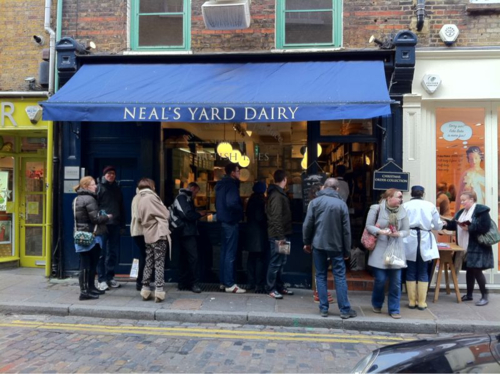
So a week back in Covent Garden was busy, exhausting but fun.  Jokes bantered back and forth.  Cheese was cut. 50lb wheels of Cheddar were hauled around and chopped up into 2kg pieces for display.  Stiltons and Sticheltons were halved, quartered and chopped up continuously.  Customers queued down the street stretching past the shop window and obliterating the doorway of the shop next door (oops – sorry Cambridge Satchel Company) and yet waiting time didn’t exceed 20 minutes in all that time.  While they waited, customers were fed cheese and are chatted to by the ‘door person’ who then directed them to the next free monger when it was their turn to be served.  The busy atmosphere bred energy as the week inevitably built to what had been predicted as the busiest day.  This year it was Friday 21st (luckily the world didn’t end).  The 2 Neal’s Yard shops in that one day sold £75,000 of cheese.  Gobsmacking is the only word that springs to mind.
That makes it 2 Christmases since leaving that I have returned for a fix of the Neal’s Yard Christmas Experience.  Part of me actually yearns for more of the sort of Christmas build up I remember from the pre Neal’s Yard days, decorating the tree on Christmas Eve whilst listening to the Carols from Kings on the radio, making mince pies, making Christmas puddings, really enjoying the Christmas preparations and wrapping presents ahead of time rather than on Christmas morning.  But it’s a hard habit to shift.  Who knows, I might yet don the white wellies again….if they’ll have me back.
the infamous Christmas Queue courtesy of the Rockets & Rayguns blog on Tumblr

The Joy of Creme Fraiche

I may be biased, but I have to hold my hands up and say that I think that the Crème Fraiche from Neal’s Yard Creamery is the best I have ever tasted.  Since leaving London it’s been missing from my life and I had just about kidded myself that I didn’t miss it all that much, until I tried some again and all pretence was gone.  Damn that stuff is good.  I could sit down with a great big pot and a great big spoon and be one very happy girl.  It does everything a crème fraiche should: accompanies a chocolate tart or apple pie, gives a silky, lovely texture to everything cooked with it but equally, you could just sit down and stuff your face with the hard stuff and revel in its light, lactic, buttery flavour that steers just onto the clean side of richness.  I am equally enthusiastic about their yoghurts.  There’s a joy-enducing layer of cream on top and the flavour is so much richer and more complex than the standard, straight-down-the-line acidity of most yoghurts, with an almost salty, savoury edge.
Suffice to say it wasn’t just the cheese that interested me on this trip to Neal’s Yard Creamery.  I have an interest in yoghurt making and the idea of making my own crème fraiche in my own dairy at some future point is definitely something I like the sound of.
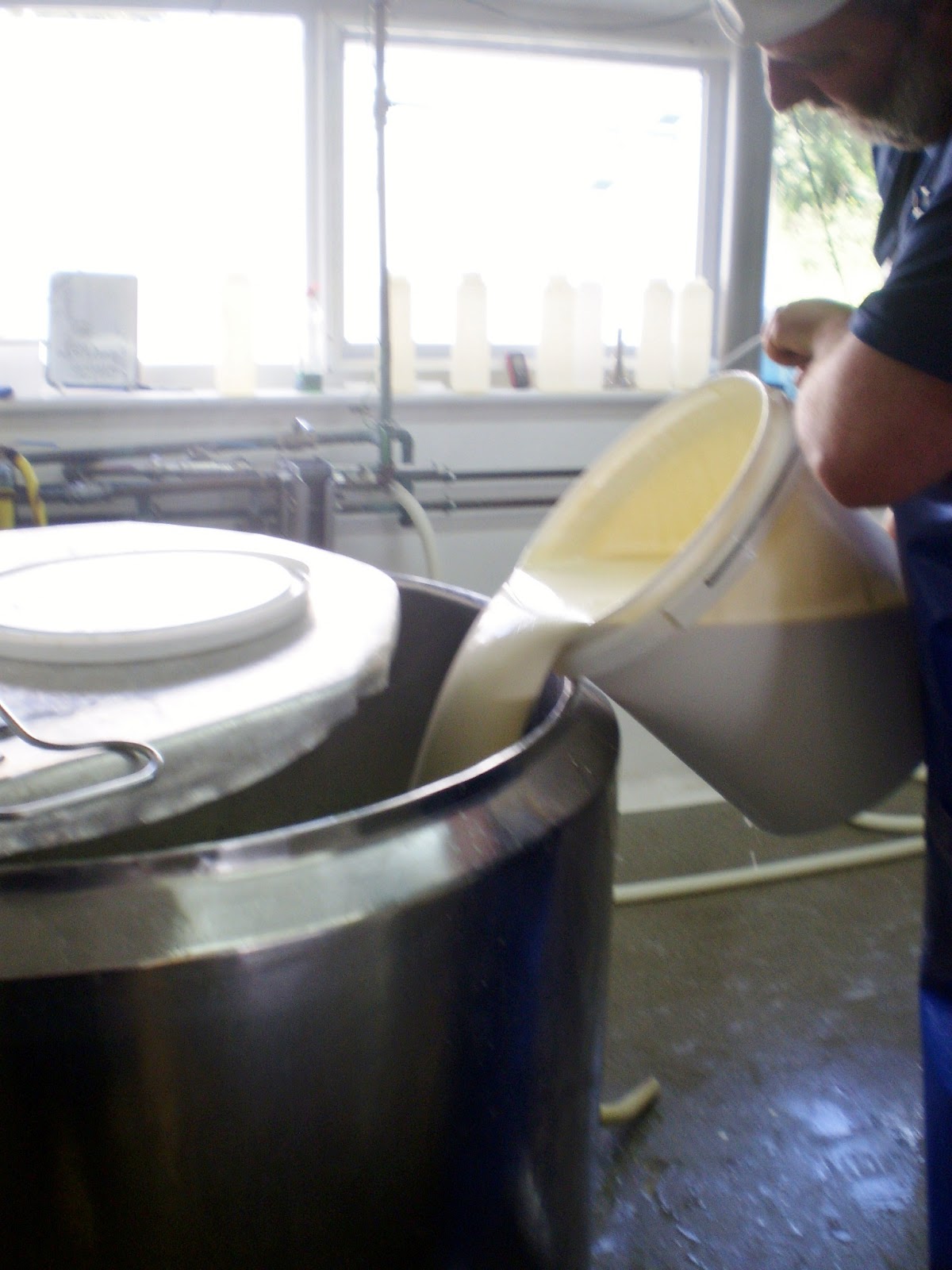
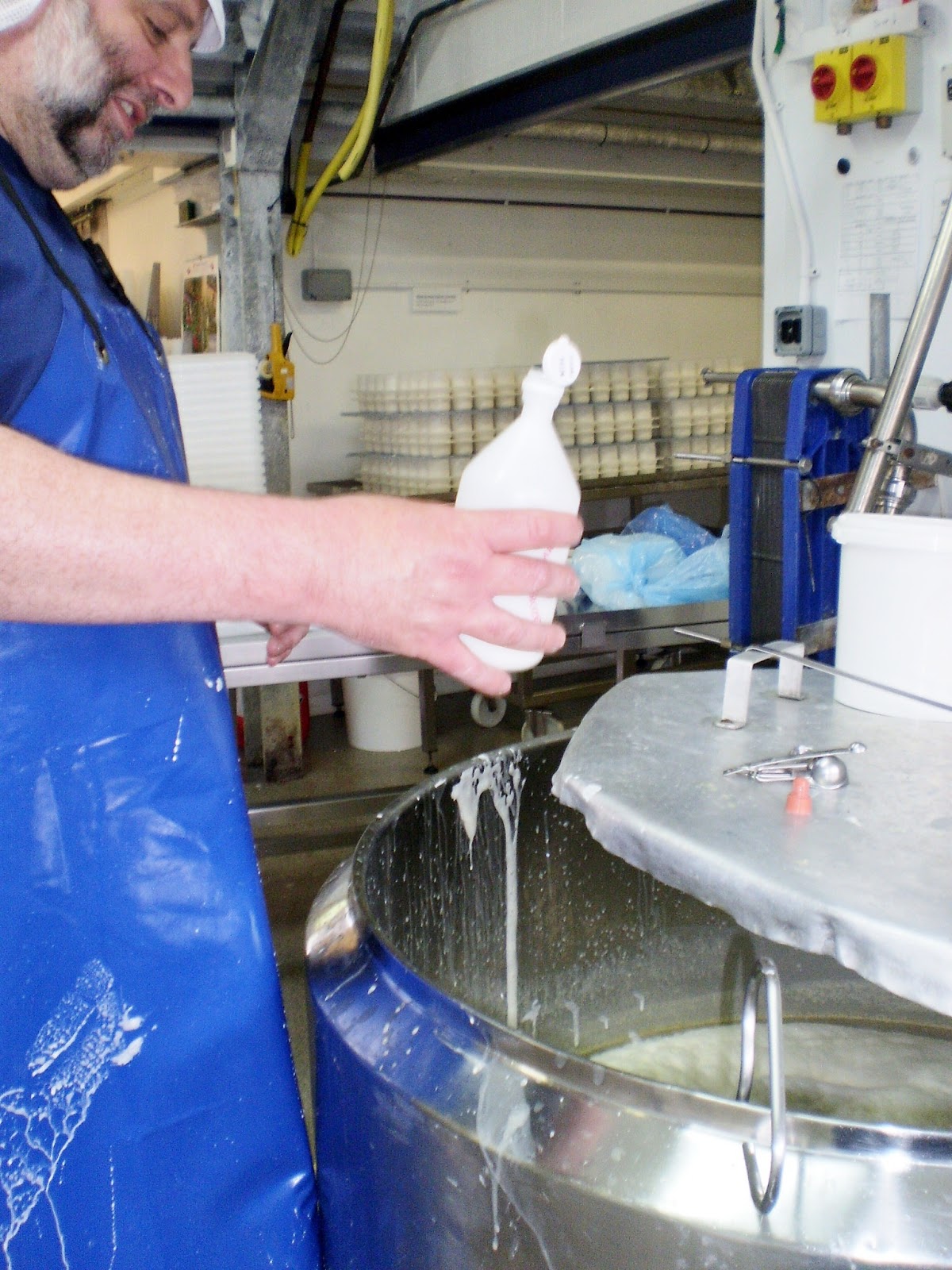
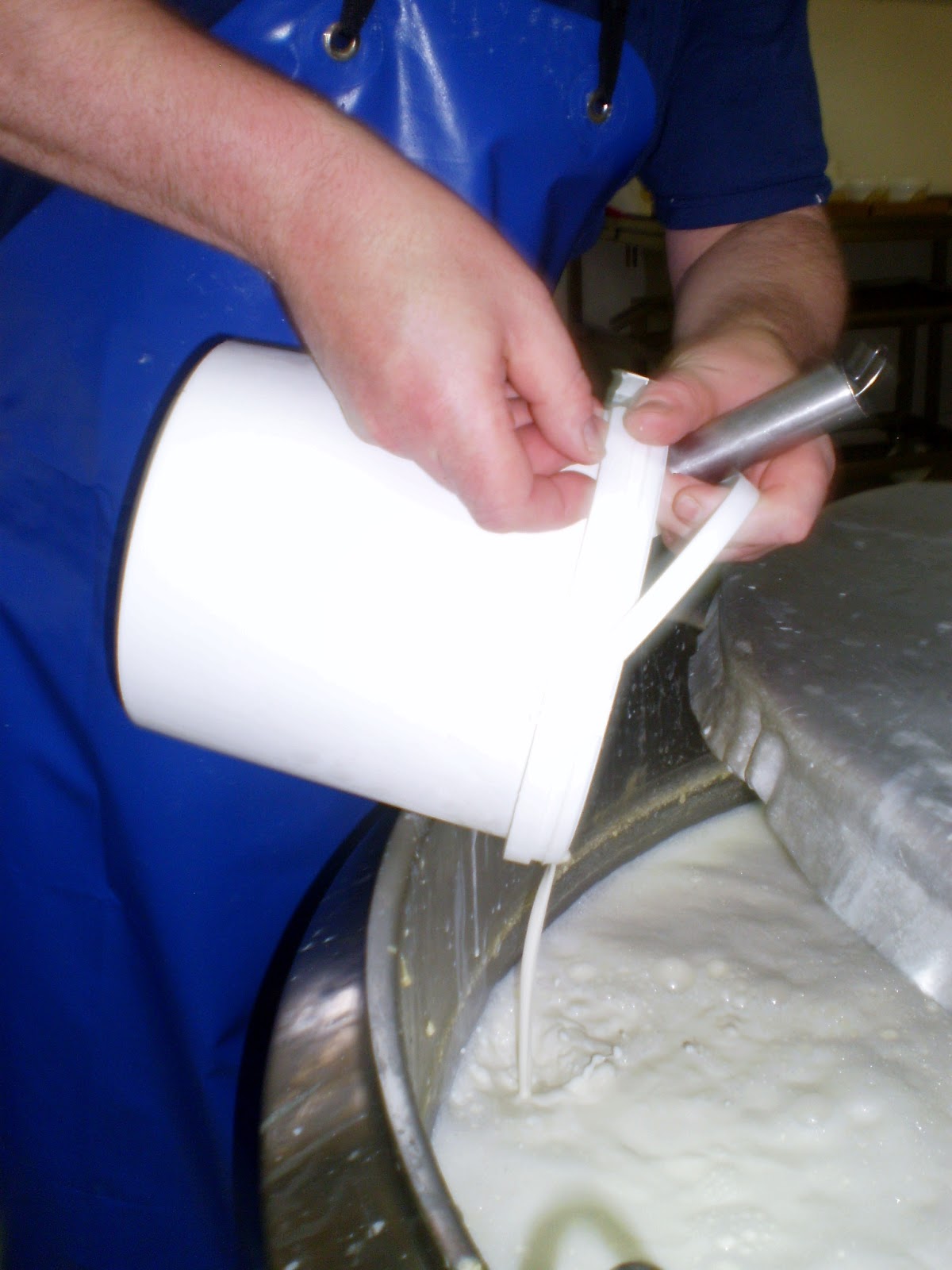
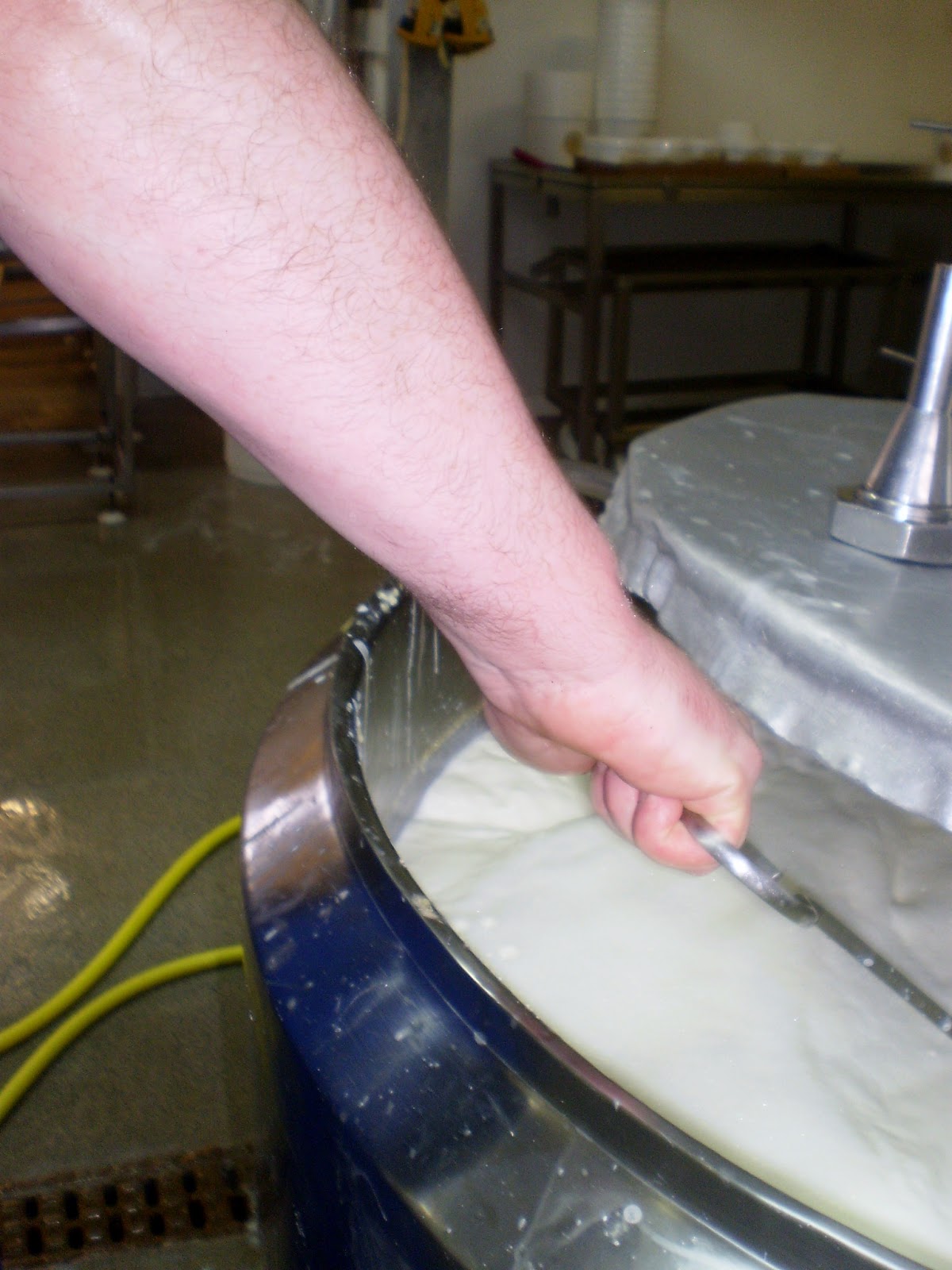
Monday is crème fraiche day at Neal’s Yard Creamery and Thursday is yoghurt day.  Both follow a similar routine as the milk and cream are both heated first before cooling to the appropriate temperature for the starter to be added.   This helps actually form a firmer set.  In an amateur way, at home, I have played around with various ways of making yoghurt using both Jersey milk from Ivy House Farm (back when I was in London), milk from the local supermarket (not really recommended) and finally sheeps milk from Martin & Nicola’s in Cumbria.  I tried it heated first and then cooled and I tried it just incubated from room temperature and can report back that it is indeed true; you get a better set if you heat the milk first.  While a loosely set, very delicate yoghurt is actually quite fun to eat, it’s no good commercially if the yoghurt has to travel any further than from the fridge to kitchen counter.  Same goes for crème fraiche.  So, both are effectively pasteurised and then cooled down to the appropriate starter temperature.  In the case of the Crème Fraiche which is made using a mesophilic starter (the much revered MT36) this temperature is around 26C while the Greek Yoghurt starter, being thermophilic, needs to only cool to a temperature somewhere in the low 40s C.  The cultures added and left to disperse and begin to incubate for a little while, it is then time for pouring.
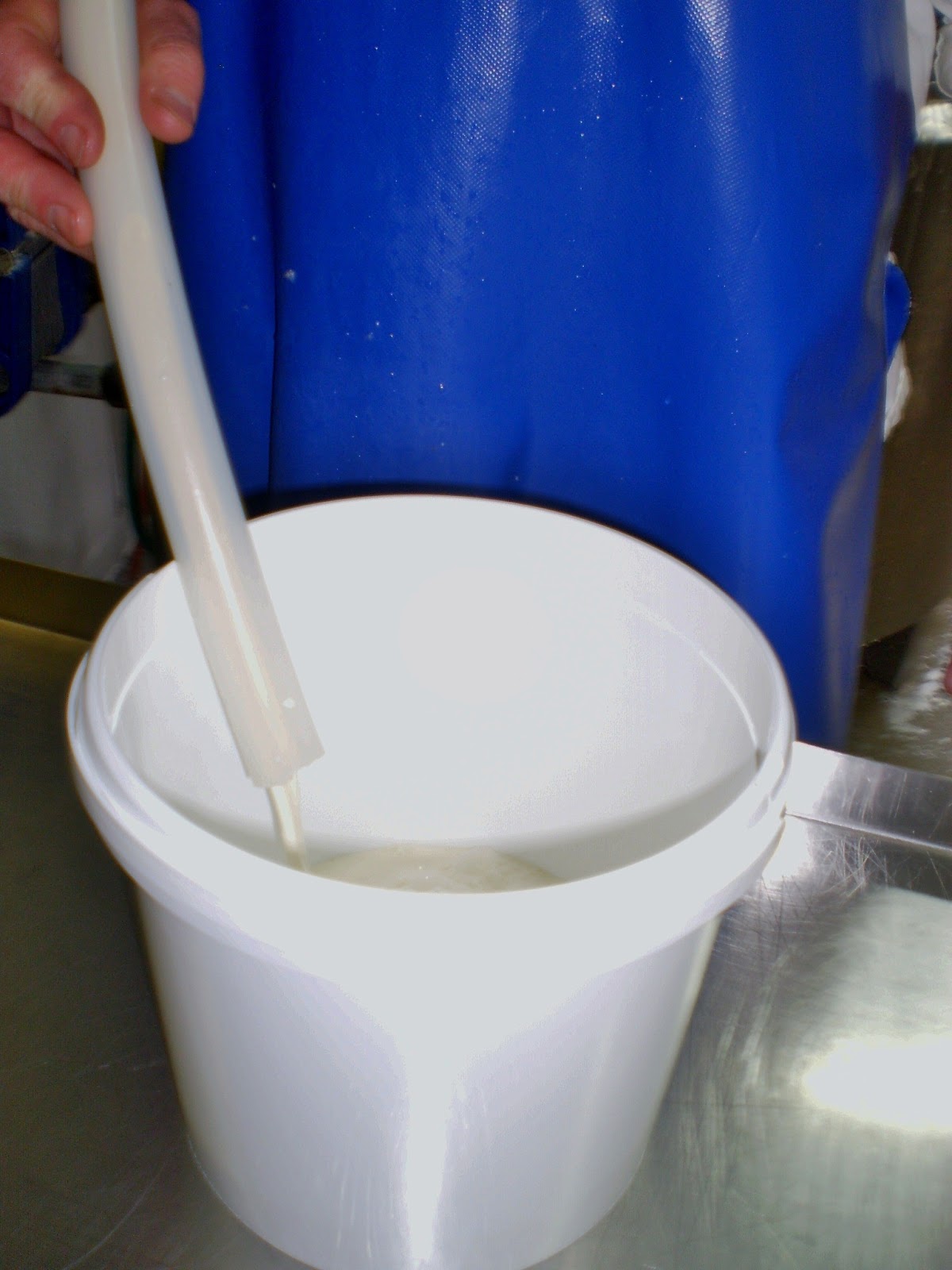
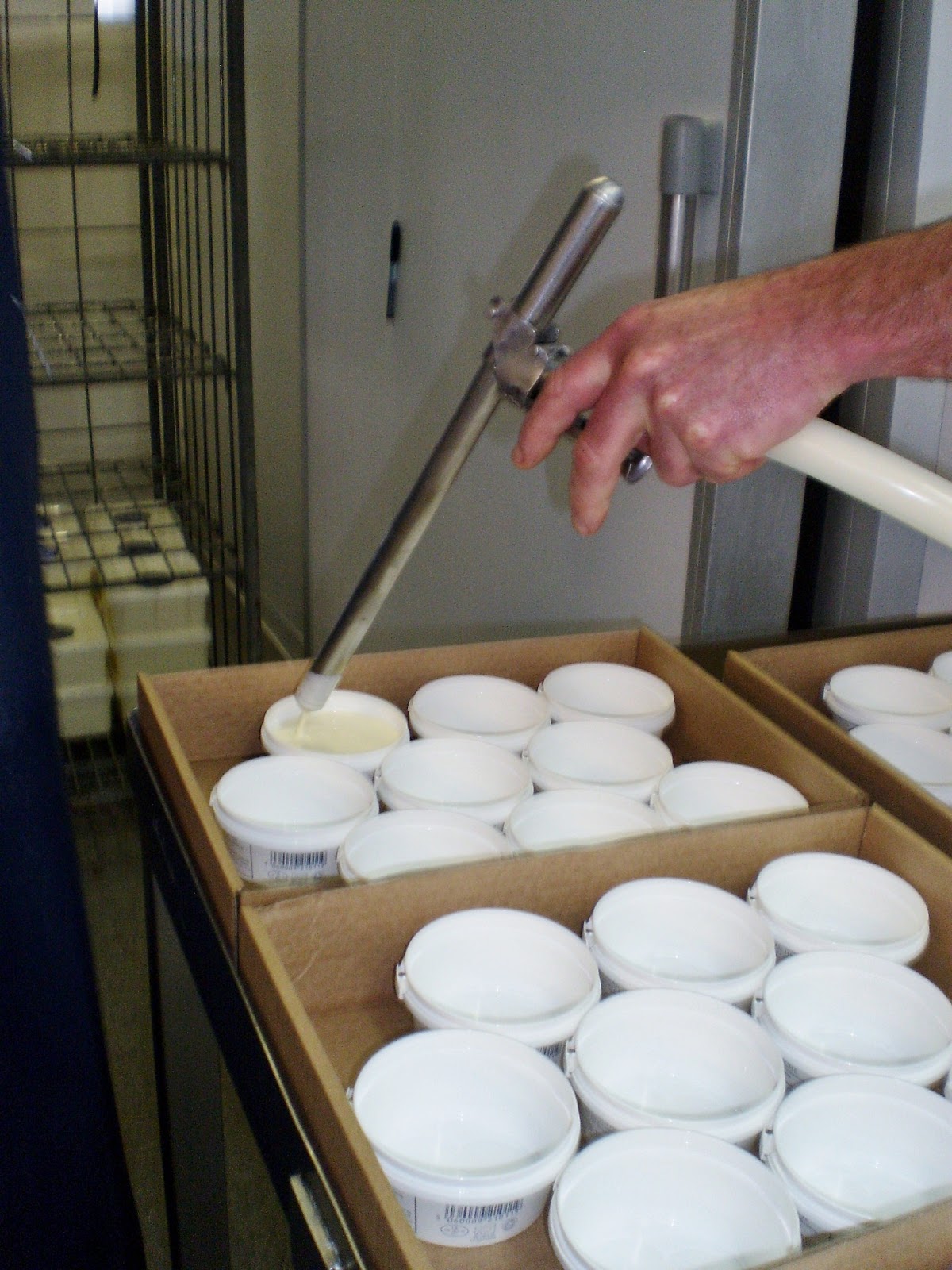
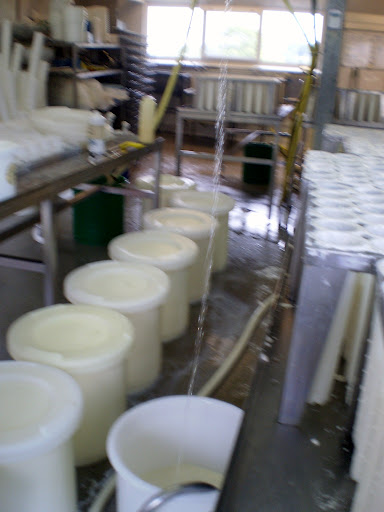
Pouring is an exercise in itself when you make as much of both yoghurt and crème fraiche as Neal’s Yard Creamery do.  A pallet is wheeled in, stacked high with cardboard trays each containing either 340g pots (12oz as it used to be when they started out) or 116g pots (4oz).  All of these need to be filled and no spillage is allowed as the trays then become greasy and messy and any spare crème fraiche or yoghurt coagulates on lids or bottoms of pots and creates a display nightmare for any retailer that is buying them.  Each of these in turn needs the lids snapped on and it has to be done in a particular way so that they don’t bulge and look blown.
Then, after the fiddly work, it’s time to fill the catering sizes: 2.5lt tubs, 5lt buckets and even 25lt buckets.  All of these, once filled, are transferred to trolleys and wheeled away to spend 24hours in an insulated room designed to keep them at just the right temperature to get them to set.  The following day they are refrigerated and from then on are ready for sale.
Pouring fiddliness aside, the actual process is quite simple; it’s choosing your ingredients with extreme care and then handling them with respect that makes for such good yoghurts and crème fraiche.
The organic double cream used for the crème fraiche is delicious and is handled carefully to make sure the fats are kept as intact as possible.
The milk used for the yoghurt is the same milk as is used for their Finn and cows curd cheeses and is already chosen carefully because of its fats, proteins and the care the farmers take over their animals.
Both are heated gently and slowly in a vat rather than being pumped aggressively through a pasteuriser and heated at speed.
Finally the cultures are tried and tested.
They use the same yoghurt culture as was used all those years ago when Neal’s Yard Creamery and Neal’s Yard Dairy were one and the same.  Experience has taught Charlie and Haydn that it works best if they make up a strong bucket of the starter and leave it for a week to culture and incubate, then add it the following week.  Keeping a rolling mother culture going, always using one bucket of last week’s yoghurt, lead to the more complex flavour gradually diminishing to a straight forward acidity.
And what more can be said about MT36 (their creme fraiche starter) except it just delivers.  Used now by Graham Kirkham (Kirkham’s Lancashire), the Trethowan family (Gorwydd Caerphilly), Joe Schneider (Stichelton) and Martin Gott (St James & Brother David), it delivers rich but lactic flavours in whatever it is used for.

Acidity and Cheesey Chemistry

Before any of my long standing friends wonder who I am and what I’ve done with Anne, I should point out that the chemical knowledge in this post is courtesy of the collective brains of Dr Jemima Cordle, Dr Katie Jewell and M. Ivan Larcher who have very kindly either taught me the info or have answered my questions on the subject.  I hope I have interpreted it correctly.  Any chemists out there, please pick me up on any mistakes so I can correct them.

The difference between titration and pH is that you use titration to calculate the concentration of Hydrogen ions by means of measuring the amount of alkali ions you have added to cause a certain colour change.
A pH measurement is the log (base10) of the concentration of Hydrogen ions.
 
pH meter at Neal’s Yard Creamery recording acidity development of Finn curd
Titratable Acidity kit set up at Old Hall Farm
 
Hydrogen Ions, Hydroxyl Ions and Acidity
In a basic solution there will be Hydrogen ions (H+) and Hydroxyl ions (OH-).  The H+ ions determine the acidity of a solution and the OH- ones are in predominance in a basic solution (when you stick both ions together you get H2O which is water)
Although pure water is present largely in its molecular form rather than atomic (which means that there are bonds linking the H atoms to the O atom to form the water molecule) a portion of it is ionised and present as H+ and OH-.
Because these two ions are present in equal quantities in a pure solution of water it remains neutral with a pH of 7. (The actual pH number is derived from the concentration of H+ present). 
When substances are dissolved in water they often disturb the H+ OH- balance. 
When the concentration of H+ is higher than the concentration of OH- the solution is said to be acidic and the pH is less than 7. 
When the concentration of H+ is less than the concentration of OH- the solution is said to be basic and the pH is more than 7. 
Acids and bases can vary hugely in strength. Hydrochloric acid for instance has a lot of H+ ions present and has a pH of 1. Citric acid on the other hand has less H+ ions present in it and has a pH of around 2.5. 
How the pH meter measures
A pH meter is able to directly measure the concentration of H+ ions present in a solution into which the probe is stuck. It then converts this concentration to the pH reading. 
How the TA measures
Titratable acidity measurement on the other hand is an indirect technique to measure the H+ concentration. There are certain ‘indicator’ solutions available that change colour when the solution they are in gets to a certain pH.
In cheesemaking we use phenolphthalein which turns pink when the solution gets to pH8.3. So we add a basic solution (NaOH or sodium hydroxide) to the milk or whey until enough OH- have been added to cause the colour change.
The amount that has been needed will tell you how many H+ ions were present in the original solution.
To milk you need to add very little NaOH because milk contains a very small amount of H+ but to whey from cheese the morning after making, you need to add a lot more NaOH because the lactic acid bacteria have produced a lot of acid and therefore a lot of H+ ions are present.
Buffering
Having said this there is a complication which means that the pH/titratable acidity measurements are not 100% correlated. The complication is an interesting acid/base phenomenon known as buffering.
Buffering happens when an acid or base is added to a solution, but the pH does not change. This happens in cheesemaking because there is a lot of protein present.
The protein is able to capture H+ ions as they are formed and therefore prevents them from ‘being seen’ in the solution. They do not add to the H+ concentration that determines the acidity.
This can also happen with OH- ions – the protein can capture them and stop them from causing a pH change.  
The latter is relevant during titratable acidity measurements because sometimes even though OH- ions are being added they are not being used to neutralise the H+ present and raise the pH to 8.3.  Instead the protein is capturing them.  This distorts the relationship between pH and TA in a non-uniform way.
It will depend on the specific composition of the milk and the stage of acidity that has been reached. 
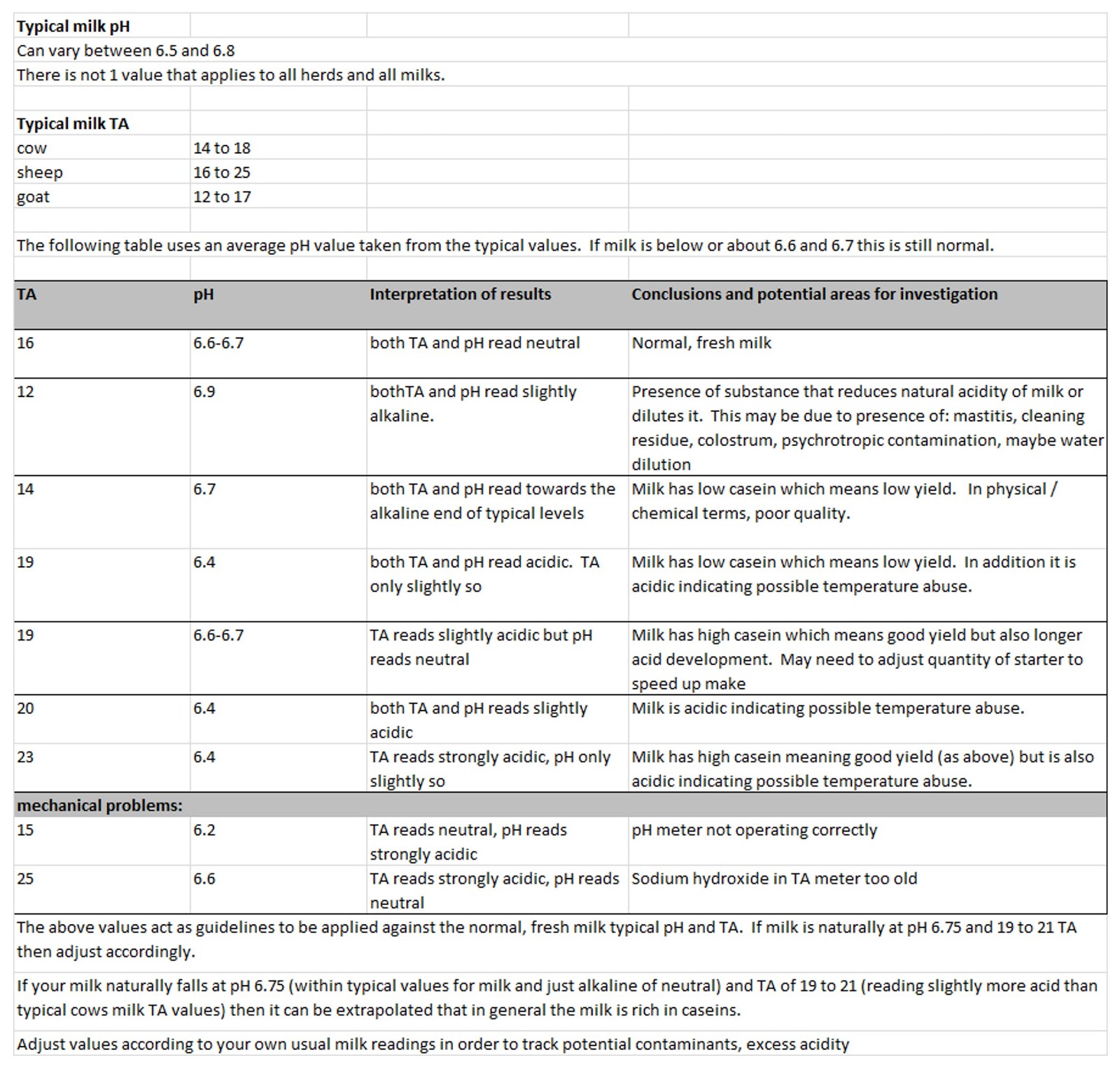
Comparisons of pH and TA therefore on a daily basis can help you extrapolate some physical properties of the milk you are working with – see the chart that follows.


Finn, the Great White Cheese (at Neal’s Yard Creamery)

Lactic cows milk cheese is a subject dear to the heart at the moment as one of the dairies I’m working with, is interested in making a Chaource style cheese.  When I heard about this, it pretty much clinched me wanting to work with them as, independently, I had been thinking of making Chaource myself when I set up on my own, inspired in part by Jasper Hill Farms’ Constant Bliss made over in Vermont and also by a couple of very happy days in the dairy at Hill Farm Dairy making Stawley with Caroline Atkinson.  It therefore follows on that while at Neal’s Yard Creamery I was particularly keen to spend some time observing how they make Finn.
On the Tuesday morning, bright and early, Charlie set off with their little trailer and tank (and yours truly in the passenger seat), heading for the farm to collect milk.  While the goats milk comes from about an hour away in Gloucestershire, the cows milk is a mere half hour away near Glasbury on Wye at the farm of Andrew & Rachel Giles.  Their cows are New Zealand Friesian, a very similar breed to the old British Friesian and as such have higher levels of fats and proteins than the industry standard the Holstein or Holstein Friesian cross.  There are a few Jerseys as well whose influence is probably pretty diluted across the herd as a whole but will give a little extra richness.  They are also farmed on a New Zealand system being out on grass for as long of the year as possible and requiring less concentrates and a more natural feeding regime as a result.  As we arrived at the farm, the milking was in progress and all seemed calm and under control.  We greeted the milkers and unloaded milk from the bulk tank into our little tank on the trailer.  As we filled the tank, I could see in the distance, the cows that had been milked happily making their way back to the fields.  They know their way back without a guide.
Back at Neal’s Yard Creamery, the milk was ready to process.  Starter had been made up and was added.  Double Cream was added too and the buckets left with the milk ripening.  It follows the same lactic process as the goats milk, rennet late afternoon and ladling the following morning but the composition and cream content are less co-operative than with the goats milk.  Cows milk will separate out into milk and cream more readily than sheep or goats milk and especially when kept at warm temperatures such as the 22C or thereabouts that lactic cheeses like to set at.  The danger therefore when making a lactic cheese, is that your cream separates out on top and forms a set cream cheese rather separate from the other curd.  To counteract this, Haydn goes back after the rennet has been added but before it is actually set and stirs the cream back in again.  This is something I have tried too since then when making a couple of batches of Jersey milk cheese and getting the timing right is by no means easy, believe you me.  However if done correctly, the curd the following morning has a lovely clear whey pool above it and the cream is integrated into the mix.  And this is what we found the following morning when checking the pH.
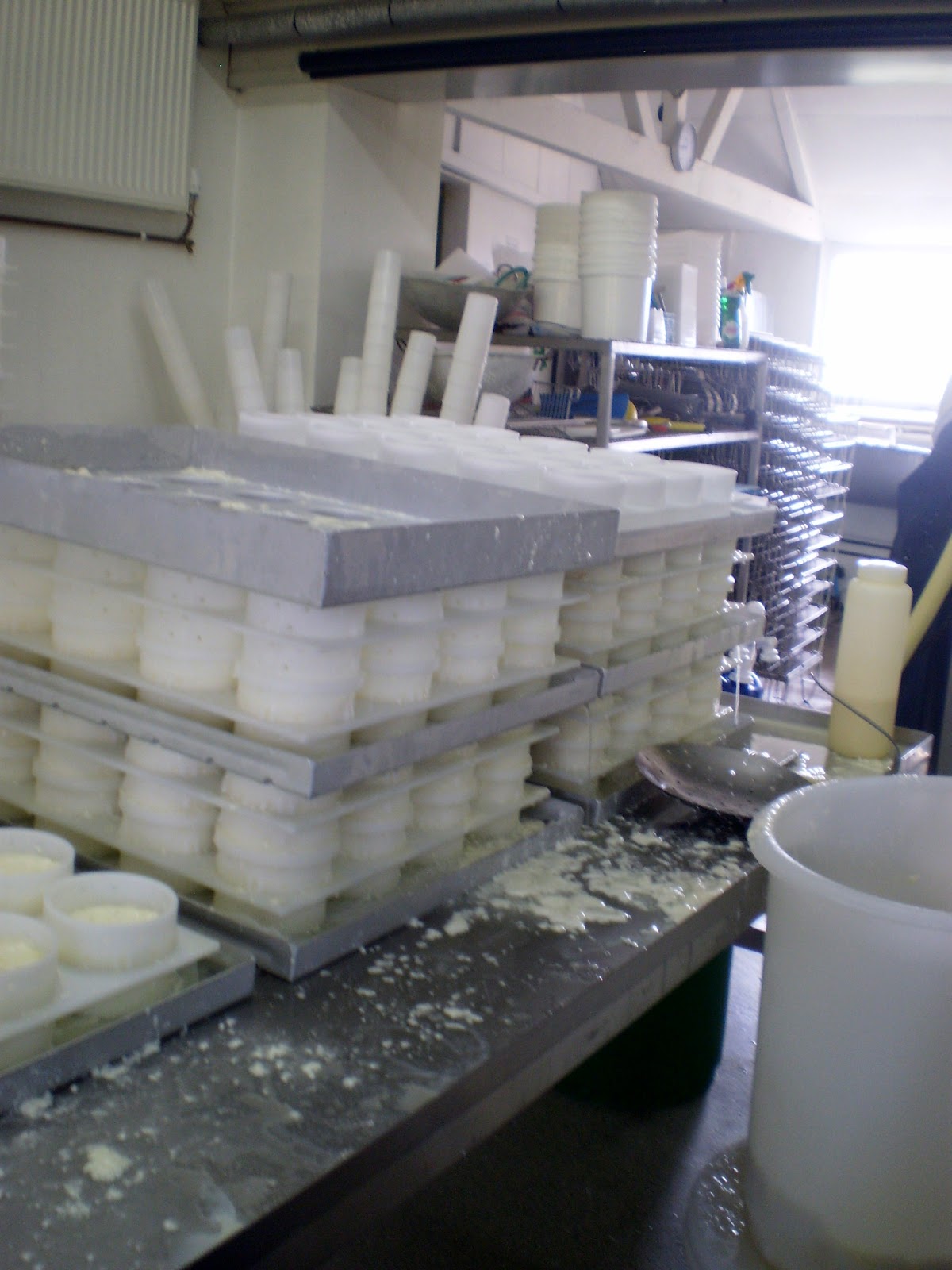
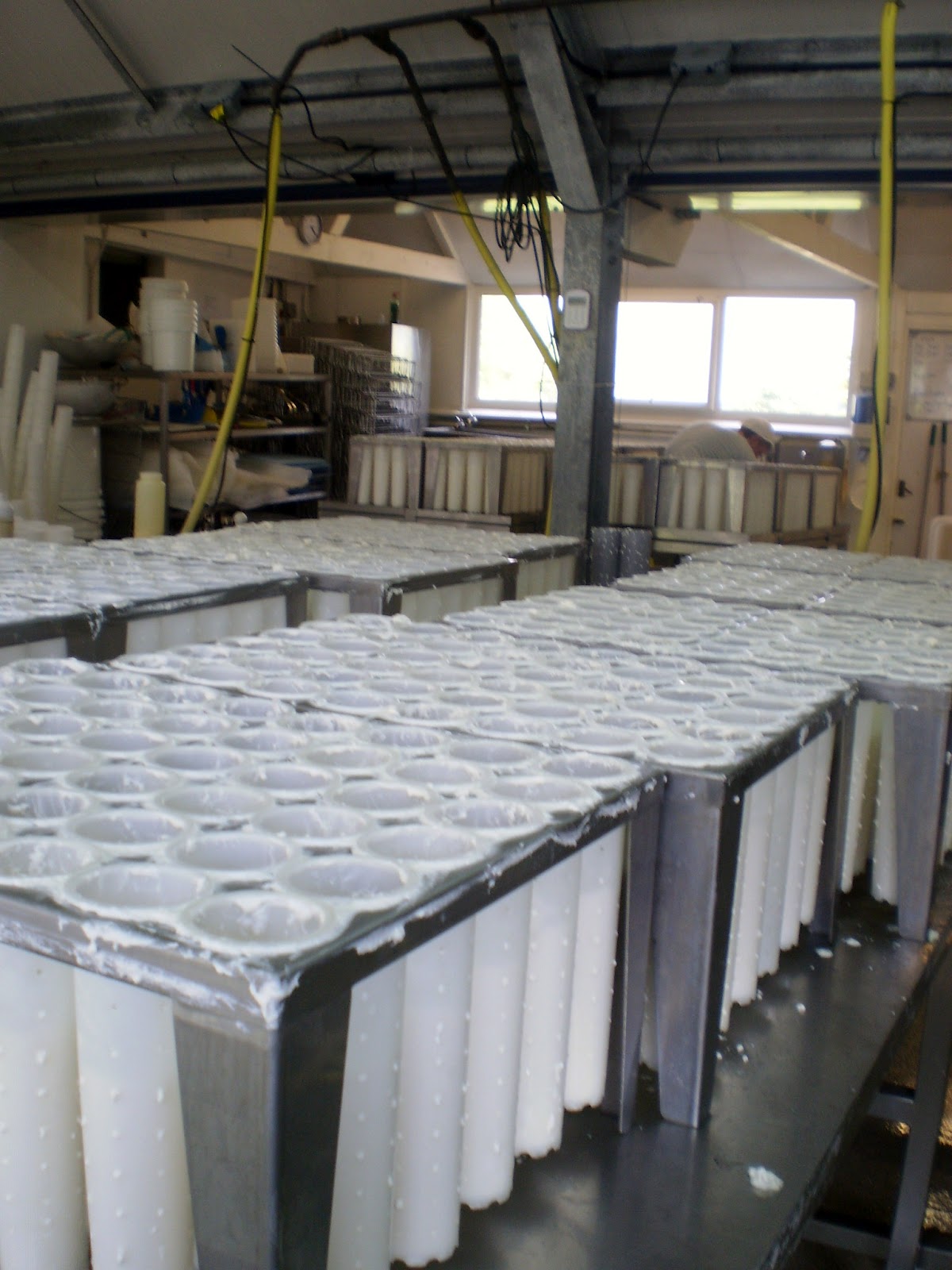
For the Finn, Charlie bought a set of rigid interlinked moulds and draining trays to fit them so they can be stacked as high as the ladler can reach on the draining table.  In my case, that’s not actually all that high but for the considerably taller Charlie and Haydn that’s a great space saving advantage.  They are also beautifully simple to use.  No moulds tipping over of slipping about, you just ladle and ladle until they are full up, then pop a tray and another set of moulds on top and off you go again.  As for washing?  Well they would be a bit tricky to clean by hand, but if you have a dishwasher there’s no problem, and frankly, if you are making over 400 Ragstones a week, never mind Dorstones, Perroche, Perroche logs for catering, Goats Curd, Finn & Cows Curd, a dishwasher is something you will definitely need.
Another thing I was keen to find out about the Finn, is how to control bitter flavours that are an inevitable part of fat breakdown.  Partly Neal’s Yard Creamery have this under control by pumping the milk more gently so that it is handled carefully as it comes in from the tank.   Another aspect in developing the flavour has been dropping the temperature at which rennet is added but rather than protect the fats, this has the effect of allowing greater complexity of flavour to develop from the starter bacteria.  It all contributes, however, to having a rich, buttery lactic flavour that showcases the best of the cream and none of the down sides.

Goats Milk Cheese in the Golden Valley

Before I got embroiled in the vegan debate, I was recounting a visit to Neal’s Yard Creamery.  It’s time to return to June and Herefordshire and in this post, lactic set goats milk cheeses.
Day 1 at Neal’s Yard Creamery and, bright and early, I headed into the dairy.  Charlie starts the day checking over the previous days cheeses and doing odd jobs: checking the acidity of the renneted buckets of curd from yesterday and ascertaining when to cut or ladle them, casting an experienced eye over already draining cheeses and levelling out where necessary.  I gave him a quarter of an hour to get going without someone asking a million questions (‘but why are you doing that? Where’s the such and such… ‘ etc) and then headed in.  Charlie was at work checking pH and ladling an experiment cheese he’s playing with.  Shortly afterwards, the next shift started and with the arrival of Ellen and (a little later) Haydn, ladling began in earnest.
All of Neal’s Yard Creamery’s goats cheeses are what’s called lactic cheeses.  This means that they acidify slowly and over a long period of time but ultimately to a high level.  On Monday morning, the cheeses to be ladled were Dorstone, the milk for which had been collected the day before.  Haydn had been in the dairy, added starter, left the milk to acidify and then at the magic pH point ( I could tell you but I’d have to kill you) had added rennet and left the buckets of curd overnight to set and continue acidification.  The following morning we were ready to ladle.
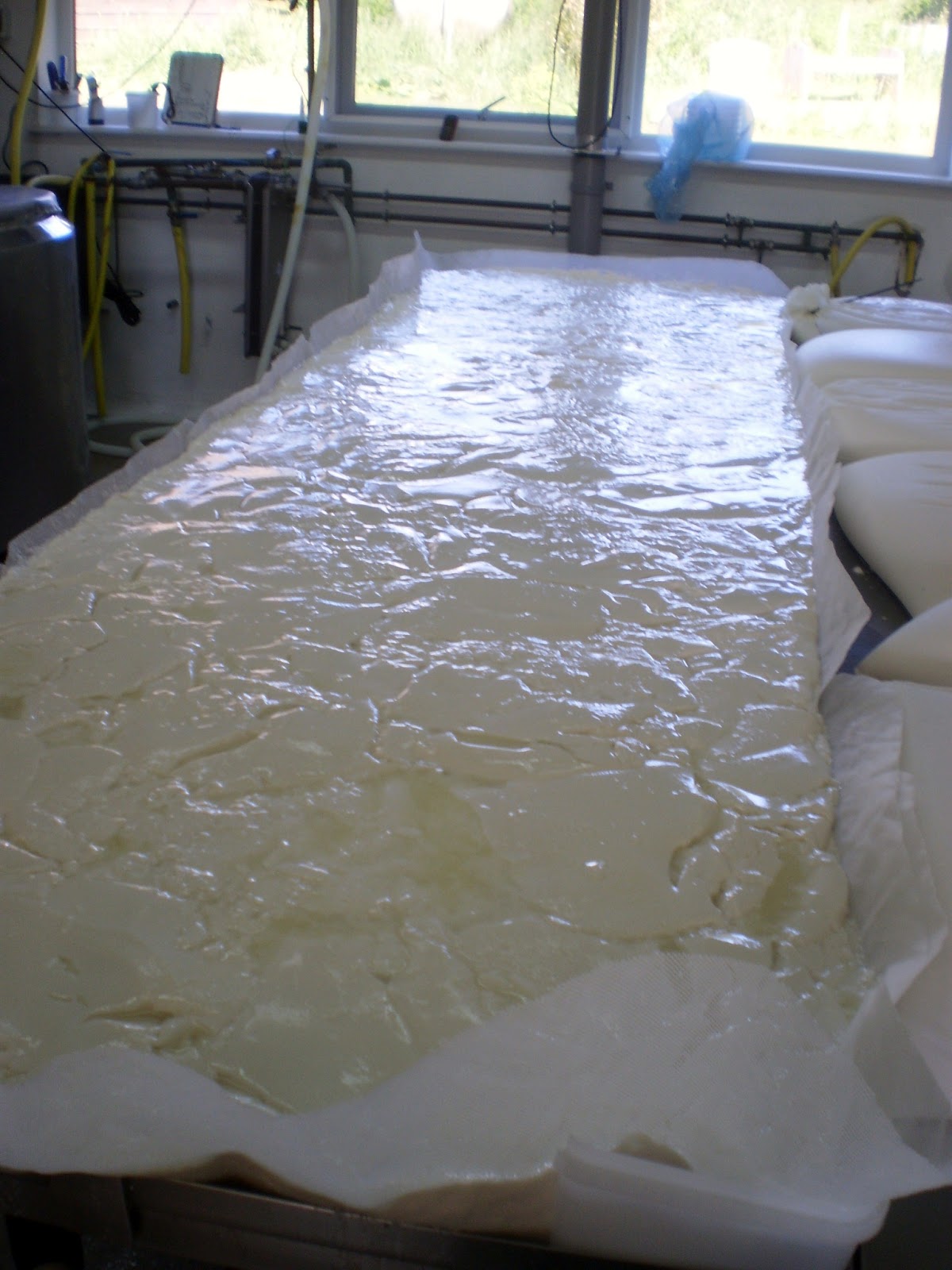
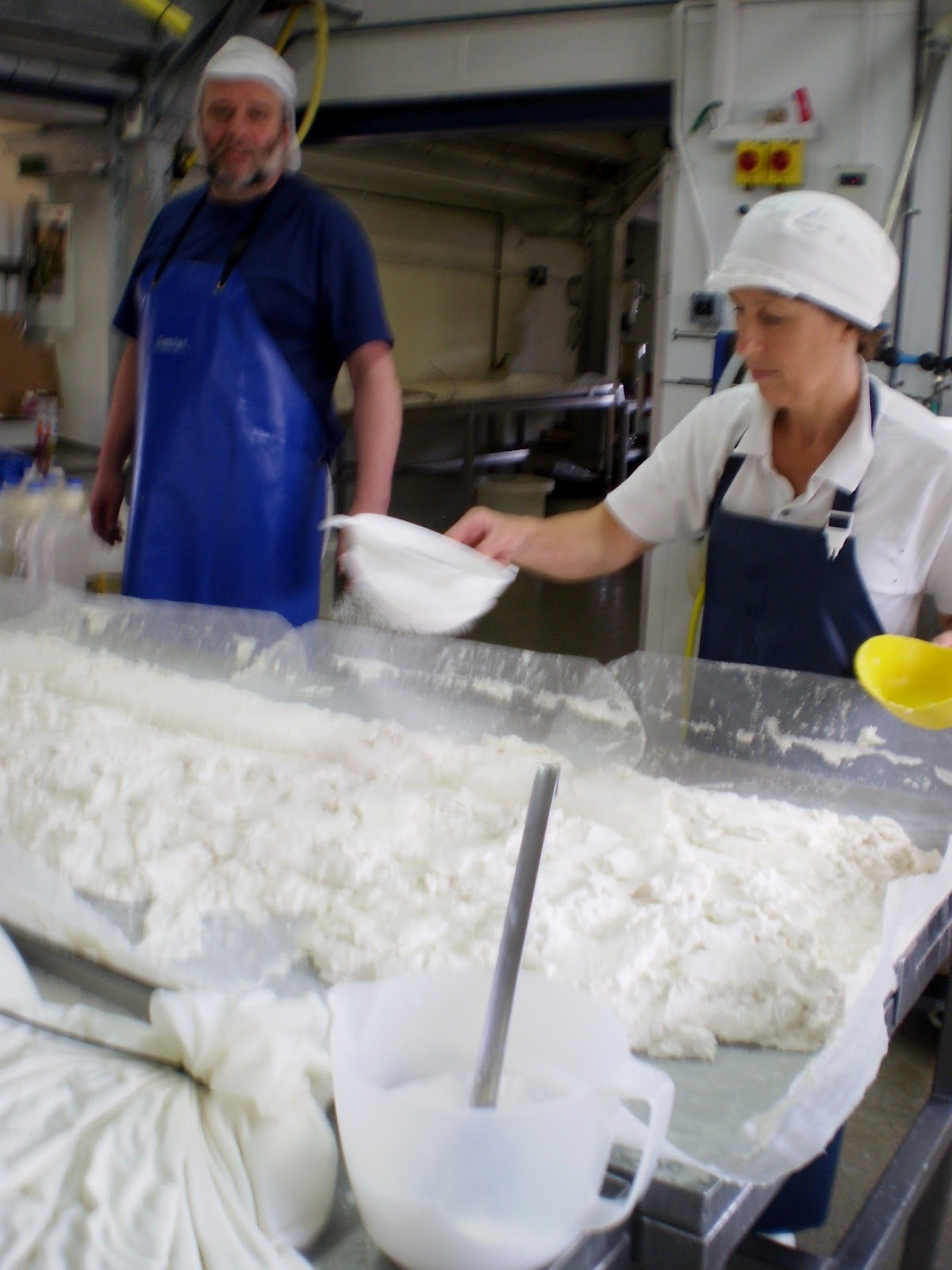
Dorstone curd is pre-drained, which means that before it makes it into the actual moulds that will give it shape, some of the moisture is removed by draining the whole lot of it first.  This used to be done in giant sacks that look for all the world like big curdy pillowcases and this is still done for Neal’s Yard Creamery’s goats curd but Haydn is experimenting when it comes to drainage and the Dorstone.  The drainage table was lined with plastic matting, curd ladled out onto and initial drainage commenced.  A few hours later, the drained curd will have salt mixed into it and will be transferred into cheese moulds which will then be turned out the following morning.
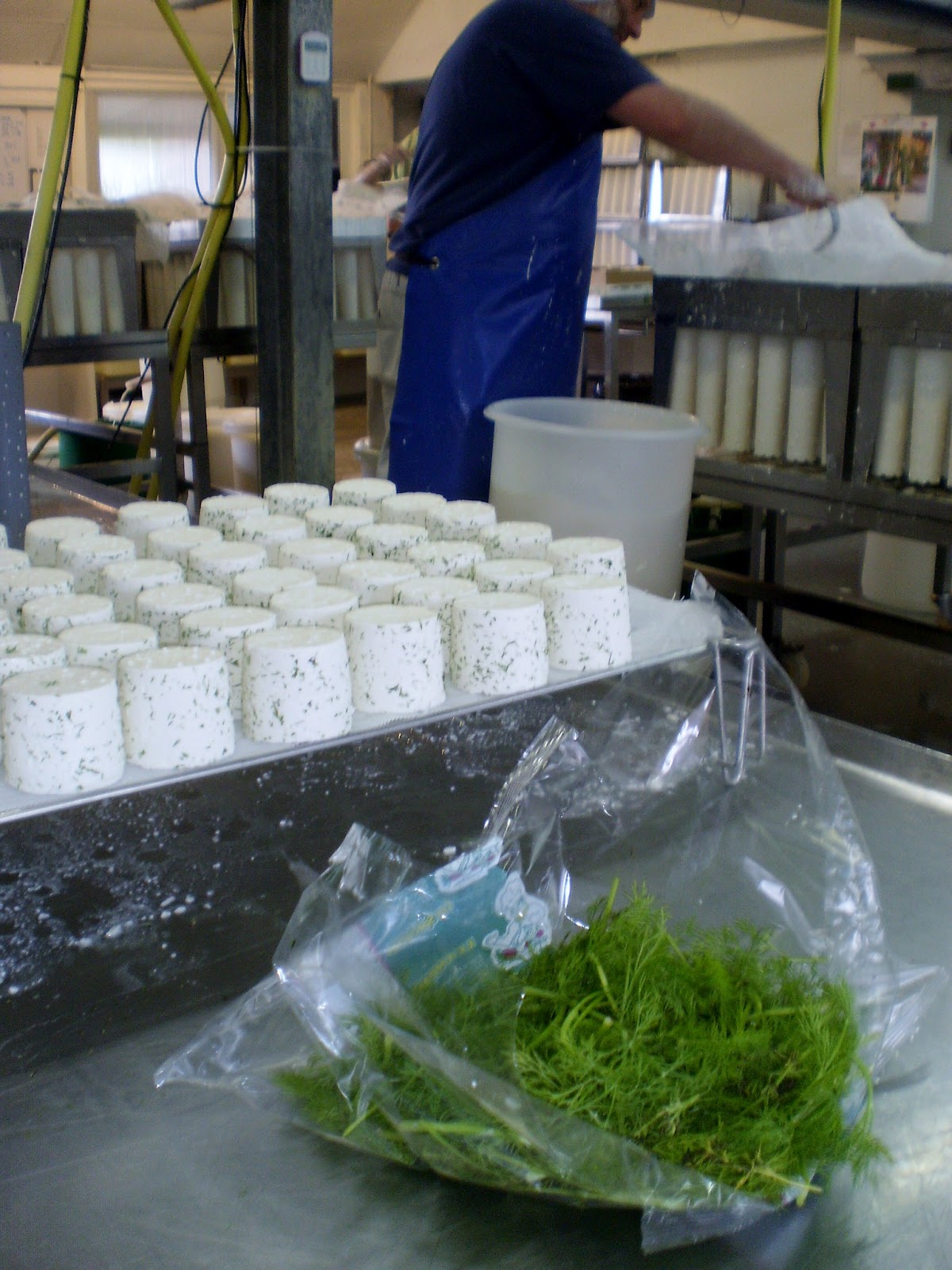
Meanwhile, in a corner of the room, Perroche curd was also being ladled.  Perroche curd is unusual for a lactic cheese because it is cut.  It’s very gently cut and in large squares but a few cuts are made and help get the moisture out.  These cheeses are only ever destined to remain fresh and rindless or in the case of the herb perroche, dusted with chopped dill, tarragon or rosemary.  Simple, but oh how effective.  My particular favourite, since you asked, is dill.  Sadly (for me) the sales on Perroche were good this week and there were none left after orders had been packed.  This meant none for me to buy.  Not in fact that I was allowed to buy any of the cheese I took home in the end, but I did try!
Mid-morning, Tim arrived with a fresh lot of goats milk, which was duly given a dose of starter and destined to be ladled out as Ragstones or Perroche logs the following day.  Meanwhile, Haydn was busy preparing more starter for the rest of the week and heating up cream for the crème fraiche (but more of that anon).  It is genuinely a hive of activity at Neal’s Yard Creamery but one in which each person has their own area and responsibilities and works efficiently away at them.  While all the cheese was being looked after and the crème fraiche being prepared, in a quiet, out of the way corner, Strained Greek Yoghurt was being poured into pots and maturing cheeses from the cold rooms were being turned.
The Ragstone milk is given its dose of starter as the Dorstone milk was.  In the afternoon, rennet’s added and the following morning it is time for acidity checking and ladling and so the routine continues.  Later in the week it’s the turn of cows milk, Neal’s Yard Creamery’s lactic double cream Finn and their Greek Style Yoghurt.  But that, is a tale for another day.

Response to a Vegan

My friend Louisa recently wrote this post following her conversation with a vegan friend.  Her conversation made her think about farming, particularly influenced, as she was at the time, by her pregnancy.  She asked me for my point of view as someone in the dairy profession.
This isn’t the first time I’ve been faced with vegetarian or vegan ideas telling me that dairy is bad, cruel and inhumane.  A vegan has chosen to eschew all animal products so as not to set themselves above another living animal or use it for food.  That is their choice.  I on the other hand believe in being an omnivore as evolution has developed me.  In that context, I should point out, I am not against eating vegetables. Nor am I against eating meals that solely consist of vegetables or grains on a regular basis.  I agree with it.  But I maintain the choice not to.  To convince others to follow the vegan way, dairy farming can be presented as cruel and inhumane.  This is not the reality I know.
The scale of dairy farming that I am connected with is not large scale.  The biggest herd I am aware of is about 450 cows.  In many cases it is considerably less.  To put this in context, there are super farms most commonly in the USA although they exist also in Europe, that contain thousands of cows.  Sometimes tens of thousands.  This is not a world I know. In the smaller scale industry, the herdsman or farmer recognises their cows by their face as you do with pets.  The relationship between people and animals is different of course, but there is affection there in bucket loads.  The farmer, the cows, the milkers, the cheesemakers are a team producing milk and cheese.  The cows work hard, no doubt about it.  They do have to have a calf each season in order to produce milk.  In return they are given the best care the farmer can give.  Are they kept in captivity and forcibly raped each year as Louisa’s friend suggested? No.
Partly this is because the majority of people are basically kind and care about other living animals (human or otherwise).  Farmers are not an exception to this rule.  In fact if you choose to make a living by working with animals, chances are you are a more caring or compassionate person because confronted face to face with another living being, you cannot help but respond with affection or some degree of emotion. At the very least, you feel a responsibility for them.  As a social species it’s in our genetic make-up.  Partly, this is also because contrary to most people’s expectations, it actually makes financial sense as well as emotional sense.  Animals are expensive to buy, rear and look after.  Profits in milk and even cheese production are not very big.  Know anyone who made their fortune from cheese?  Me neither.  You can’t afford for them to be ill, unhappy or badly treated.  It literally doesn’t add up.
However I think it’s worth taking each issue presented in Louisa’s account separately and giving each a response.
 
Captivity
Keeping animals indoors is a more common practice in large scale farming.  I can see how this could be argued as keeping animals in captivity.  However every size of farm is subject to welfare standards and inspected by veterinary officers in the UK to ensure the cows aren’t distressed.   I am not here to answer for large scale farming because it’s not a world I know.  For the record, I am not sure that I agree with keeping animals indoors when nature actually intended them to live in the open.  This actually extends to humans too who in the main are too sedentary and live indoors now much more than is healthy.  However if there’s a decent regulatory system checking that the animals are healthy and looked after, as there is in the UK, I don’t rationally see why it can’t work.
The farms I know and have worked with over 16 years at Neal’s Yard Dairy and more recently as I work more directly as a cheesemaker, keep their animals out in the fields as long as the weather allows.  This means, in the UK, that they are kept outside eating fresh grass from the end of March to the end of October and longer if possible.  During the winter, they are moved into sheds and bedded down on straw that is changed and refreshed several times a day in order to keep them in clean and comfortable surroundings.  It’s in nobody’s interest for the cows either to be up to their udders in churned up mud outside, or for them to be standing in their own shit inside.  That way lies illness and very unhappy animals.
It’s not just an act of basic compassion either.  For the cows to produce milk and work as hard as they do, they need the best possible living conditions.  A distressed or sick animal can’t produce good milk and vets and medicines are very expensive.  Finally, cows cost thousands of pounds each.  If you have either bought in a herd or spent years breeding it up, the very last thing you want is for them to be ill-treated and sick.  The economics and the ethics both go hand in hand on this one.
 
Cow(or Bull) Rape
Louisa’s friend suggested that artificially inseminating a cow in order to get her pregnant is rape.  Furthermore, she stated that in order to collect semen, bulls are encouraged to penetrate another castrated bull all day until enough semen is collected.  It doesn’t quite work like that in my experience.
Cows aren’t always inseminated.  Some people do keep a bull for the job.  It is, however, done in the majority of cases.  It isn’t a dignified process as the semen has to be administered to the animal by the vet using a slim rod that delivers the semen past the cervix.  I have never heard anyone refer to the process as rape as was suggested or the equipment used as a rape pack.  The only term I’ve ever heard used is AI.  Which is what humans have too.
Cows are not inseminated before they are hormonally ready, which they indicate by mounting each other in the field.  They also are inseminated in familiar and stress free environments.  A stressed animal is less likely to conceive.  Given the cost of the semen and the vet’s time, it’s not in the farmers’ economic interest to upset their animals.  Again ethics and economics work to the same end point.
The suggestion that semen is collected by raping a castrated bull did make my eyes open wide and needed a little research.  I have now read many procedures on semen collection (never thought I’d be doing that on a train to London!) and I believe what Louisa’s friend alluded to is a misunderstanding or possibly misinformation of what’s called ‘the artificial vagina method’.  The bull ejaculates into a rubber sheath and cup structure with a hose attached to it.  This may be put on another cow or a dummy covered in cowskin.  The semen is collected from the end of the hose and this is then diluted. Each ejaculation therefore provides numerous samples.  The point being the bull can only keep going for so long.  If the semen is diluted, he doesn’t need to go at it all day.  The participating cow, if a cow is used, is not actually penetrated although I suspect if you watch the youtube videos on the subject (yes there are videos of it and no I didn’t research that far on the train) it won’t look all that pretty.  Animal sex is not human sex and shouldn’t be judged as if it was.  As to how often a live animal is used when a more easily manipulated dummy could be used, I can’t say.  I know what I’d be using if I were in the semen collection business.
 
The Fate of the Calves
After they have been born, the calves stay with their mother for an allotted period of time.  They need to suckle to get the colostrum which will provide them with valuable antibodies as well as rich nourishment.  After the colostrum is finished, they are bottle fed with a formula or with surplus milk.  It depends on the farmer themselves as to which they chose.  Each cow gives on average 20 litres milk a day so depending on how much is needed for processing there may also be milk for the calves.  In the Auvergne in France, particularly with herds whose milk supplies the manufacture of Salers, calves are left on their mothers until they no longer need to suckle.  The animals are milked out in the mountain pasture.  The calves have one teat, the herdsmen milk from the other 3.
Female calves are reared separately to the milking herd until they are old enough to have their first calf.  Comparing this to a child being ripped from its mother’s breast however is loading the emotional balance.  Animals are not humans.  They shouldn’t be treated like humans.  They should be treated well, don’t get me wrong, but they should be treated appropriately.  A cow is a cow, a dog is a dog etc.  Their mentality, emotions and sense of moral structure is not ours.  My dog sees nothing wrong with dry humping his bedding in front of large groups of people or trying to have sex with other dogs on a walk.  If I did that, I’d be locked up and quite rightly so.  Translated into the mother and offspring bond however, it seems generally proven in mammals that there is a basic bond between mother and young regardless of species.  The length and strength of this is commensurate with how much the young need their mother’s protection.  Humans babies can’t cope by themselves.  They are even unable to support the weight of their own heads at first and the maternal bond is a very strong one out of necessity.  Calves are able to stand up minutes after birth.  They grow to full size and sexual maturity considerably quicker than we do.  Consequently the maternal bond between cow and calf diminishes earlier.
The fate of male calves is another issue and not palatable for vegetarians or vegans.  Male calves are superfluous to dairy production.  AI can give a higher rate of heifers because it is possible to use sexed semen, which while not 100% accurate does give a higher probability of female calves being born.  However, the dilemma of the boy calves remains.  It is a source of distress to many dairy farmers that there isn’t more of a use for them in the UK.
In the 1980s, a campaign against veal crates has tarred all veal with the same brush in the eyes of the public be it white veal (milk fed, very young animals, potentially restrained to prevent movement and toughening of muscle tissue) or rose veal (6 month old animals, appropriately fed and allowed room to move about).   Most people in the UK react to the idea of eating veal with horror and the unfortunate knock on effect of this has been to make things worse for the male calves, not better.  If reared for veal, it is true they don’t have a long life.  They get 6 months or possibly a little more which is not a great deal less than lamb or pork.  If they can’t be reared for veal, they have to be killed at about a day old.  This is heart-breaking for the farmer who in many cases has been up all night with the cow to help her deliver the calf safely but farms are businesses and not charity.  One argument faced with this unpleasant fact, says, avoid all dairy.  As an omnivore, I say eat veal.
 
Cast out at 7 years old with their throats slit
On a small scale farm, this is very unlikely to happen to the dairy herd.  Cows are a huge investment.  Not only that, but, as the farmer, you are intensely aware that they are a living animal to which you have a responsibility.  Again the economics and the ethics go hand in hand.  You want the cow to have a long life.  This means good health and happy animals.  I know farms where the cows are into their 14thor 15th lactations which puts them at 16 or 17 years old at least.  I don’t know offhand of somewhere where the cows are still going at 21, apparently their natural lifespan in the wild, but whether that is down to breeding or the act of being milked & therefore the number of pregnancies, I do not know.  There is also a difference in the lifespan between pedigree dogs and mongrels.  Dairy cows are pedigree animals.  As to the ethics of breeding pedigree animals, that is most definitely another argument for another day.
There comes a point when cows are no longer productive and I’m afraid no farmer is wealthy enough to keep them all on as pets.  When the day comes however, they aren’t carted off packed into crates.  There are UK laws governing how many animals you can transport and how much space they need which mean that they actually travel better than most tube going London commuters.  When they are killed it is quickly and humanely done.
 
Do we have the right to farm?
I believe we are omnivores.  We were born with the ability to derive nutrition from plant and animal sources and have developed the mental capacity to farm animals and cultivate crops.  Does that give us a right to farm as such?  No.  We are privileged and it is down to each and every one of us to remember how lucky we are.
To my mind, farming is a service that is provided for those of us who buy and consume.  The animals and the farmers play an equally important part.  As a consumer, I, in turn, play my part.  I choose to buy from farms I know, where the systems are sustainable and the animals well-treated.  If in doubt or indeed in a large shop or supermarket, I look out for organic or RSPCA approved labelling as providing a certain standard.  If it’s a smaller shop then I ask the shopkeeper.
One area on which Louisa’s vegan friend and I might agree is that you should think long and hard about what you eat and where your food is coming from.  After that, we differ entirely.  I am evolutionarily adapted to be able to eat meat and dairy as well as plants.  I am lucky to be born into this position and I don’t see shopping as a casual act.  Where I spend my money reinforces this privilege, and my food choices have consequences.  Our position in the food chain should not be abused.
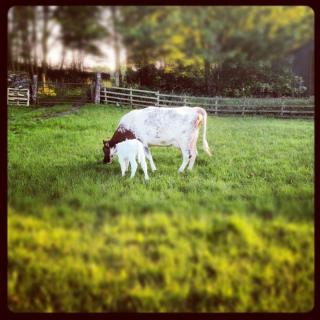
A Dairy Shorthorn Cow and new born calf on Holker Farm whose herd currently contains 8 cows.

Anne goes to Neal’s Yard Creamery

At the end of June, I spent the best part of a week at Neal’s Yard Creamery in Herefordshire learning and making cheese, crème fraiche and yoghurts with them.
In the past I’ve made lots of social visits to Herefordshire in general and Neal’s Yard Creamery in particular so it was great to be back and to catch up with Charlie, Grainne, Conan, Holly, Finn and Rags the dog.
Although initially Neal’s Yard Creamery and Neal’s Yard Dairy were one and the same, the two parted ways after a few years when Charlie Westhead, until then an employee at Neal’s Yard Dairy working in the shop and driving around the country buying and selecting cheese, moved into cheesemaking and developed Neal’s Yard Creamery as a separate and sister company.  At first they were situated out at Ide Hill, near Sevenoaks in Kent but in 1996, Charlie moved the business to their own premises overlooking the Golden Valley in a particularly beautiful part of Herefordshire, near the border with Wales.
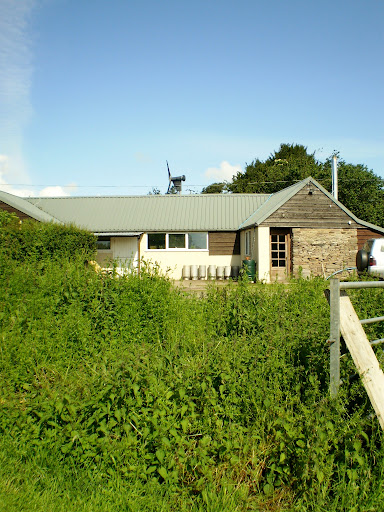
The building that houses Neal’s Yard Creamery these days is an open-space, converted farm building that has been extended to house a variety of cold rooms and cheesemaking space.  The impressive thing, when you work alongside them, is the variety of products they manage to make and how they are able to organise the space in order to make each of them.
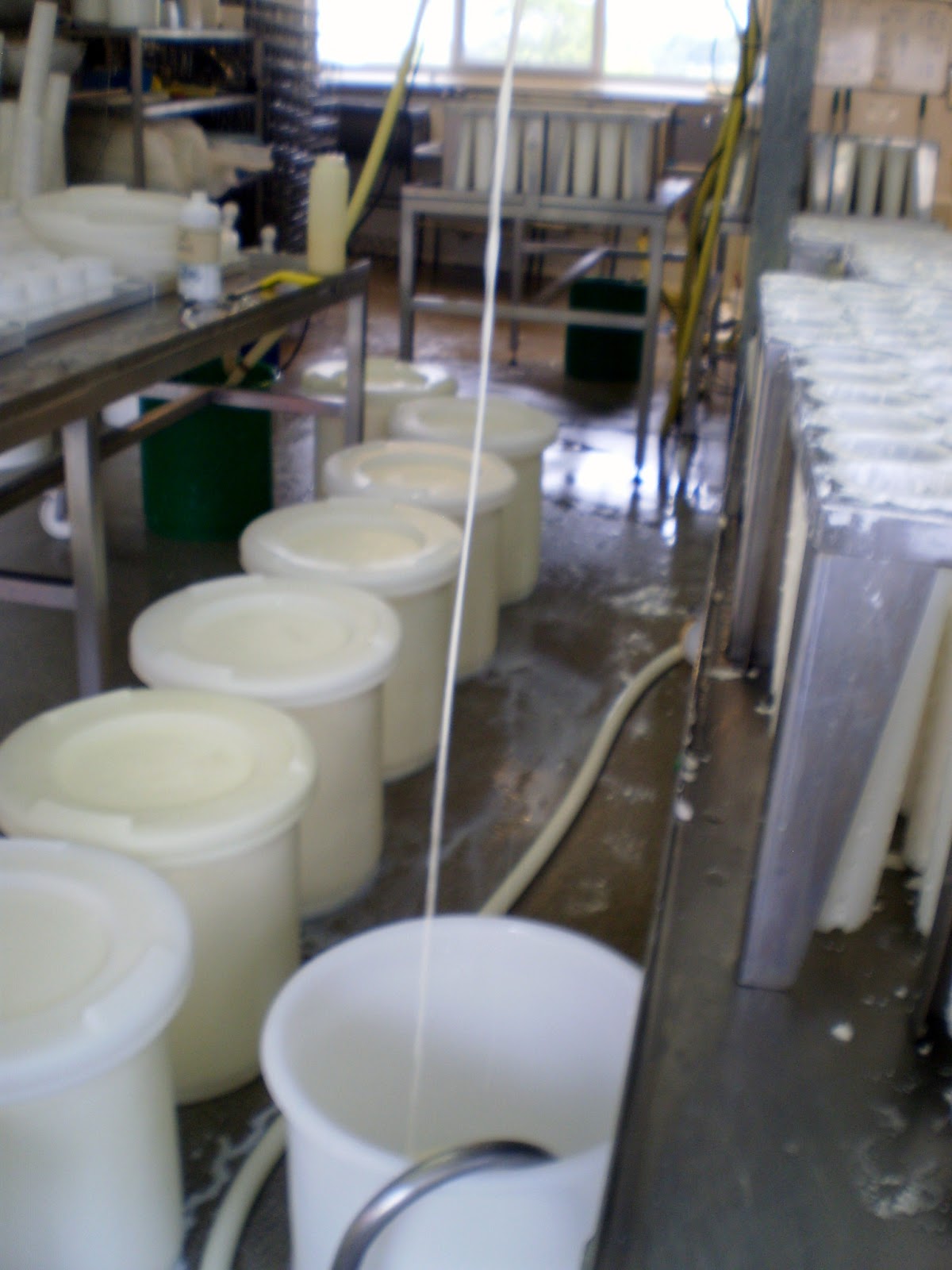
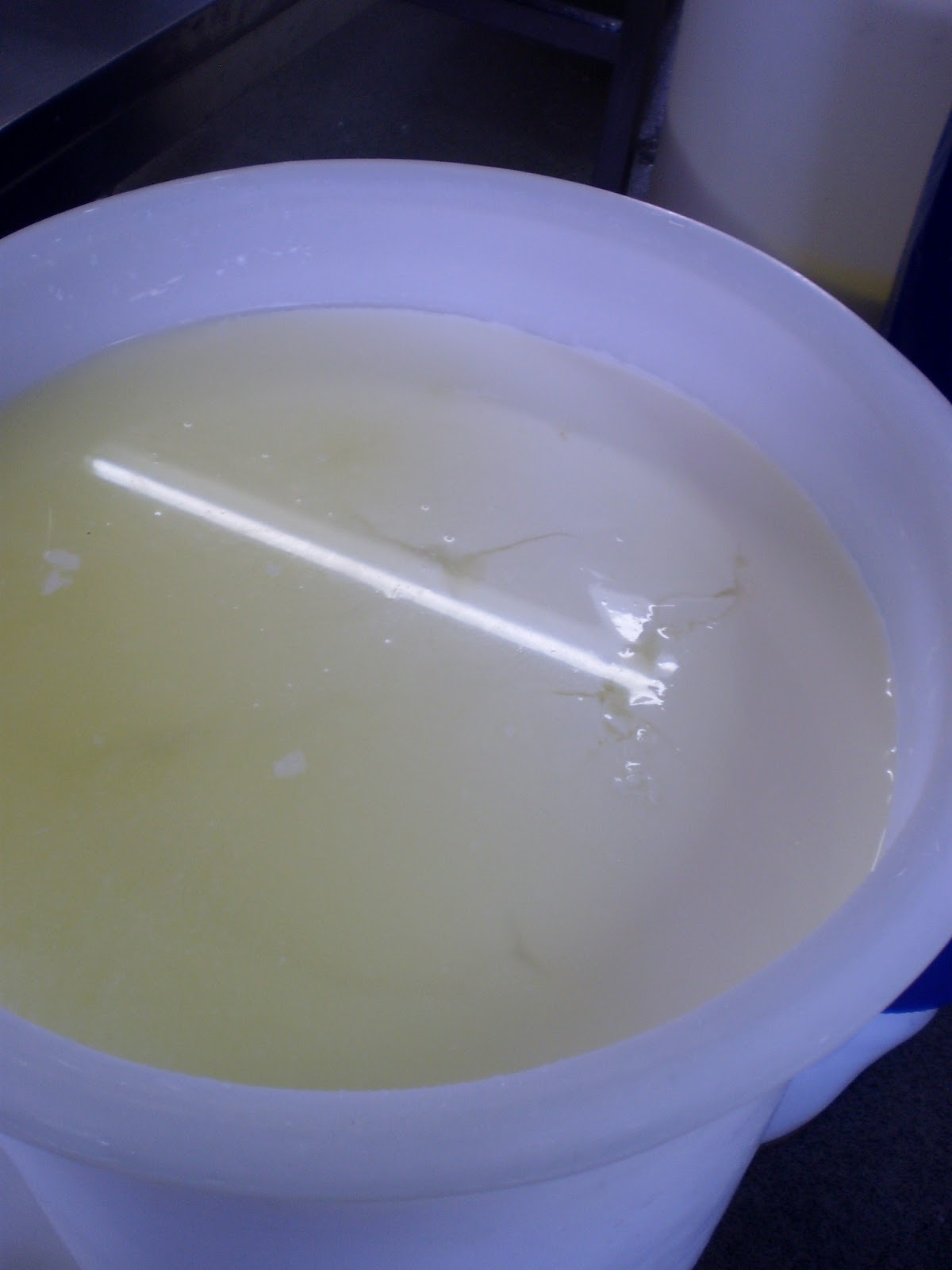
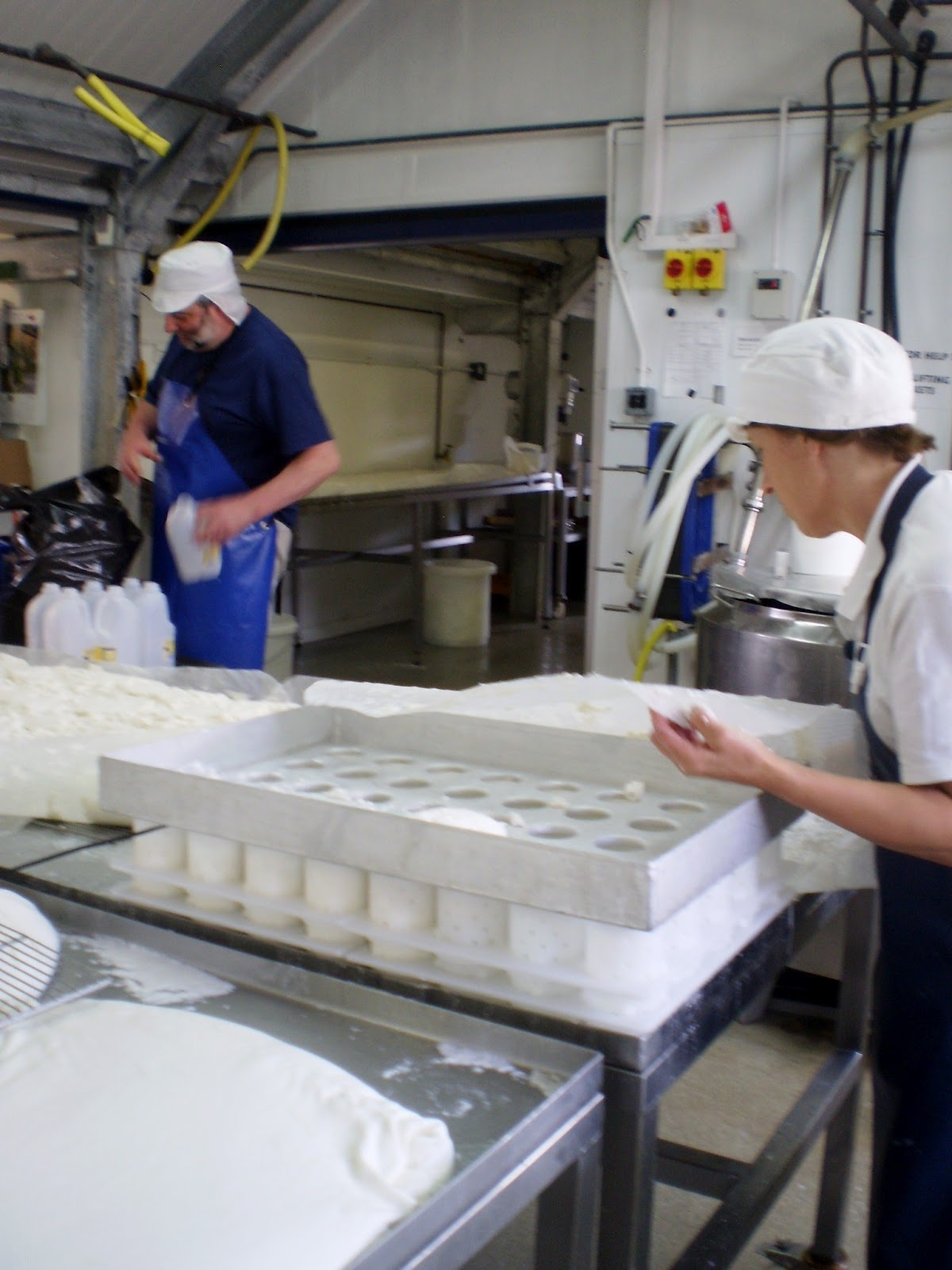
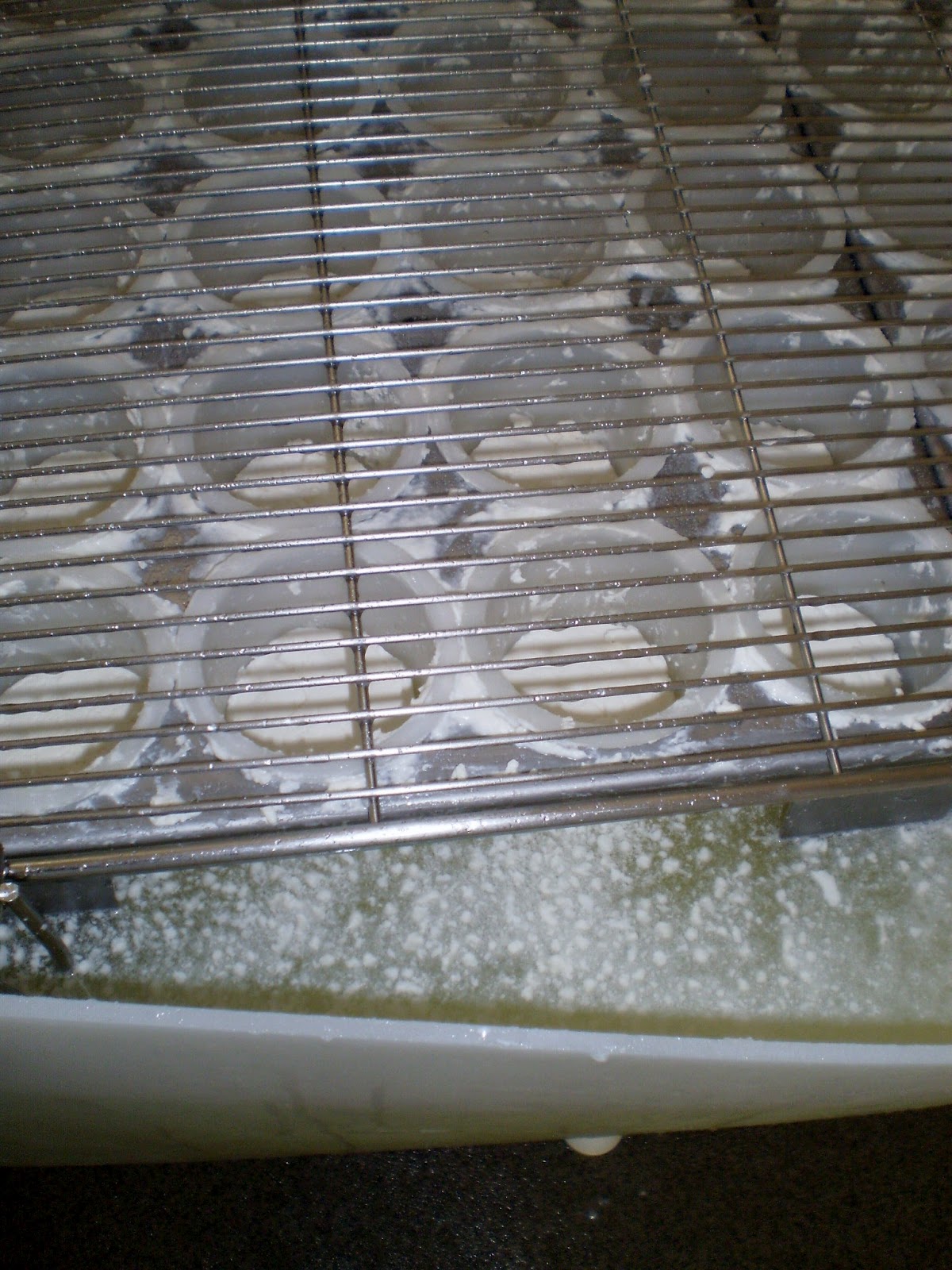
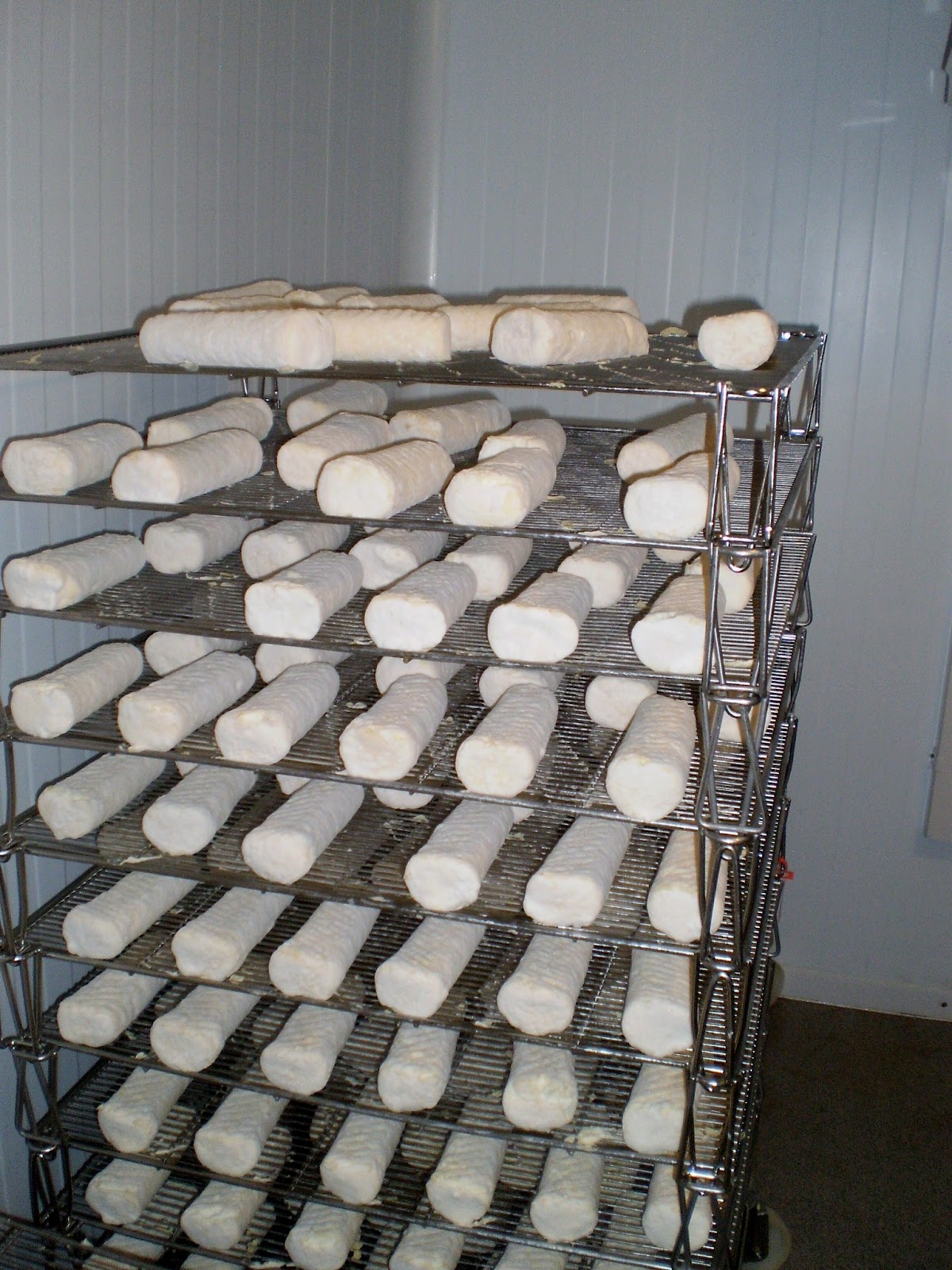
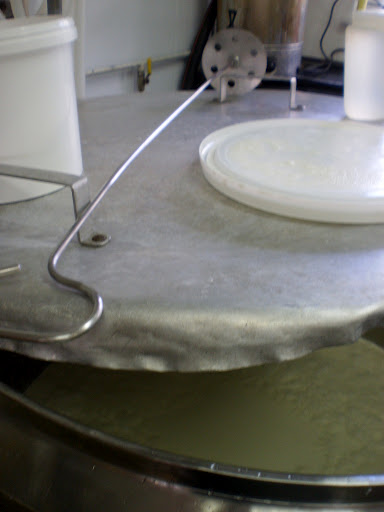
There is no cheese vat.  Milk is set in a series of plastic tubs for the cows milk cheeses and goats milk cheeses alike.  They are then ladled onto a series of draining tables.  In amongst the draining cheeses, workstations are set up to wrap the fresh cheeses or to transfer the maturing cheeses onto wire racks and then into the appropriate incubation room or cold room.  Meanwhile, a small vat in the corner heats the milk and cream for yoghurts and crème fraiche and at the appropriate time, the mixture is poured into pots to be incubated and set.
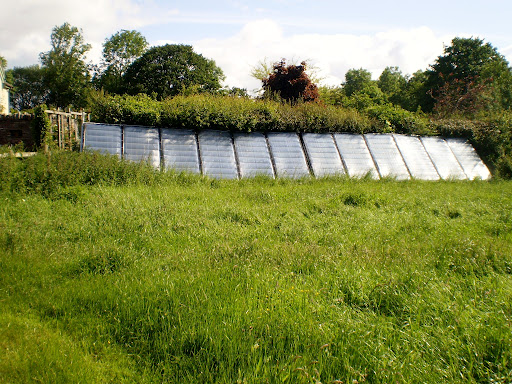
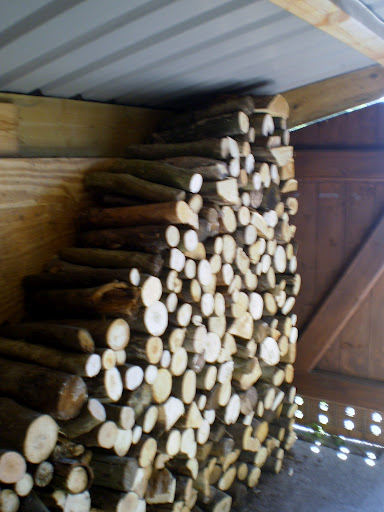
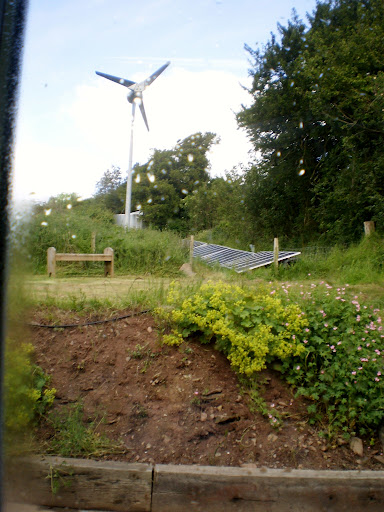
Another thing I had been wanting to look at, as well, with a view to giving feedback for a dairy I hope to work with in Oxfordshire was the alternative energy sources Neal’s Yard Creamery has.  A windmill and a series of solar panels provide power and contribute to hot water.  Their boiler is wood powered and so effective that not only Charlie but also his longstanding head cheesemaker Haydn Roberts sing its praises.  If you make the amount of cheese, yoghurt and crème fraiche that these guys do, you really appreciate hot water for your washing up, not to mention for heating up all the milk and keeping the whole Creamery warm!

It was a fascinating week in which I learned far too much to report in one post.  Stay tuned for more cheesey details.

For Anyone who has ever worked in Marketing…

Dear Cheese lover
My name is Donald Coyle and I’m writing to you today to tell about what’s great about the Cheesier Cheese Cheese Company.
Unlike so many cheese companies that pretend to deal in real cheese selling ludicrously named processed gimmicks like Kermit’s Lancashire and Quirkes Cheddar we only deal with genuine traditional cheeses like Mrs Cobblebottom’s Old traditional Double Wensleydale with chive and balsamic tomatoes. We believe too much of today’s cheese market is dominated by marketing men full of advertising speak and Armani suits that’s why all our marketing men wear smocks, straw hats and mutter in an authentic Somerset drawl (some even sound like they’ve been to Norfolk!).When dealing with traditionally made cheeses that have been matured for, in some cases, as long as three weeks, it is essential to educate the public; take them by the hand, so to speak, and let them walk with you through the cheese garden and smell the various cheese flowers and smile as the cheesy bees spread the cheese pollen and turn the cheeslets flowers into big mummy and daddy cheese fruit.
Take, for example, Old Mr Skruttock’s blue-veined, log. Most people are surprised that it’s not blue at all, more a brown colour with a lumpy curd structure not unlike a poorly made bar of chocolate. In fact only last week someone visited our shop in the old quarter of the Millennium Business Park for Innovation and dropped their log right outside our door. Our specially trained staff of Innuit cheesemongers had their lab coats and visors off in a flash, but could not catch the woman in time to tell her how great Old Skruttock’s log is grilled and tossed into salad or grated on some fish.

Besides customer service we believe in getting the right product. Selection is vital. To this end we demand only the latest, up-to-date catalogues before we make any purchase. Selection is also part of getting to know your supplier, putting a face to the name, photographing it and keeping it on file. I can remember when I was a junior sales executive meeting my first supply-client in a lay-by off the old A30, I was so excited, he a little nervous and undernourished and after we convinced him there was no means of escape we got on like a house on fire, which was ironic as his house burned down soon after and he found himself cooling his heels at Her Majesty’s Pleasure before we could pay him for the eighteen wheels of his exquisite rabbit liver Cheddar he had in the bucket of his digger. We gave all his thirteen children a place to live and work for only a nominal fee – I mean, what are friends for.

So the next time you fancy some real cheese, pop down to your local chemist and try some Old Mother Scuzzbucket’s little goats’ milk cretins, or scoop up some of Brian Problem’s runny Brie-style cheese – Brian’s Runny Problem (not suitable for pregnant ladies, old people, young people, middle-aged people or small animals) and enjoy.

Enjoy

Donald Coyle

—————————————————————————————-

(I can’t lay claim to this particular masterpiece.  It is the work of one Dominic Coyte, cheese legend, formerly of Neal’s Yard Dairy and now to be found selling Comte at the Borough Cheese Company in either Borough Market or the Maltby Street area.  Dom, I salute you.  This little piece of writing dashed off one afternoon is, for me, the gift that just keeps on giving.)

Head, Heart and Gut

Out in the big bad world of consultancy and self employment, the consequences of different expectations can be significant and trusting your gut is invaluable.   It just takes practice to know when to call it.
There are those that suggest there’s no room for the heart in business, and, while this is something with which I utterly disagree, there are times when the 3 way decision process of head, heart and gut get a little complicated.  This sounds a little cryptic and not unlike an offal menu choice in a restaurant to boot?  I will elaborate.
I have been waiting to work with a farm in Cumbria about which I’ve posted before.  The whole process has not been straightforward from the get go.   Someone with more experience than me would have cut their losses sooner.  Someone with more experience than me actually did.  It was they who put my name forward, thinking, in all fairness, that it would be an experience that I could learn from.  I have indeed, but perhaps not in the way that any of us expected.
The farm itself is beautiful, with 18th century stone barns, horses and cows out on pasture, a tiny  slate-floored butter-making dairy, wooden stalled milking parlour and the most picturesque of dairy cows, long eye-lashed Jerseys.  For a potential cheesemaker there is a lot to excite the intellect and rev up the gut instinct as well.  There are so few cows that cleanliness in the milking parlour is phenomenal, the animals are milked into a bucket with no lengths of pipework to require excessive pumping, or with difficult to clean corners.  They want to set up a dairy and produce cheese.  So far so good.
So in the winter, as work at Holker Farm was winding down and Martin put me in touch with them, why did I hesitate so long before calling?  Certainly part of it was nerves – what if they say no?  However, I was also unsure that we were on the same wavelength.  This seems a crazy thing to consider before having actually discussed the project with them, but there was a niggle from the off.   One of the farm owners was already connected with the food industry and involved in a product that, for most people, has a great reputation. But, the rareified foodie atmosphere I’ve been involved with due to Neal’s Yard and the early days setting up Borough Market has either made me the worst kind of foodie snob, or exceptionally discriminating on quality.  I do hope that it’s the latter, although one of my oldest friends, Elaine Macintyre, thinks I should start up another blog called Foodie Bitch after watching Saturday Kitchen with me a couple of times and hearing my running commentary!  Did I want to make cheese with someone whose quality aims were to get into Booths and Waitrose?  Or did I want to see it on the Neal’s Yard shop counters and being sold with the full enthusiasm of their wholesale sales teams into some of the best restaurants and shops in the country and across the world?  And at the end of the day could I afford to discriminate anyway?  I did have to earn money after all.
As it turned out, the Head said, ‘Get involved and get a job’.  So I met them.  Things seemed positive and there was a lot to like about the farm and the cows and their plans.  But the work wasn’t immediate, not even on a developmental basis before planning permission.  So I moved away from Cumbria and we stayed in touch.
Planning permission for them has been a royal nightmare.  While waiting has also been frustrating for me, I am hugely sympathetic to the agonies they’ve been through with its attendant stress and emotional roller coaster.   But all this time, I wasn’t making cheese.
Head began to say ‘Get another job’.
I began work on my CV and as it was a good 16 years since it had been dusted off to get a job at Neal’s Yard Dairy, as a mere lass, that was a project in itself.
Heart however said ‘Hang on.  If it does work out it at this farm, it would be so great.  Look where you’d be working.  Look where you’d be living.  Look what great milk you’d be working with.’
Gut was indecisive – there were things to like, but it was still not quite sure…
Planning permission got worse.  Communication dwindled.  I was in Cumbria, went in to see them and found out a few key dates to contact them on for further information.  They still wanted to make cheese very much but they were having a stressful time fighting with the administrators of the Lake District National Parks over Open Days, a key part of their business plan and marketing strategy.
Back home again, Gut went from indecisive to negative.  Head was checking for jobs online.  Heart was still holding out but getting talked down.
At this point, they got in touch and said, let’s make some trial batches.  I booked in a weekend and travelled up to make cheese.  I made 3 cheeses and left them with instructions on how to look after them in our Heath Robinson adaptation of their old butter dairy.  I knew it would take a few goes to get something worthwhile.   Unfortunately they didn’t.  Then, into the bargain, the planning permission struggle took a turn for the worse.
On the eve of my next visit, I was told they wanted to cancel or postpone.  Too late, the hotel room was booked already.  At 10.30 the night before I was due to drive up, we agreed to have another trial make with them uneasy about the cost.  Gut wanted to back out by this point, but the agreement had been made.  Head rationalised that it was employment and experience and would be a good thing.  Heart was happy to be back there again and enjoying itself in Cumbria and ladling curd – both things that please it immensely.  I made 6 cheeses this time (more milk) and went home.
About 3 weeks later as it comes time to pay the second invoice for hours worked, Gut finally emerges the winner.  I should have let him argue louder and earlier.
The farmers are stressed, fed up with all the obstacles in their path up until now, physically exhausted with farming in the evenings and weekends on top of full time jobs plus family and emotionally and mentally knackered too.  Finding that 2 batches in, they don’t yet have a cheese they could put on sale has been a knock back that leaves them distraught and dissatisfied.  For me, it’s only to be expected that after making a mere 9 cheeses, you haven’t finalised the process and recipe yet.  Particularly so, when it all has to be done while camping in a room they normally use for other things.  But, I suspect, that’s not what they want to hear.
I may be aiming at making something more challenging than they are comfortable with.  I could have chosen something easier to make.  They may just be a little too used to an easier or more automated process of food manufacture.  Less hands on, less hand made and more standard.  At the end of the day getting partisan about things doesn’t help any of us.
I have suggested someone else for them to work with who has vastly more experience than me.  Gut says this is probably a better fit for them as they are new to the whole farming business, never mind cheesemaking too.  They can find an easier, less stressful cheese to make and employ someone local.  I can find part time work and put my cheese-directed energies into another dairy with whom I’m working.  It’s time to cut losses and move on.  Heart has been told to stuff it.
With the new dairy, Gut, Head & Heart are all in accord.  From the very beginning, Gut, in particular has felt this was the right fit.  Heart remains a little wistful about life in Cumbria and will miss how exceptionally beautiful it is there, but it will also love the hills, woods and fields of Oxfordshire and especially the kites and birds of prey swooping high above.
I still believe strongly that business should be about heart as well as head and gut instinct.  A business without heart is something I can’t work for, especially if it is my own.  At the end of the day, profit and money are not enough.   I don’t think any artisan food producer feels differently.  But it can lead you astray if you listen to it for too long and it knows how to sing that siren song.
A business isn’t just about intellect either.  My head can rationalise anything to myself.  It can take up any position it chooses and argue convincingly, even if, a second ago, I was arguing for something completely opposite.  An intellectual, unemotional analysis and presentation are valuable but they can be twisted whichever way you want.  There are lies, damned lies and statistics.
Instinct, at the end of the day, is the most valuable tool I have.  Evolutionarily it’s there to keep me alive, safe and away from danger.  A few months wasted on a cheesemaking project that hasn’t come to fruition is hardly the greatest danger I’ve ever faced, but in the modern world, that’s the sort of thing my instinct has to work with.  Gut my old friend, I will listen to you more in future.
Hmm that too sounds like ordering off a restaurant menu.  The analogy works right to the very end.


Adventures in Flour part 2: Pasta

It was thanks to the Cavuto sisters on their bread-making visit that we made pasta.  They had come over, equipped with 00 flour for the dough and semola flour for kneading and knocking back.  They had been a little over generous with the amount they brought and when the bread was finished and proving,
Paola looked at the semola and said
‘Shall we make pasta?  I’ll just throw this flour away otherwise’
I didn’t need asking twice.  Oh yes we shall.
The type of pasta she intended to make is what they call pasta corta (literally short pasta) locally and it’s made without egg.  It’s eaten in a soup-like sauce made of tomatoes, onions, carrot, a sprig or 2 of parsley and borlotti beans.  You can also add a little chilli if you like.  In terms of ingredients, it’s very similar to the pasta dough that makes orechiette but it’s rolled out thinner and is less dumpling-like when cooked.
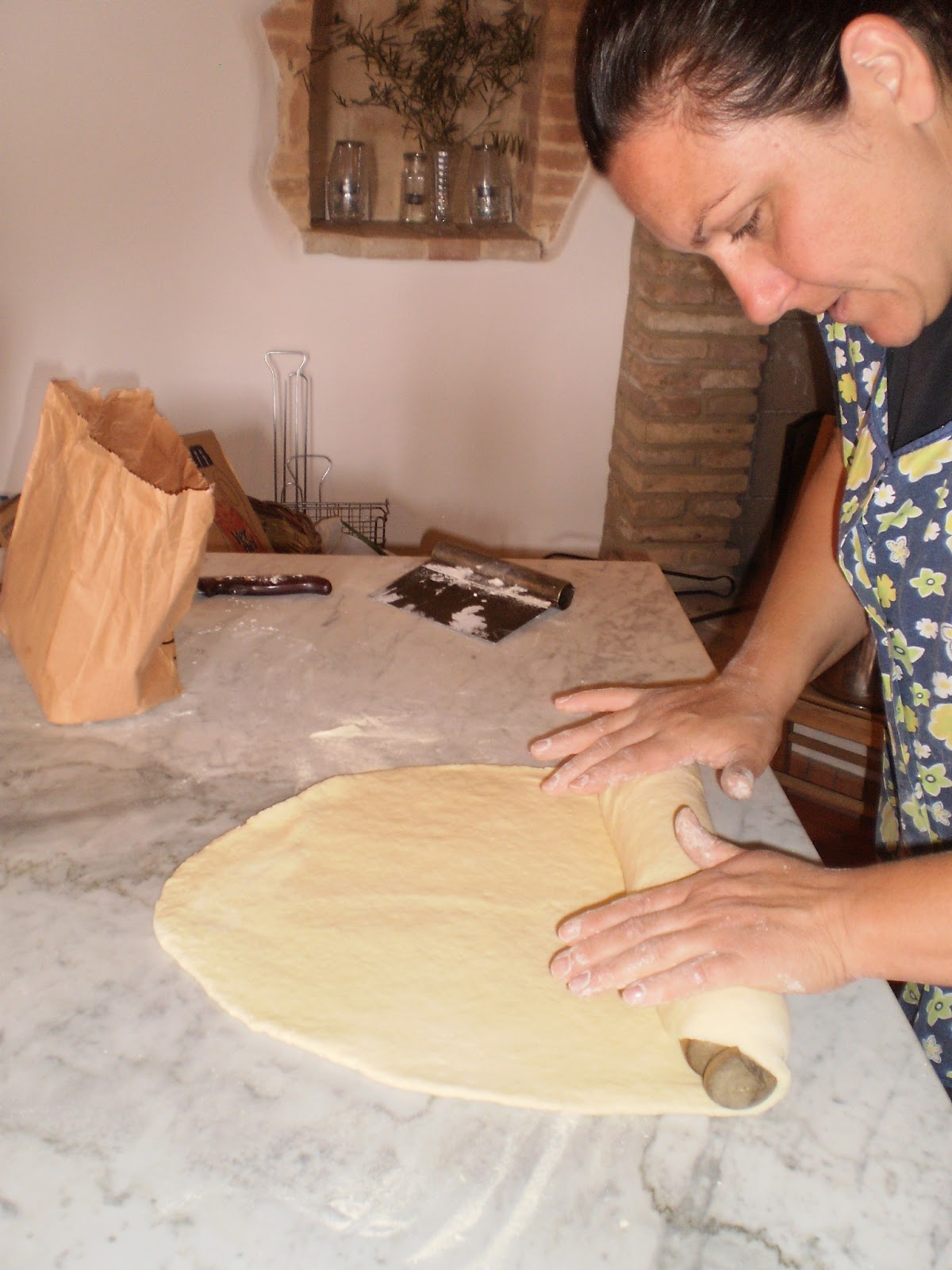
The semola was tipped out onto the marble table top.  Apparently marble is the best surface for making, mixing and kneading dough which in Italian is succinctly referred to as ‘impastire’.  A well was formed in the centre, water added and mixed in and salt added to the mix.  Once formed, the dough was kneaded to a silky consistency but compared to bread kneading, it was minimal. Then it was ready to be rolled out.
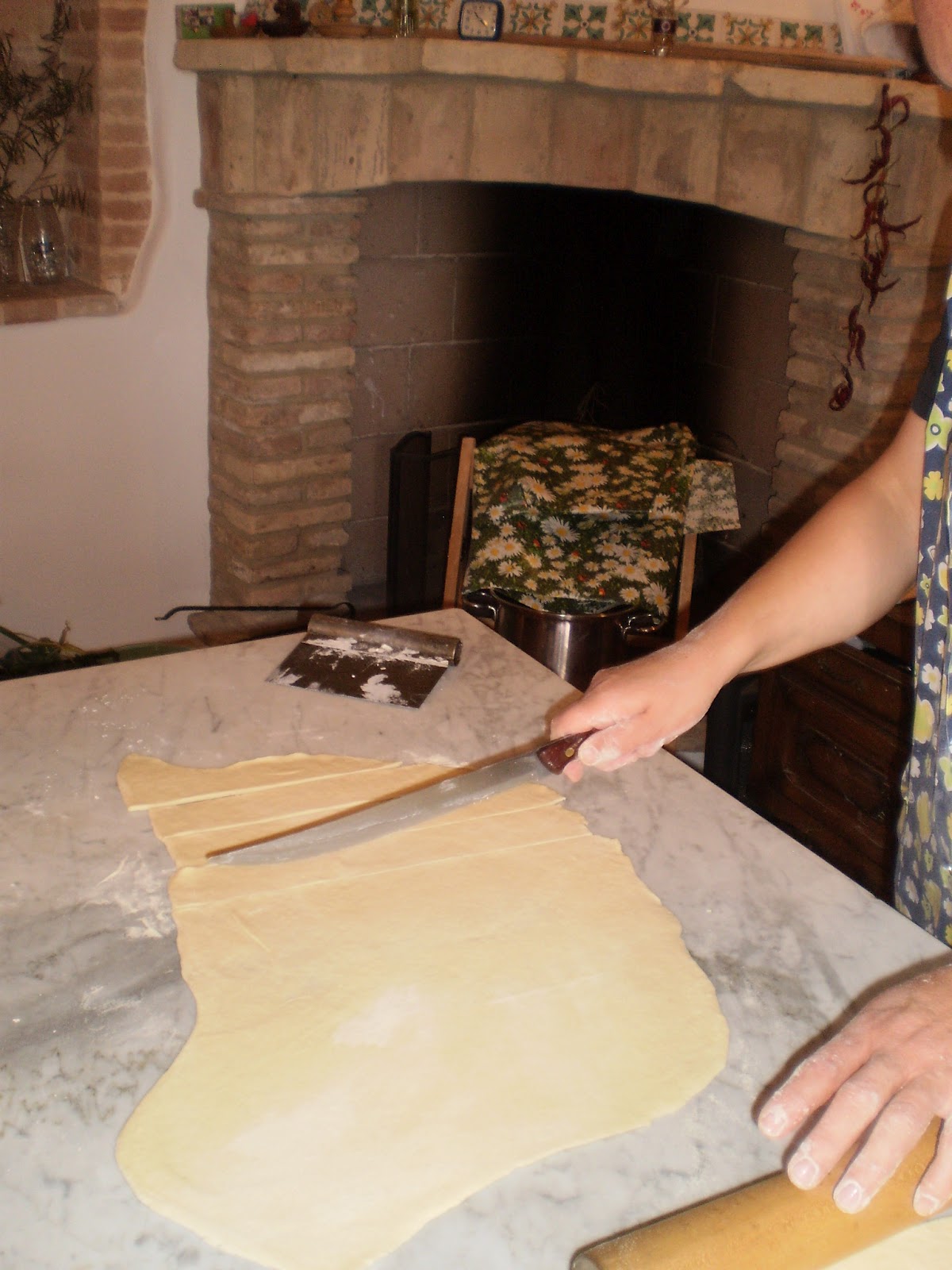
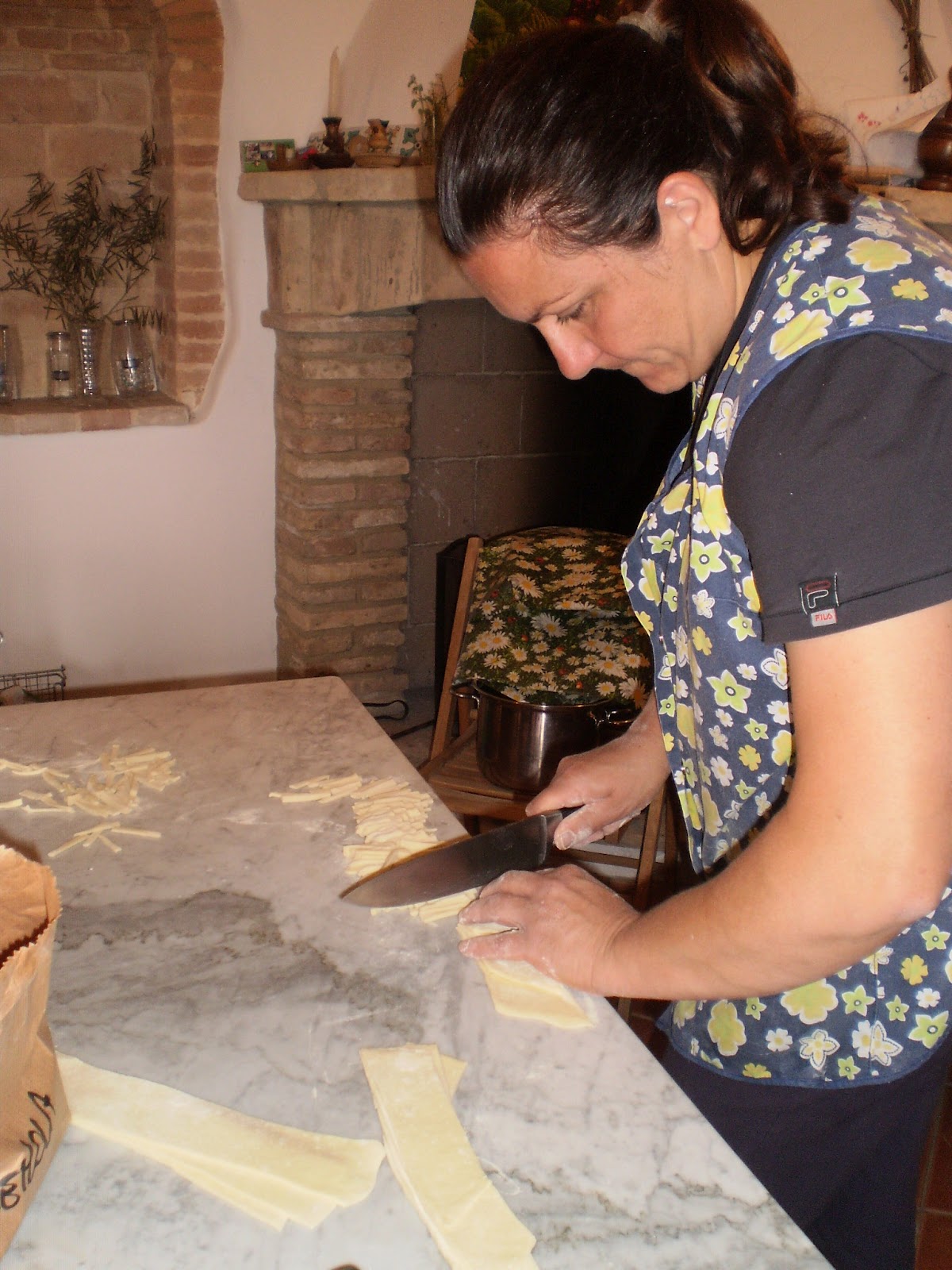
If you are Italian, you will have a long thin rolling pin with no handles because this dough rolls out to quite a large area.  We, however, are not Italian and we had my great aunt’s old rolling pin that my mum had inherited and about 40 years ago, brought out to equip our house in Italy.  The dough was then cut in half to be rolled out and when it was at the right thickness, it was cut into long strips about 4cm wide.  These strips were then dusted with semola, piled up on top of each other 3 at a time and then cut into little strips.  The strips were then separated and put onto a tray that again had been dusted with semola.  More semola was then applied on top to keep them from sticking to each other and to the next layer that would soon be covering them.
Meanwhile the sauce was prepared and the water went on to boil.  Onion, carrot and a sprig or 2 of parsley were sweated in olive oil.  Tomato passata was added.  The borlotti beans were drained and rinsed and added.  We had bottled beans of course but if you were properly traditional, you would have soaked them up the night before and already boiled them for 3 hours before draining and adding to the tomatoes and soffrito.  This all cooked away (seasoned of course with salt and black pepper, we omitted the chilli this time due to my extremely chilli sensitive mother) for about 20 minutes while the salted water boiled for the pasta and it was cast in to cook.  Pasta cooking took a couple of minutes at most and it was then drained but the salted water was reserved.  Sauce was added to the pasta and a ladle full of the pasta water too.
Our timing wasn’t entirely right as it was about half an hour until lunchtime but my mother started to rally the troops anyway thinking that as the pasta was dressed it must be eaten straight away.  Apparently not.
‘Just keep adding some of the pasta water when it dries out’ we were assured and it worked too.  However they did add a condition not to wait too long before eating as obviously it was at its best when freshly done.
This only dealt with half the pasta Paola had made though.  The other half was cooked up a day later, following another recipe they use locally as well.  Strictly speaking it’s a winter recipe but hey we were experimenting.  It is a similar principle to the borlotti beans (Sagne e Faciul in the local dialect) but uses chickpeas and as it has no tomatoes is described as being ‘in bianco’.  Equally good, I have to say.  Happy days.